State Medicaid Actions Related to the Passage of The Deficit - - PDF document

state medicaid actions related to the passage of the
SMART_READER_LITE
LIVE PREVIEW

State Medicaid Actions Related to the Passage of The Deficit - - PDF document

Figure 0 State Medicaid Actions Related to the Passage of The Deficit Reduction Act For: Background Briefing for Reporters June 19, 2006 K A I S E R C O K A I S E R C O M M I S S I O N I S S I O N O N O N


slide-1
SLIDE 1

1

K A I S E K A I S E R C O R C O M M I S S I O N I S S I O N O N O N

Medicaid and th edicaid and the Uninsured e Uninsured Figure 0

State Medicaid Actions Related to the Passage of The Deficit Reduction Act

For: Background Briefing for Reporters June 19, 2006

K A I S E K A I S E R C O R C O M M I S S I O N I S S I O N O N O N

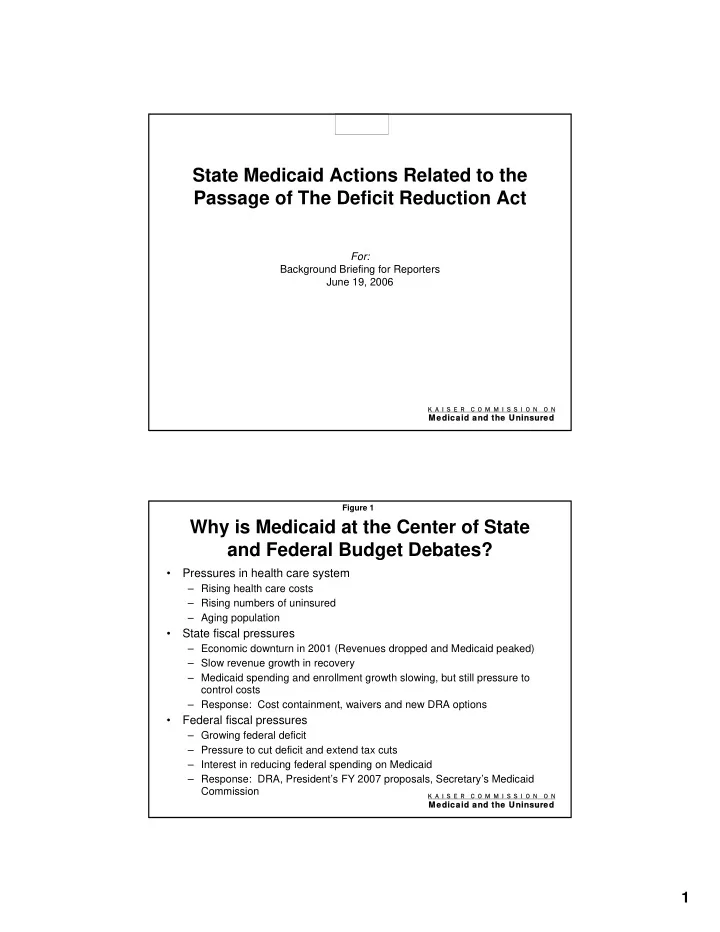
Medicaid and th edicaid and the Uninsured e Uninsured Figure 1

Why is Medicaid at the Center of State and Federal Budget Debates?

  • Pressures in health care system

– Rising health care costs – Rising numbers of uninsured – Aging population

  • State fiscal pressures

– Economic downturn in 2001 (Revenues dropped and Medicaid peaked) – Slow revenue growth in recovery – Medicaid spending and enrollment growth slowing, but still pressure to control costs – Response: Cost containment, waivers and new DRA options

  • Federal fiscal pressures

– Growing federal deficit – Pressure to cut deficit and extend tax cuts – Interest in reducing federal spending on Medicaid – Response: DRA, President’s FY 2007 proposals, Secretary’s Medicaid Commission

slide-2
SLIDE 2

2

K A I S E K A I S E R C O R C O M M I S S I O N I S S I O N O N O N

Medicaid and th edicaid and the Uninsured e Uninsured Figure 2

Distribution of Medicaid Spending Reductions in the Deficit Reduction Act

37% 28% 2006-2010 2006-2015

Note: “Other” provisions in the conference report include targeted case management, third-party recovery, provider taxes, and requiring evidence of citizenship SOURCE: CBO, January 27, 2006

Long-Term Care Prescription Drug Payment Other

10 Year Savings = $43.2 Billion

Benefits and Cost Sharing

5 Year Savings = $11.5 Billion

K A I S E K A I S E R C O R C O M M I S S I O N I S S I O N O N O N

Medicaid and th edicaid and the Uninsured e Uninsured Figure 3

DRA Requires Proof of Citizenship for Medicaid

  • Prior to the DRA states had to establish that Medicaid applicants were

citizens or in satisfactory immigration status

– 47 states allowed applicants to self-declare citizenship status – Most immigrants are not eligible for Medicaid – Illegal immigrants are only eligible for emergency Medicaid services

  • DRA requires all new and current Medicaid enrollees to document proof
  • f citizenship starting July 1, 2006
  • Law specifies some documents & HHS had authority to list alternatives

– Primary: US Passport, Certificate of Naturalization or Citizenship (law) – Secondary: birth certificate and other government documents (most in law) – 3rd Level: includes some non-government documentation (guidance) – 4th Level: includes affidavits “only in rare circumstances” (guidance)

  • New administrative burdens for states and new barriers for beneficiaries
  • Contrasts with state efforts to simplify eligibility process
  • Wide range of estimates about coverage impact
slide-3
SLIDE 3

3

K A I S E K A I S E R C O R C O M M I S S I O N I S S I O N O N O N

Medicaid and th edicaid and the Uninsured e Uninsured Figure 4

Cost Sharing Provisions in the DRA

  • Prior to DRA states could impose nominal cost sharing to certain

Medicaid beneficiaries but could not impose premiums

  • Cost sharing and premiums changes:

– Allows states to impose higher or new cost sharing and premiums – Allows states to make cost sharing “enforceable” – Maintains exemption for mandatory children and pregnant women (except for non-preferred prescription drugs) – Allows variation in benefits and cost sharing across groups and geographic areas

  • CBO estimates:

– 13 million or 20% of all Medicaid beneficiaries will be affected by provisions – 80% of the savings would be attributable to decreased utilization

  • Research shows that imposing premiums and cost sharing on low-

income populations can create barriers to access, reduce utilization of essential services and increase financial strain on families

K A I S E K A I S E R C O R C O M M I S S I O N I S S I O N O N O N

Medicaid and th edicaid and the Uninsured e Uninsured Figure 5

Benefit Provisions in the DRA

  • Prior to DRA states were required to cover mandatory services & could

receive federal match for optional services

  • Allows states to use “benchmark” or “benchmark equivalent” plans for

certain groups

– FEHBP- Blue Cross/Blue Shield PPO – Any state employees plan – Largest commercial HMO in state – Secretary-approved

  • Maintains current benefits for individuals with disabilities or long term

care needs (can be enrolled on voluntary basis)

  • Maintains EPSDT coverage as wrap-around for children (could be hard

to implement)

  • Does not apply to expansion populations
  • Allows variation across groups and geographic areas
  • CBO estimates benefit limits could affect 1.6 million enrollees
  • Limited benefits could result in unmet health needs and barriers to

access for uncovered services

slide-4
SLIDE 4

4

K A I S E K A I S E R C O R C O M M I S S I O N I S S I O N O N O N

Medicaid and th edicaid and the Uninsured e Uninsured Figure 6

West Virginia Used New DRA SPA Options

  • Use of “Secretary-approved” coverage option under the DRA

for children and parents

– 3 out of 4 subject to new plan are children – working parents w/ incomes up to 37% FPL - $6,142 for a family of 3

  • Parents will be required to sign and comply with a “member

agreement” to access certain “Enhanced Benefits” for themselves and their children (including mental health services, diabetes care, and drugs beyond a four-drug limit)

  • If individuals fail to meet responsibilities, moved to Basic

Plan for 12 months or until re-determination

  • Unclear how children will access mandated EPSDT wrap

around services

  • Providers will monitor their patients’ compliance and report

to the state.

K A I S E K A I S E R C O R C O M M I S S I O N I S S I O N O N O N

Medicaid and th edicaid and the Uninsured e Uninsured Figure 7

West Virginia Member Agreement

Member responsibilities. I will…..

  • do my best to stay healthy
  • go to health improvement programs as directed

by my medical home

  • read the booklets and papers my medical home

gives me. If I have questions about them I will ask for help

  • go to my medical home when I am sick
  • take my children to their medical home when

they are sick

  • go to my medical home for check ups
  • take the medicines my health care provider

prescribes for me

  • show up on time when I have my appointments
  • bring my children to their appointments on time
  • call the medical home to let them know if I

cannot keep my appointments or those for my children

  • let my medical home know when there has been

a change in my address or phone number for myself of my children

  • use the hospital emergency room only for

emergencies

Member rights. I have the right to….

  • to pick my medical home. This is where I go

for check-ups or when I am sick and where my health care records will be.

  • to decide things about my health care and the

health care of my children…to see my medical records…to ask questions about my health care and the health care of my children.

  • I will be treated fairly and with respect. I will

get the care and treatment I need as soon as

  • possible. I will not be treated differently

because I am in the Medicaid program.

  • know about all laws and rules of the Medicaid

program

  • I can contact Medicaid or my health plan with

any questions about my health care

  • be sent a written notice when West Virginia

Medicaid decides to deny or limit my Medicaid eligibility…appeal a decision about my eligibility

  • appeal a decision that says I have not kept the

member responsibilities in this agreement
slide-5
SLIDE 5

5

K A I S E K A I S E R C O R C O M M I S S I O N I S S I O N O N O N

Medicaid and th edicaid and the Uninsured e Uninsured Figure 8

Kentucky Used New DRA SPA Options

  • Creates 4 Targeted Benefits Plans using “Secretary-

approved” Coverage option

– Global Choices (default) – Family Choices (most kids) – Optimum Choices (MRDD) – Comprehensive Choices (Nursing Home Care)

  • New cost sharing requirements and service limits (i.e. $225

max OOP and 4 prescription limit)

– Cost sharing expected to have the most immediate effect on beneficiaries

  • Emphasis on disease management, Get Healthy Benefit

Accounts, and premium assistance

  • Expanded access to community based long-term care

services and consumer direction

  • State expects to save $1 billion over 7 years

K A I S E K A I S E R C O R C O M M I S S I O N I S S I O N O N O N

Medicaid and th edicaid and the Uninsured e Uninsured Figure 9

Florida Used an 1115 Waiver for Medicaid Changes

  • State will allot risk-adjusted premiums for beneficiaries who will choose

among different managed care plans

– “Opt-out” to ESI or individual plan with no benefit or cost sharing standards

  • New authority for plans to determine benefits for adults

– Required to cover all mandatory benefits, be actuarially equivalent to current program, and be sufficient for “vast majority of enrollees”

  • No benefit limit for children – continued coverage of EPSDT
  • New overall annual maximum benefit limit for adults
  • Individuals can earn “Enhanced Benefits” by engaging in healthy

activities

  • Low-Income Pool of $1 billion for safety-net providers
  • Per capita cap on federal funds
  • Key questions: accuracy of the risk-adjusted premiums; actuarial value
  • f the adult benefit over time; changes in financial risk for beneficiaries,

state and plans; shift in control to private plans; effects of increase plan choice on beneficiaries

slide-6
SLIDE 6

6

K A I S E K A I S E R C O R C O M M I S S I O N I S S I O N O N O N

Medicaid and th edicaid and the Uninsured e Uninsured Figure 10

What Changes Still Require Waivers?

  • Changes that no longer require waivers

– Benefit limits for current eligibility categories within DRA limits – Premiums and cost sharing within DRA limits – Allowing providers to deny care based on cost sharing – Varying benefits and/or cost sharing across groups or locales

  • Changes that still require waivers

– Providing Medicaid coverage to childless adults – Benefit limits, premiums, and cost sharing increases beyond DRA limits – Limiting benefits for new eligibility groups – Eliminating EPSDT requirements – Enrollment caps

  • Waivers must meet federal budget neutrality

requirements, no budget neutrality for SPAs

K A I S E K A I S E R C O R C O M M I S S I O N I S S I O N O N O N

Medicaid and th edicaid and the Uninsured e Uninsured Figure 11

Some New Directions in Medicaid

  • Emphasis on personal behavior and responsibility

– “Consumer choice” of plans / Long-term Care Services – Increased premiums and/or cost sharing – Behavior modification through incentives

  • “Tailored” benefits

– Variation in benefit packages across groups or geographic areas

  • Increased role of private marketplace

– Increased control to plans to determine benefit packages – Emphasis on premium assistance – Public/private long-term care partnerships

  • Restricting spending/increasing spending predictability

– Defined contribution approaches – Aggregate cap on federal funding

slide-7
SLIDE 7

7

K A I S E K A I S E R C O R C O M M I S S I O N I S S I O N O N O N

Medicaid and th edicaid and the Uninsured e Uninsured Figure 12

Issues to Consider for Medicaid Reform

  • Medicaid is nation’s health safety net
  • Beneficiaries are poor with limited resources
  • Low-income beneficiaries have limited access to

employer sponsored health coverage

  • Many have chronic conditions with multiple health needs
  • Medicaid assists those with disabilities requiring both

acute and long-term care

  • Beneath the averages, there are a few high-cost cases
  • Limits on Medicaid result in more uninsured and

increased unmet health needs

  • Some states continue to use Medicaid as a vehicle to

expand health insurance coverage

K A I S E K A I S E R C O R C O M M I S S I O N I S S I O N O N O N

Medicaid and th edicaid and the Uninsured e Uninsured Figure 13

Enrollees Expenditures on benefits

Medicaid Enrollees and Expenditures by Enrollment Group, 2003

Children 18% Elderly 28% Disabled 42% Adults 12% Children 49% Elderly 11% Disabled 14% Adults 26 % Total = 55 million Total = $234 billion

SOURCE: Urban Institute and Kaiser Commission on Medicaid and the Uninsured estimates based on 2003 MSIS data.

slide-8
SLIDE 8

8

K A I S E K A I S E R C O R C O M M I S S I O N I S S I O N O N O N

Medicaid and th edicaid and the Uninsured e Uninsured Figure 14

Distribution of Per Person Medicaid Expenditures, 2001

1.1% 2.5% 4.0% 6.6% 14.1% 18.0% 42.4% 11.2% $0 $0-1,000 $1,000- 2,000 $2,000- 5,000 $5,000- 10,000 $10,000- 25,000 $25,000- 50,000 >$50,000

Note: Numbers may not add up precisely due to rounding. Source: Urban Institute calculations based on the 2001 Medicaid Statistical Information System Summary File, Sommers, A. and M. Cohen, “Medicaid High Cost Enrollees, How Much do they Drive Program Spending,” KCMU, March 2006. K A I S E K A I S E R C O R C O M M I S S I O N I S S I O N O N O N

Medicaid and th edicaid and the Uninsured e Uninsured Figure 15

Impact of Increased Cost Sharing in Oregon

Note: Includes adults subject to benefit, premium, and cost sharing changes who were continuously enrolled for six months following the changes. Categories are not mutually exclusive; will not sum to 100%. Source: Carlson, M. and B. Wright, “The Impact of Program Changes on Enrollment, Access, and Utilization, in the Oregon Health Plan Standard Population,” March 2005.

10% 15% 17% 20% 24% 28% 35%

Do Not Have Doctor Owed Provider Money Did Not Have Copay Cost Too Much No Transportation Could Not Get Appointment Insurance Not Accepted

Reasons for not obtaining care among those who reported unmet need:

slide-9
SLIDE 9

9

K A I S E K A I S E R C O R C O M M I S S I O N I S S I O N O N O N

Medicaid and th edicaid and the Uninsured e Uninsured Figure 16

30% 92% 55% 4% 15% 4% Poor Workers Higher Income Workers

Covered by Own or Spouse's Employer Declined offer from Own

  • r Spouse's Employer

Not offered through Own

  • r Spouse's Employer

Access to Employer-Based Coverage by Family Income, 2005

SOURCE: Garrett and Clemens-Cope, Changes in Employer- Sponsored Health Insurance, 2001-2005, KCMU report forthcoming.

(Family Income <100% FPL) (Family Income 400%+ FPL)

K A I S E K A I S E R C O R C O M M I S S I O N I S S I O N O N O N

Medicaid and th edicaid and the Uninsured e Uninsured Figure 17

Key Questions

  • What additional guidance will come from CMS? How will

that affect our understanding of the DRA?

  • How many states will use new options in the DRA?
  • Will the DRA affect the number of states pursuing 1115

Waivers?

  • How will Medicaid changes (through DRA or waivers)

affect the availability and affordability of Medicaid coverage?

  • How will changes be evaluated?
  • How does the DRA impact the recommendations from the

Leavitt Commission?