Idahos Todays Discussion Medicaid Idahos Medicaid Expansion - - PDF document

idaho s
SMART_READER_LITE
LIVE PREVIEW

Idahos Todays Discussion Medicaid Idahos Medicaid Expansion - - PDF document

Idahos Todays Discussion Medicaid Idahos Medicaid Expansion Medicaid Expansion Timeline for January 1, 2020 Strategies Consumer Experience for Medicaid Expansion: Steps (How / When) & Framework Medicaid


slide-1
SLIDE 1

Idaho’s Medicaid Expansion Strategies & Framework with SB 1204

Today’s Discussion

  • Idaho’s Medicaid
  • Medicaid Expansion Timeline for January 1, 2020
  • Consumer Experience for Medicaid Expansion: Steps (How / When)
  • Medicaid Expansion Enrollment: Counts, Activities, Expectations
  • Medicaid Expansion: Service Capacity with Doctors and Facilities
  • Medicaid Expansion Coverage and Services Available
  • Idaho’s Medicaid Expansion: Federal Waivers
  • MedicaidExpansion.idaho.gov
  • Questions and Discussion

Last Updated: June 17, 2019

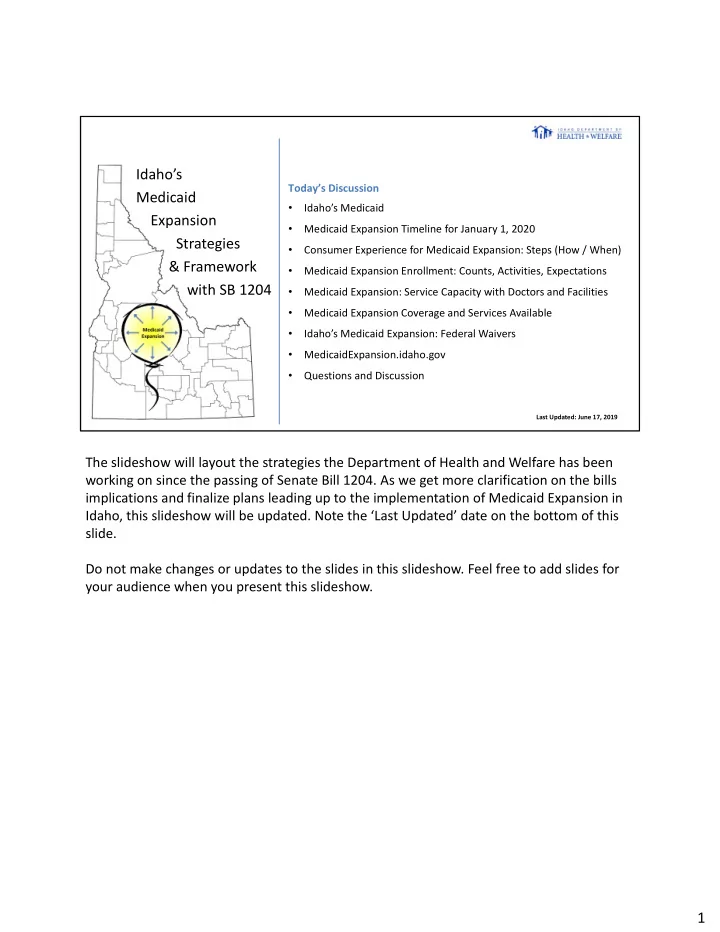
The slideshow will layout the strategies the Department of Health and Welfare has been working on since the passing of Senate Bill 1204. As we get more clarification on the bills implications and finalize plans leading up to the implementation of Medicaid Expansion in Idaho, this slideshow will be updated. Note the ‘Last Updated’ date on the bottom of this slide. Do not make changes or updates to the slides in this slideshow. Feel free to add slides for your audience when you present this slideshow.

1

slide-2
SLIDE 2

Unsubsidized > 400% FPL Unsubsidized > 400% FPL Unsubsidized > 400% FPL Unsubsidized > 400% FPL Unsubsidized > 400% FPL Unsubsidized > 400% FPL Unsubsidized > 400% FPL 138%

Idaho’s Medicaid: Income Eligibility for Health Coverage (existing, expanded, and APTC)

ELIGIBILITY CATEGORY PERCENT OF FEDERAL POVERTY LEVEL (FPL) 50% 100% 150% 200% 250% 300% 350% 400% Children up to Age 18 Health Insurance Exchange (APTC) Children’s Medicaid (up to 185% FPL) Pregnant Women Medicaid (up to 138% FPL) APTC People with Disability Medicaid APTC (unless eligible for Medicare) People w/Severe Disability Long Term Care Medicaid (up to ~230% FPL) APTC (unless eligible for Medicare) Adults with Children

Parents

Medicaid Expansion APTC Adults without Children Medicaid Expansion APTC Children with SED (Y.E.S.) Medicaid (up to 300% FPL) APTC Adults

  • ver

age 65

Medicare subsidy

Medicaid Medicare 2 Medicaid Expansion Waiver

IF APPROVED

Waiver

IF APPROVED

Most programs on this slide will not change from the current limits. The Medicaid Expansion for People with Disabilities may include individuals who are currently over

  • income. Expansion for Adults with Children will expand from the current 26% and Adults

without Children will expand from 0%. A 1332 waiver will be written to allow choice for both of these groups (Adults w/ Children and Adults w/out Children) but, there is uncertainty for those between 100‐138%, until the waiver is approved or denied. Will get more clarification on the Medicare population.

2

slide-3
SLIDE 3

Medicaid Expansion Timeline for January 1, 2020

3 Nov 1, 2019 Medicaid Enrollment Begins applications accepted for Medicaid Expansion

Ongoing Medicaid Expansion coverage in Idaho FEB MAR APR MAY JUN JUL AUG SEP OCT DEC 2019 JAN 2019 NOV DEC 2018 JAN 2020 NOV 2018

Nov 6, 2018 VOTERS pass Proposition 2 to expand Medicaid Nov 20, 2018 Medicaid Expansion becomes law Jan – Apr 2019 Idaho Legislature determines “the Idaho way” for Medicaid Expansion with SB 1204 Starting Jan 1, 2020 Medicaid Expansion Coverage Begins Apr – Sep 2019 Department of Health & Welfare Builds eligibility and claims processing for Medicaid Expansion and Submits necessary waivers Jul – Oct 2019 Partner/Provider Readiness Begins Partners and Health Care Providers receive training to be ready for Enrollment and Coverage Waiver Approvals & Implementations

Unknowns

Timelines? Approvals?

Develop Administrative Rules

SB 1204 was finalized in April, but much work will need to be done to build enhancements

  • n IDHW systems (IBES and MMIS) through September.

Waivers will be prepared and submitted as quickly as possible. Timelines and approvals for the waivers will differ and are driven mostly by CMS, but the 1332 waiver will need to be approved or denied by September in order to move forward with SB 1204’s requirement that individuals can choose coverage between 100 and 138% FPL. In the absence of approval, we will need to move forward with enrolling all those from 0‐138% in Medicaid. Training and communications are being developed now for internal and external partners, with the goal of beginning in July after stakeholder input has been considered. Partners can get access to PDAP, a view‐only portal, to see who is pre‐enrolled for Medicaid. ‘Enrollment assistors’ can assist clients to apply. The Division of Welfare will do a streamlined enrollment for SNAP participants beginning in

  • July. As this group performs their normal 6‐month SNAP recertification they will be asked if

they want to enroll in Medicaid. If they do, they will be pre‐enrolled for coverage that will start Jan 1, 2020, without further actions on their part. Starting November 1, Welfare will start accepting applications for those not pre‐enrolled with coverage beginning January 1.

3

slide-4
SLIDE 4

Consumer Experience for Medicaid Expansion: Steps – How and When

4 Learn the options Receive Medicaid Card Pick a Doctor Primary Care Physician (PCP) Use Medicaid for covered services Eligible? Enroll multiple methods

Refer to other services

Consumer Steps

MAIL OFFICE ON‐LINE PHONE FAST TRACK ENROLLMENT

NO

JUL AUG SEP OCT DEC 2019 NOV JAN 2020 Enrollment Communication & Coordination with Partners Fast Track Enrollment Open Enrollment Medicaid Coverage Begins

Prior to July Submit waivers Clarify Legislation Create Business Processes Design and Build Automation Plan and Begin Communication Strategies

YES

The first step for individuals and families potentially eligible for Medicaid is to learn the

  • ptions. Next step will be to enroll through various methods, of their choice. An eligibility

decision will be made, based on the information provided with their enrollment, for Medicaid services. If individuals are pre‐enrolled for Medicaid before January 1, they will be eligible to use their Medicaid benefits beginning January 1 (even if they have not yet received a Medicaid Card in the mail or if they have not selected a primary care provider through Healthy Connections).

4

slide-5
SLIDE 5

60

~ 70,000 Known to the Department Projected to be Income Eligible

  • SNAP (food stamps)
  • Denied Medicaid
  • Parents with Kids on Medicaid
  • Subsidized Insurance (APTC)
  • Behavioral Health

~ 21,000 Unknown to the Department Projected to be Income Eligible

Medicaid Expansion Enrollment: Counts, Activities, and Expectations

5 91,000 estimated newly eligible in Idaho

20

People (thousands)

40 90 80

Department Assisted Enrollment SNAP + Others ≈ 70,000

  • Contact begins July 2019
  • Use existing verifications
  • Simplified Enrollment
  • Minimize open enrollment effort
  • Early signups

Number of People Activities January 1, 2020 Expectation Open Enrollment Partner assisted enrollment ~21,000 Begins November 1 Applications received/processed Department Assisted Enrollment Estimating ~60,000 enrollments Open Enrollment Estimating ~10,000 enrollments Enrolled and Eligible January 1, 2020 ~70,000

It is projected that there are 91,000 individuals eligible for Medicaid Expansion in Idaho. 70,000 are known, in some way, to IDHW; and 21,000 are not known to IDHW. Through the Division of Welfare’s Enrollment Strategy, with individuals known to the IDHW, it is estimated that ~60,000 individuals can be enrolled. With outreach through the partner community and other referrals, it is estimated that another 10,000 individuals can be enrolled that are not known to IDHW. IDHW anticipates that through assisted enrollment within the Department and statewide partner engagement, up to 70,000 individuals could be ready to start Medicaid coverage on January 1.

5

slide-6
SLIDE 6

Medicaid Expansion Estimates

Almost 70,000 individuals in Idaho are known to the Department and are thought to be eligible for Medicaid Expansion. County level estimates of these individuals are shown in the map and table below. It is estimated another 21,000 individuals, not known to the Department, make up the projected number of 91,000 potentially Medicaid eligible individuals. County Population Estimated Medicaid Expansion by County County Population Estimated Medicaid Expansion by County Count Count Count Percent Ada 456,849 14,612 3.20% Gem 17,379 834 4.80% Adams 4,147 167 4.03% Gooding 15,124 634 4.19% Bannock 85,269 3,969 4.65% Idaho 16,369 533 3.26% Bear lake 6,028 245 4.07% Jefferson 28,446 1,251 4.40% Benewah 9,184 355 3.86% Jerome 23,627 960 4.06% Bingham 45,927 2,014 4.38% Kootenai 157,637 5,951 3.78% Blaine 22,024 696 3.16% Latah 39,333 1,068 2.72% Boise 7,290 311 4.26% Lemhi 7,875 438 5.56% Bonner 43,560 1,931 4.43% Lewis 3,887 231 5.94% Bonneville 114,595 5,619 4.90% Lincoln 5,318 259 4.88% Boundary 11,922 542 4.55% Madison 39,141 2,366 6.05% Butte 2,602 112 4.30% Minidoka 20,729 821 3.96% Camas 1,102 49 4.47% Nez Perce 40,385 1,205 2.98% Canyon 216,699 10,418 4.81% Oneida 4,427 154 3.47% Caribou 7,034 236 3.35% Owyhee 11,628 598 5.14% Cassia 23,664 1,009 4.26% Payette 23,215 1,066 4.59% Clark 873 18 2.11% Power 7,600 358 4.71% Clearwater 8,546 282 3.30% Shoshone 12,542 736 5.87% Custer 4,172 205 4.92% Teton 11,381 435 3.82% Elmore 26,823 1,059 3.95% Twin falls 85,124 3,934 4.62% Franklin 13,564 508 3.74% Valley 10,687 395 3.69% Fremont 13,094 774 5.91% Washington 10,121 502 4.96% Total Population Count 1,716,943 69,860

This map and table show where approximately 70,000 people, known to the IDHW and who are thought to be eligible for Medicaid Expansion, live in Idaho (using address information on file). We can identify these individuals because of their recent participation in programs such as SNAP, Behavioral Health, the Advanced Payment of the Tax Credit (APTC), or because they have children in other programs or recently closed programs. These ‘Known Customers’ will be targeted through IDHW’s Assisted Enrollment process. Not shown on this map and table are an additional 21,000 ‘Unknown Individuals’ that Milliman estimated will enroll based on our states census data. On the map, the dark red counties are the ones with the highest percentage of the population who might be eligible for Medicaid under expansion. Counties range from 2.11% to 6.05% of their total county population with new Medicaid coverage. This information will be important for enrollment and matching strategies.

6

slide-7
SLIDE 7

Medicaid Expansion: Service Capacity with Doctors and Facilities

7

* The percentage of Primary Care Physicians in Idaho who take Medicaid patients is above 90%; ** For purposes of estimating the impact of Medicaid Expansion, this estimate is based on current enrollment patterns. Not all PCPs in this PCP count take adults, so this is only a rough estimate Region 1 Region 2 Region 3 Region 4 Region 5 Region 6 Region 7 Total

1 Enrolled in Healthy Connections per Region

30,113 11,476 51,824 50,293 30,913 27,801 36,349 238,769

2 Number of Primary Care Physicians (PCP)*

414 161 403 698 205 317 252 2,450

3 Medicaid Customers per PCP

73 71 129 72 151 88 144

4 Number of Primary Care Physician Locations

69 44 67 117 65 70 74 506

5 Number of Medicaid Customers per Location

436 261 773 430 476 397 491

6 New Eligibles w/ Medicaid Expansion per Region

12,394 4,323 17,697 21,333 10,893 9,747 14,613 91,000

7 Total Eligibles w/ Medicaid Expansion (1+6)**

42,507 15,799 69,521 71,626 41,806 37,548 50,962

8 Percent Eligibles increase w/ Medicaid Expansion

(compare line 7 to line 1) 41% 38% 34% 42% 35% 35% 40%

9 Medicaid Customers per PCP if no new PCP's

(compare to line 3; increases by % in line 8) 103 98 173 103 204 119 202 Medicaid Expansion Medicaid Today Idaho Primary Care Statistics January 2019

The yellow information shows current statistics for Medicaid today. The green Medicaid Expansion shows what the landscape might look like after 91,000 additional individuals are

  • enrolled. IDHW is talking to providers and hospitals as based on the increases seen in

certain regions. These projections will be helpful to use in planning to get more providers signed up and getting individuals assigned to those providers.

7

slide-8
SLIDE 8

Additional Idaho Medicaid Services

  • Optometrist Services
  • Podiatrist Services
  • Chiropractic Services
  • Dental Services
  • Preventive Health Assistance

Medicaid Expansion Coverage and Services Available

8 Federally required Medicaid benefits Ambulatory Medical Services: primary care, specialist care,

  • utpatient surgery, and other outpatient medical services

Emergency Services: emergency room services and ambulance Hospital Services: inpatient services, including physician, surgery, and radiation therapy Maternity and Newborn Care: prenatal, postnatal, and maternity care Mental Health and Substance Use Disorder Services: individual, family, and group counseling, and other outpatient and inpatient mental health and substance use disorder services Prescription Drugs: all FDA approved drugs required under federal coverage provisions Rehabilitative and Habilitative Services and Devices: physical,

  • ccupational, and speech therapy, durable medical equipment and

supplies, rehabilitative nursing facility services, and other habilitative services Laboratory Services: diagnostic lab tests and imaging such as X‐rays and CT/PET/MRI Preventive and Wellness Services: includes preventive screenings, immunizations, diabetes education, tobacco cessation Pediatric Services: routine eye exams, medically necessary

  • rthodontia, eyeglasses, dental services

This slide shows what benefits will be available to the Medicaid Expansion population when medically necessary. New eligibles will receive only these benefits unless they meet additional criteria for enhanced services. Services they may qualify for include: Hospice, extensive personal care services, private duty nursing, targeted service coordination for the IDD population, and institutionalization in either an ICF/ID or Skilled Nursing Facility

8

slide-9
SLIDE 9

Idaho’s Medicaid Expansion: SB 1204 (Sideboards and Waivers)

9

SB 1204

Medicaid Expansion

Allow behavioral health services rendered in an IMD for those between 19 & 65 years of age to be payable by Idaho Medicaid. Require individuals 19‐59 years old to be working 20hrs/week or volunteering or enrolled in school to be eligible for Medicaid No State Work & Training Program Requires Health Risk Assessment to include questions on substance use disorders and make appropriate referrals Require individuals seeking family planning services to have a referral from a Medical Home (if provider is

  • utside established Medical Home)

Allow individuals 100% to 138% to maintain APTC and Insurance Exchange coverage or decline private coverage and choose Medicaid coverage Submit an 1115 Institution for Mental Disease (IMD) Waiver Submit an 1115 Work Requirements Waiver with… Exemptions:  Mental or Physical illness  Disability  Caring for a child/other  Tribal members  Receiving Substance Use Disorder (SUD) treatment Verifying participation and activities every 6 months Submit a 1332 (possible 1115) Coverage Choice Waiver Submit an 1115 (or appropriate) Family Planning Waiver No Waiver Required

A current summary of the final SB 1204 legislation is highlighted in the orange block. It was amended twice during the session. Individuals must be working as a condition to receive Medicaid, unless they qualify for an

  • exemption. IDHW recommended a work requirement approach similar to SNAP, but SB

1204 doesn’t follow SNAP rules. There will be no money for IDHW to help with work and training services. Individuals will need to verify work monthly, but IDHW will only verify every 6 months. Currently, services rendered to Medicaid Participants between ages 19 & 65 from an IMD are not eligible for Medicaid reimbursement. These services are available in other inpatient hospital settings, but there are very few of these beds in Idaho. This waiver will give Medicaid participants greater access to these behavioral health services . The Family Planning Waiver will require individuals seeking family planning services to have a referral if the preferred provider is outside the established Medical Home. The work requirement requires individuals between 100‐138% to be enrolled in APTC UNLESS they decline that coverage and then apply for Medicaid. There is not an option to select APTC vs. Medicaid on the application. This waiver needs to be approved through CCIIO and Department of Treasury.

9

slide-10
SLIDE 10

Healthy Connections will update their Health Risk Assessment to include questions about substance abuse and will make any necessary referral to Optum.

9

slide-11
SLIDE 11

Idaho’s Medicaid Expansion: Federal Waivers

10 1115 Institution for Mental Disease (Mental Health ‐ IMD) Waiver

  • Increase access to certain Substance Use Disorder (SUD) and

Mental Health services

  • Many states have received similar waivers in the past few years

1115 Work Requirements Waiver

  • Individuals are not eligible for Medicaid unless working or exempt
  • Federal Waiver Approval has been received by:
  • Arkansas, Kentucky, Arizona, Indiana, and Utah
  • Federal Courts have stopped implementations in:
  • Arkansas and Kentucky
  • No State is currently using work requirements for Medicaid

1332 Coverage Choice Waiver – Out for Public Comment

  • Working with federal partners to determine Waiver path
  • Idaho’s waiver request will be the first of its kind
  • Must have decision by December 31, 2019
  • Idaho’s waiver must prove budget neutrality

1115 Family Planning Waiver

  • South Carolina, Tennessee, and Texas have applied for family

planning waivers; all are pending a federal decision WAIVER EXPECTATIONS and IMPACTS Create Waivers April‐August Submit Waivers July ‐ September

(waiver schedules will vary)

Implementation Based on Federal Approval WAIVER Process  Waivers CANNOT delay Jan 1, 2020 implementation  Waivers CANNOT reduce federal match (FMAP) rate below 90%  Legislature REVIEWS Medicaid Expansion in 2023

Along with building system enhancements, IDHW is also in the process of preparing and submitting waivers. These waivers will be submitted separately, so they aren’t dependent

  • n each other.

IDHW will need a decision on the 1332 waiver by September in order for systems to be

  • ready. If this particular waiver is not approved or if it is denied by that time, eligible

individuals will be approved for Medicaid, not APTC. About 20,000 individuals are currently on APTC who will be eligible for Medicaid. These individuals will be determined eligible for the following year and their information will be sent to Idaho’s Insurance Marketplace, (Your Health Idaho or YHI), for 2020 coverage,

  • automatically. If IDHW does not get a waiver approval, these people will be moved to

Medicaid coverage.

10

slide-12
SLIDE 12

https://medicaidexpansion.idaho.gov

11

IDHW is working on a communication and training plan. There will be more details in the

  • future. The goal is to make sure everyone has the tools they need to best serve their
  • customers. IDHW leadership meets weekly to talk across all internal Divisions about the

best way to plan for Medicaid Expansion. This website is the public’s landing page for information on Medicaid Expansion. It provides basic information about Expansion and will be updated as more information is finalized.

11

slide-13
SLIDE 13

Questions & Discussion

Contact the Department for the latest updates before sharing this PowerPoint deck with others

Contact the Department for the latest updates before sharing the PPT with others.

12

slide-14
SLIDE 14

Generally APTC covers:

  • Children from 185% to 400% FPL
  • Adults from 100% to 400% FPL

APTC

Advance Payment of the Premium Tax Credit

APTC Children’s Medicaid

Idaho’s Medicaid: Existing and Expanded alongside Subsidized Insurance (APTC) Coverage

Federal Poverty Level (FPL)

Children 0‐18 Adults Generally Medicaid covers:

  • Children (Children’s Medicaid) from 0% to 185% FPL
  • Parents (Historical AFDC) from 0% to 26% FPL

Other groups modify this general coverage:

  • Aged/Disabled (AABD)

Medicaid from 0% to ~80% FPL

  • Pregnant Women (PW)

Medicaid from 0% to 138% FPL

  • Severely Disabled ‐ Long Term Care (LTC)

Medicaid from 0% to ~230%

  • Breast & Cervical Cancer diagnoses (BCC)

Medicaid from 0% to 250% FPL

  • Children with Serious Emotional Disturbance (SED)

Medicaid (Y.E.S.) from 0% to 300% FPL

Medicaid Expansion covers non‐disabled:

  • Adults from 0% to 138% FPL

200% 400% 300% 100% 138% 250% 1 3

Breast & Cervical Cancer (BCC) Children with SED (Y.E.S.) Severely Disabled ‐ Long Term Care (LTC) Pregnant Women (PW)

Medicaid Expansion

Parents Disabled (AABD)

Waiver Requests:

  • Adults from 100% to 138% FPL Have a Choice

This slide shows where existing Health Coverage Assistance programs begin and end and where the Medicaid Expansion group will receive coverage. IDHW will seek a waiver that allows adults between 100‐138% to have a choice about whether they want to stay on APTC or switch to Medicaid. An important point to note is that SB 1204 requires adults to stay on APTC UNLESS they decline APTC and then are approved for Medicaid. The blended

  • range/green represents the unknowns of timelines and result of the waiver request.

13