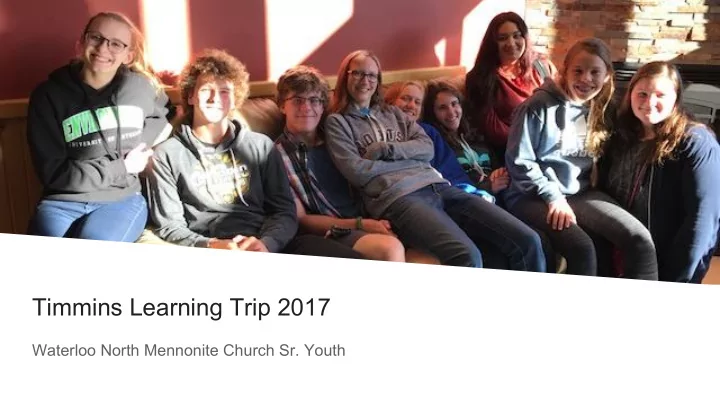
Timmins Learning Trip 2017 Waterloo North Mennonite Church Sr. Youth - - PowerPoint PPT Presentation

timmins learning trip 2017
SMART_READER_LITE
LIVE PREVIEW

Timmins Learning Trip 2017 Waterloo North Mennonite Church Sr. Youth - - PowerPoint PPT Presentation

Timmins Learning Trip 2017 Waterloo North Mennonite Church Sr. Youth Introduction: Learning Tour? Meeting our indigenous neighbours Listening to history Learning current issues Hearing future hopes Reflecting on


slide-1
SLIDE 1

Timmins Learning Trip 2017

Waterloo North Mennonite Church Sr. Youth

slide-2
SLIDE 2

Introduction: Learning Tour?

  • Meeting our indigenous neighbours
  • Listening to history
  • Learning current issues
  • Hearing future hopes
  • Reflecting on experiences
  • Passing on what we learned

(and an excellent opportunity to spend 20 hours in a van! :-)

slide-3
SLIDE 3

Introduction: Who We Met

  • Ursula Rodrique (Mushkegowuk Tribal Council Liason) → Treaty 9 briefing
  • Heather Murray (Timmins Native Friendship Centre) → Community outreach
  • Abigail Davey (Ojibway and Cree Cultural Centre) → Jingle dress tradition
  • Amanda (Indigeous Youth) → Fetal alcohol syndrome disorder
  • Kristin Murray (Misiway Community Health Centre) → Health promotion
  • Gilbert Scott (Mushkegowuk Council Land Use) → Roadblocks to prosperity
  • Job Mollins Koene (Mushkegowuk Council Policy Advisor) → Policy issues
  • Unnie Koosees (Artisan with Niska Program) → Native art display
  • Lindsay Mollins Koene (MCC Ontario) → Indigenous Neighbours program
  • Isaac Shelley (MCC Ontario) → Indigenous Neighbours program
slide-4
SLIDE 4

Learning: Treaty 9 (1905-1906 and 1929-1930)

  • Covering ~2/3rds of northern Ontario
  • Essentially ceding land
  • Allowing hunting, trapping and fishing
  • $4/year payment → net effect is no

financial benefit from lands Issues:

  • Written vs oral treaty
  • Very quick -- 1 evening per village
  • Lack of understanding of agreement

http://mushkegowuk.com/documents/jamesbaytreaty9_realoralagreement.pdf

slide-5
SLIDE 5
slide-6
SLIDE 6
slide-7
SLIDE 7

Learning: Residential Schools

  • Created to “get rid of

the indian problem”

  • Removed children

from families

  • Stripped language

and culture

  • Many opportunities

for abuse

  • Included Mennonite

run schools!

slide-8
SLIDE 8

Learning: Intergenerational Trauma

  • Loss of a culture -- young

people are struggling to re-learn

  • Survivors of residential

schools are not open to share experiences

  • Legacy:

○ Loss of independence ○ High unemployment ○ Alcoholism and substance abuse ○ Depression and suicide

→ Recovery will take generations

slide-9
SLIDE 9

Learning: Fetal Alcohol Spectrum Disorder (FASD)

  • Presented to us by an affected teenager who freely shared her experiences
  • Is common in indigenous communities where alcoholism is a large problem
  • Individuals start life disadvantaged from birth and must work to overcome issues

http://www.ahf.ca/downloads/addictive-behaviours.pdf

slide-10
SLIDE 10

Understanding: Conditions on Reserves The People of Kattawapiskak River

2012 Documentary about housing crisis in Attawapiskat (https://www.nfb.ca/film/people_of_kattawapiskak_river/)

  • Filmmaker found shockingly poor conditions for many in

community, leading to declaring a state of emergency

  • Became a national issue in 2012, including ill-advised

appointment of a 3rd party manager by Supreme Court

  • The Victor Diamond Mine (De Boers) is on traditional

land of the people of Attawapiskat, and although permitting included First Nation approval, the promised and anticipated financial benefits have not been seen

slide-11
SLIDE 11

Understanding: Jingle Dress

  • One focus point for re-learning traditions
  • Traditionally 365 cones on dress

Movie: Jingle Dress -- First Dance www.jingledress.ca

slide-12
SLIDE 12

Understanding: Medicine Wheel

  • Medicines
  • Spirituality
slide-13
SLIDE 13

Understanding: Hunting

  • Traditionally a main focus of existence
  • Still makes sense in present (groceries are very expensive in the north)
  • Skills have been lost by many through the years
  • Spiritual aspect -- respect for animals -- not only functional
  • Trapping line routes can be affected by land development (treaties promised

free access for hunting, trapping and fishing)

slide-14
SLIDE 14

Experiencing: Friendship Centre

  • A hub of activity for many social support programs (e.g., maternal health,

youth programs, substance use support, counselling, etc.)

  • Also a physical place (building was previously a school) for gathering
  • We met indigenous people originally from many different communities at a

weekly community social time, which included the opportunity to share food and coffee

  • Had organised a youth “camp” experience to re-learn traditional skills and

language

slide-15
SLIDE 15

Experiencing: Artisans

  • Niska Artisans program (MCCO) helps support

indigenous people on the personal level (available at Kent St. office)

slide-16
SLIDE 16

Reflecting: Working Towards Reconciliation

In our closing circle, we were asked the following questions: 1) In particular, what teachings, information, special moment or relationship will you carry home? 2) What will be the challenge(s) that will travel home with you? 3) What will you work on as part of Reconciliation with First Peoples?

slide-17
SLIDE 17

Smudging Prayer

Zhawenimishin noogom gaagiizhigak Creator bless me this day Jimino naanaagadawendamaan To have good thoughts Jimino waabamag niiji anishinabe To see good things in a person Jimino noondawag niiji anishinabe To hear good things from a person Jimino ganoonag niiji anishinabe To talk good to a person Shigo jimino wiijiwag niiji anishinabe So that I can walk with others in a good way Miigwech Giizhe Manidoo Thank you Creator

slide-18
SLIDE 18