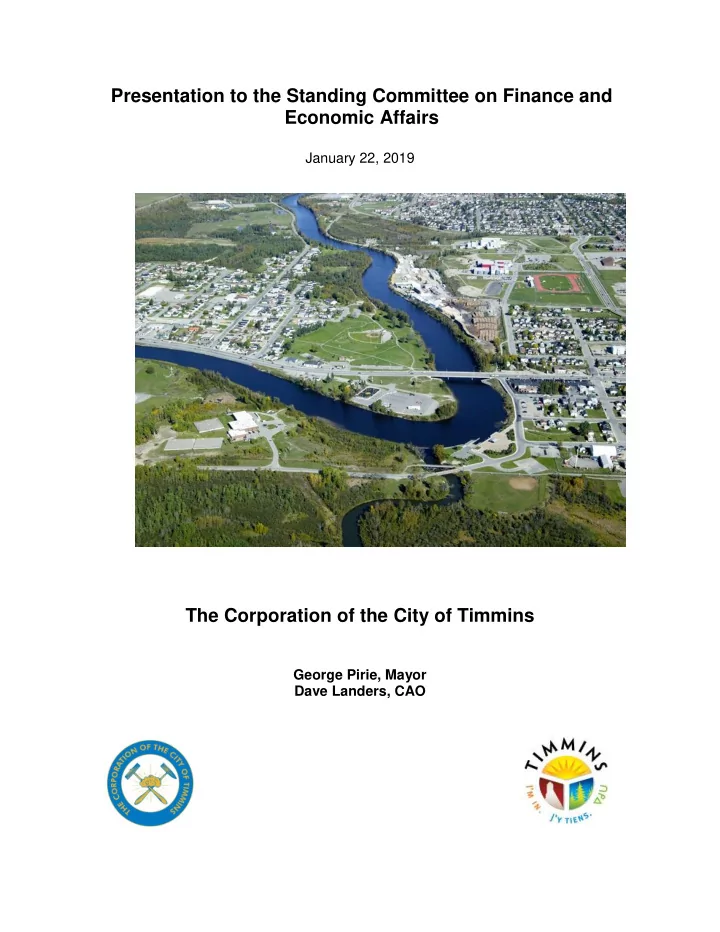
SLIDE 1
City of Timmins submission to Standing Committee on Finance & Economic Affairs Page 2 Welcome to the City of Timmins Timmins was founded in 1912 as a result of the Porcupine Gold Rush, which by the turn
- f the 21st Century has seen in excess of 67 million troy ounces of gold mined from the
Porcupine area, making it by far the largest gold rush in terms of actual gold produced. For comparison, the well-known Klondike Gold Rush produced about 12 million troy
- unces.
Municipal amalgamation in the early 1970s saw the towns in the area become the City
- f Timmins with a landmass of 3,185 km² and a population density of 14 people/ km².
Timmins remains a mining community and has seen the growth of secondary industries, such as lumbering, government and business services and tourism. Timmins is at the centre of the Mushkegowuk Council territory and has seen a growing indigenous population in recent years. Timmins also boasts a strong and vibrant francophone community. Infrastructure Challenges
- 1. Connecting Link
For the City of Timmins, Highway 101 is an arterial highway that provides a link between the Trans-Canada Highway 11 to the east and Highway 11 to the west. The Timmins connecting link of Highway 101 extends from the former ONR crossing in Porcupine (easterly limit) to Kamiskotia Road (westerly limit). A total distance of 20.9 km is covered between both limits and provides an efficient corridor to normal traffic as well as heavy industrial traffic. Until the Connecting Link program was reinstated, our focus had been towards using innovative techniques to extend the useful life of our road network. By taking advantage
- f rout and seal activities and shave and pave opportunities, we have managed to