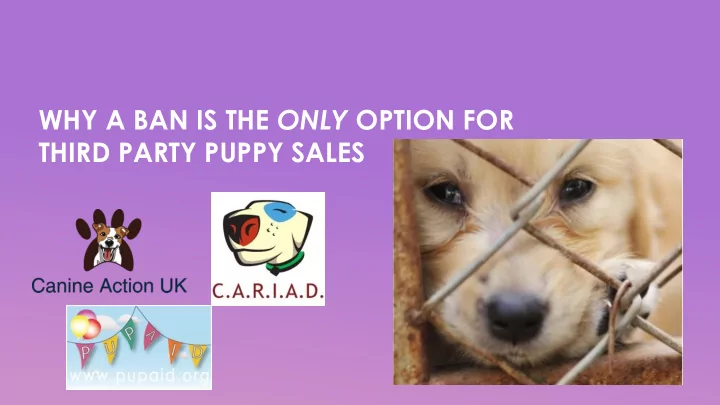
SLIDE 1
WHY A BAN IS THE ONLY OPTION FOR THIRD PARTY PUPPY SALES
SLIDE 2
WHAT IS COMMERCIAL THIRD PARTY PUPPY SELLING?
Dogs (puppies) purchased from their breeder with the deliberate
intention of reselling them shortly afterwards for a profit.
‘Regulated’ by Pet Animals Act 1951 - excludes private
rehoming/reselling a single dog and rescue/rehoming charities.
About 80 pet shop licenses permitting the sale of puppies in the UK. More than 60% of licenses are non-retail Proposed legislation changes will require anyone selling pets as a
business to hold a pet shop licence
SLIDE 3
A ban is vital to protect the welfare of puppies and an essential first step to improving standards in high risk breeding establishments. Removing the legitimacy of a source where even adequate welfare cannot be ensured is imperative to support consumers in making responsible purchases.
SLIDE 4
THE PROBLEM WITH THIRD PARTY SALES
► Responsible breeders by definition will personally find homes
for their puppies.
► Depends on and sustains low welfare, factory farming style
dog breeding.
► Breeders receive only a fraction of the eventual sale price -
little financial incentive for improvement.
SLIDE 5
► Absence of accountability ► Unsuited to rearing pet dogs that are physically and
mentally fit for purpose
► Compounded by: transport, lack of habituation, impulse
purchasing.
SLIDE 6
SCIENTIFIC RESEARCH
Higher levels of aggression towards owners and unfamiliar
people
More fearful More prone to separation anxiety and house soiling Infected with parasites and pathogens to a significant level
SLIDE 7
ANIMAL WELFARE IN ENGLAND: DOMESTIC PETS
EFRA INQUIRY RECOMMENDATION: “WE RECOMMEND THAT THE GOVERNMENT BAN THIRD PARTY SALES OF DOGS.”
GOVERNMENT RESPONSE
DEFRA “CONSIDERED THE MATTER VERY CAREFULLY” DOGS TRUST AND BLUE CROSS JOINT BRIEFING, OCTOBER 2016: “WHILST WE SUPPORT THE PRINCIPLES BEHIND A BAN ON THIRD PARTY SALES OF PUPPIES, WE ARE CONCERNED IT IS NOT CURRENTLY A PRACTICAL SOLUTION.” DEFRA HAS CONFIRMED THAT NO OTHER ORGANISATIONS WERE CONSULTED DURING THE PREPARATION OF THE RESPONSE.
SLIDE 8
SUPPLY AND DEMAND: THE REASON FOR THE THIRD PARTY PUPPY TRADE?
SUPPLY Too few ethical breeders?
► The illegal puppy trade is NOT necessarily a symptom of a deficit of
responsible UK dog breeders
► Cheap, readily available puppies from Europe may be reducing demand
for puppies from responsible UK breeders
► No indication of shortfall in supply prior to 2012
SLIDE 9 DEFINITION OF A ‘RESPONSIBLE BREEDER’
Primary criteria is that purchasers will be able to see puppies with their mother (Dogs Trust “Getting a puppy” factsheet and website; agreed unanimously by all animal welfare
- rganisations, the Government and Trading Standards).
SLIDE 10
TACKLING THE LACK OF RESPONSIBLE BREEDERS/RESPONSIBLY BRED PUPPIES
► Increase the number of responsible breeders/responsibly bred
puppies OR
► Facilitate alternative suppliers
Cannot encourage irresponsible dog breeding so the only acceptable action is to increase the number of responsible breeders AND/OR encourage existing responsible breeders to produce more puppies.
SLIDE 11
A ban will:
► Increase availability of puppies bred under more responsible
conditions - compel all dog breeders to meet baseline criteria for
responsible breeder by selling puppies directly to the public. This is the essential first step in any attempt to reform dog breeding welfare
► Reduce competition from irresponsible breeders - prevent sale of
cheaper puppies bred in Europe under conditions that do not meet UK breeding regulations. Incentivise responsible breeding practices.
SLIDE 12 ISSUES WITH COMMERCIALLY IMPORTED PUPPIES
Balai Directive 92/65/EEC
► At risk of increased abuse resulting from potential stricter enforcement
► Cannot prevent the harm caused by processes of third party trade
(transportation, stress, inadequate socialisation, risk of disease etc.)
► Cannot ensure that puppies have been bred by responsible breeders
SLIDE 13
IMPACT OF A BAN UPON ILLEGAL PUPPY SMUGGLING
► Illegal activity will not be concealed by the presence of a legal trade,
making detection easier
► Tackling puppy smuggling is essential irrespective of the legal status of
the trade
► A ban would be at least as effective a deterrent as alternative options
SLIDE 14
DEMAND
Is it necessary to meet demand?
► Impulse purchasing is a long standing problem and often leads
to abandonment/relinquishment
► Catering for ‘demand’ only makes impulse purchasing more
likely.
► Planning canine policy to cater for demand is entirely
inappropriate.
SLIDE 15
THE REALITY OF ‘MEETING’ DEMAND
► ‘Meeting demand’ for puppies in reality means exceeding demand ► Irresponsible breeders will breed to capacity to provide a steady
supply of puppies.
► Mortality rates are unrecorded - additional puppies bred or
purchased to allow for anticipated deaths.
SLIDE 16
WHAT IS THE DEMAND ACTUALLY FOR?
► Puppy buyers would never deliberately chose a low welfare
supplier when searching for their new canine member - Great British Puppy Survey 2016
► Deception is a hallmark of the third party puppy trade. ► Puppy buyers can only purchase what is available to them but
don’t just want a puppy at any cost
► No demand for irresponsibly bred puppies that carry a high risk of
developing health or behavioural issues.
SLIDE 17
► Real ‘demand’ is for a physically and mentally healthy puppy, not just ‘a
puppy’.
► Puppy buyers are vulnerable to exploitation due to the unavoidable -
and necessary - emotional element of choosing a puppy.
► Puppy dealers are expert at manipulating potential customers through
advertising and at point of sale
SLIDE 18
UNINTENDED CONSEQUENCES?
Underground puppy dealing? Regulation may be preferable over a ban if the activity would continue to exist outside the regime.
► Illegal sellers need mainstream advertising to attract a constant new
stream of purchasers – cannot evade detection.
► Purchasers have access to puppies from legitimate breeders and
therefore have no need to seek a puppy elsewhere.
► Purchasers will not knowingly seek out a hidden criminal underworld. ► Recent prosecutions against puppy dealers proves illegal activity is
identifiable irrespective of volume or circumstances.
SLIDE 19
THIRD PARTY COMMERCIAL ‘RESCUE CENTRES’?
► Would be illegal under any circumstances ► Age and type of dogs being ‘rehomed’ would raise suspicions. ► A ‘rescue’ operating as a commercial enterprise is a fraud and tax
evasion situation as well as an animal welfare concern and would not escape detection for long.
► Dependence upon advertising ensures it will remain visible. ► Anecdotal reports suggest licensing has apparently not prevented this
from happening, so cannot be viewed as a solution.
SLIDE 20
Are puppies better off being sold by licensed third party sellers than illegal dealers? Successful outcome: protection afforded through effective enforcement Licensing will only provide better protection for consumers and for animal welfare if the following statements are accurate:
1.
Licensing conditions are demanding enough to protect welfare of animals
2.
Effective enforcement of licence conditions with prompt and meaningful sanctions for non-compliance.
3.
Presents a strong deterrent against unlicensed (illegal) activity, enabling efficient detection of offenders and strong penalties.
SLIDE 21
► Licence conditions primarily restricted to animal husbandry and
administrative requirements while on the premises.
► NO indication that licence conditions will (or need to) be radically revised
and any revisions would still fall short of meaningful improvement
► Housing conditions observed in illegal establishments often very similar to
those seen in fully licensed premises
► Licensing regime only able to bring very slight benefits for welfare,
compared against the illegal trade.
SLIDE 22
- 2. The licence regime in practice
► Third party puppy trade does not have a normal business culture. ► Little chance of voluntary self-regulation when non-compliance is more
profitable.
► System designed to guide is ineffective. ► Inspections need to be frequent and unannounced but gaining access
to non-retail properties without prior consent may be impossible.
SLIDE 23
► Breaches of licence conditions usually result in improvement notices
rather than sanctions.
► Difficult to enforce subjective conditions or those which rely upon
honesty of licensee
► Assessments limited to compliance with licence conditions - cannot
investigate beyond scope of conditions
► Lack of inspector expertise, subjective interpretation and variable
application of licence conditions. (The Government has not committed to provide support and resources for additional training)
SLIDE 24
- 3. Slipping through the net?
► Enforcement of licensing regime itself falls entirely to local authorities. ► Existence of legal trade masks illegal activity. ► A sufficiently ‘robust regime’ may equally encourage illegal activity.
Irrespective of the legality of the activity, there will be an element of non-
- compliance. The question of enforcement is therefore critical.
SLIDE 25
ENFORCEMENT
Evidence of success
► Third party puppy sales are illegal unless the seller holds a pet shop licence ► Successful prosecutions against illegal puppy traders every month to date in
2017and at least nine successful prosecutions against illegal dealers in 2016.
► Prosecutions brought by various enforcement agencies, including local
authorities, trading standards and the RSPCA.
► Illegal trading is easier to prove and enables a more definitive and
conclusive result. Enforcement is clearly possible and indicates ineffectiveness of licensing at preventing illegal activity.
SLIDE 26
► Comparable lack of enforcement against licensed third party sellers ► Licensing system shields third party sellers, restricts enforcement options
for local authorities and is problematic and burdensome to administer.
► Fees paid by licensed establishments do not cover the costs of
investigating sellers operating illegally.
► In terms of resources for detecting illegal activity, the challenges are the
same.
SLIDE 27 MORE RESEARCH?
► Extensive research has recently been carried out by many
- rganisations, including Dogs Trust and Blue Cross. Scientific
and field evidence conclusively proves harm caused by third party puppy trade.
► Research cannot uncover a solution that will end third party
selling while allowing it to remain legal.
► No evidence to suggest there is a more effective solution than
an outright ban.
SLIDE 28
CONCLUSIONS
► Radical measures ARE needed and urgently if dogs and people are
not doomed to further suffering and heartbreak.
► Regulating third party puppy sales through licensing has been tried as
a solution for many years and failed to either protect dogs within the regime from harm or to prevent illegal activity.
► Objecting to a ban on grounds it will be unsuccessful implies that
even basic animal welfare goals are unachievable and suggests a lack of faith in society’s ability to protect the vulnerable and prevent criminal activity.
SLIDE 29 THE CONSEQUENCES…IF NOTHING CHANGES
“It ripped our family to pieces” “The experience we have been through is, I feel as bad as losing a human being. “ “our son insisted that he wanted to say goodbye to his dog”
Rascal, died aged 7 months
SLIDE 30 MORE DOGS AND MORE FAMILIES WILL PAY THE PRICE
“We bought our puppy on Friday and on Monday he was hospitalised, where he still remains suffering from sickness and diarrhoea.” “we said our goodbyes and watched our puppy die. “
From this… to this…
Dead within a week of purchase