Third Party Intervention under 735 ILCS 5/2-408 Brett M. Buckley - - PDF document

third party intervention under 735 ilcs 5 2 408
SMART_READER_LITE
LIVE PREVIEW

Third Party Intervention under 735 ILCS 5/2-408 Brett M. Buckley - - PDF document

Third Party Intervention under 735 ILCS 5/2-408 Brett M. Buckley Schiller DuCanto & Fleck, LLP Joe WaldecksWords of Encouragement 2018 Family Law Conference CH. 13. Pg. 1 735 ILCS 5/2-408(a) Ability of a third party to force


slide-1
SLIDE 1

Third Party Intervention under 735 ILCS 5/2-408

Brett M. Buckley Schiller DuCanto & Fleck, LLP

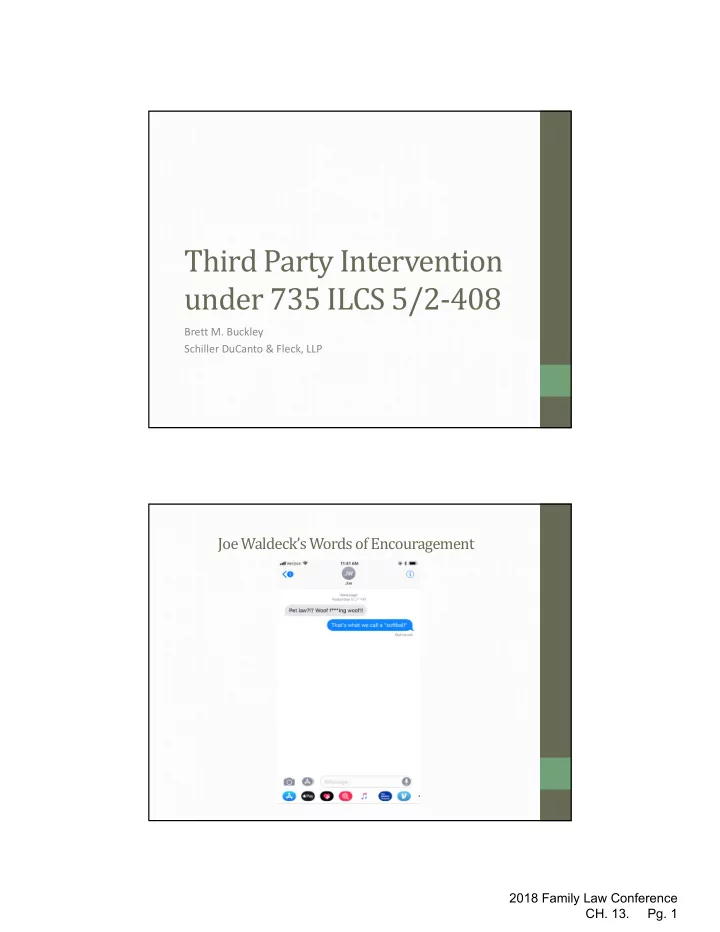
Joe Waldeck’sWords of Encouragement

2018 Family Law Conference

  • CH. 13. Pg. 1
slide-2
SLIDE 2

735 ILCS 5/2-408(a)

  • Ability of a third party to force intervention in a pending

action.

  • a)

Upon timely application anyone shall be permitted as of right to intervene in an action:

  • (1) when a statute confers an unconditional right to intervene; or
  • (2) when the representation of the applicant’s interest by existing

parties is or may be inadequate and the application will or may be bound by an order or judgment in the action; or

  • (3) when the applicant is so situated as to be adversely affected by a

distribution or other disposition of property in the custody of or subject to the control or disposition of the court or a court officer.

735 ILCS 5/2-408(b)

  • (b)Upon timely application anyone may in the discretion of

the court be permitted to intervene in an action:

  • (1) when a statute confers a condition right to intervene; or
  • (2) when an applicant’s claim or defense and the main action

have a question of law or fact in common.

2018 Family Law Conference

  • CH. 13. Pg. 2
slide-3
SLIDE 3

The Focus on 408(a): Elements of Law

  • Timely application;
  • Sufficiency of the applicant’s interest in the proceedings;

and

  • inadequacy of representation by existing parties.

Timeliness of Application

  • Generally, before the entry of a final order. However, not an

absolute rule.

  • Factors for determining timeliness include, but are not limited

to:

  • (a) when the applicant became aware of the litigation;
  • (b) amount of time elapsed between initiation of action and filing
  • f the petition (for intervention); and
  • (c) the reason for failing to seek intervention at an earlier date.
  • Freesen, Inc. v. County of McLean, 277 Ill.App.3d 68 (4th Dist. 1995)

(applicant had no reason to expect that interests did not coincide with those the Village until he received indication to the contrary from watching media coverage).

2018 Family Law Conference

  • CH. 13. Pg. 3
slide-4
SLIDE 4

Sufficiency of Interest

  • Board of Trustees of the Village of Barrington Police Pension

Fund v. Department of Insurance, 211 Ill.App.3d 698 (1st Dist. 1991):

  • “a party need not have a direct legal interests in the pending suit,

but it must have an interest greater than the general public, so that the party may stand to gain or lose by the direct legal

  • peration and effect of a judgment in the lawsuit”
  • Northern Trust Bank / Lake Forest, N.A., v. County of Lake, 311

Ill.App.3d 332 (2nd Dist. 2000) (Village of Mundelein granted leave to intervene to contest zoning in bordering village).

Inadequacy of Representation

  • “Applicants for intervention can establish inadequate representation by

showing that their interests are different from those of the existing parties”. Joyce v. Explosive Technologies International, Inc., 253 Ill.App.3d 613 (3rd

  • Dist. 1993) (heirs of decedent granted leave to intervene in widow’s

wrongful death action).

  • Factors:
  • (i) extent to which interests of applicant and of existing parties converge or

diverge;

  • (ii) the commonality of legal and factual positions;
  • (iii) the practical abilities of existing parties in terms of resources and expertise;

and

  • (iv) the vigor with which existing parties represent the applicants’ interests.

2018 Family Law Conference

  • CH. 13. Pg. 4
slide-5
SLIDE 5

Convergence v. Divergence of Interests

  • Most important factor: comparing interests of applicant and existing

parties.

  • City of Chicago v. John Hancock Mut. Life Ins. Co., 127 Ill.App.3d 140 (1st
  • Dist. 1984):
  • If the applicant presents a unique interest, the presumption or inference is

that the existing parties do not adequately represent such interest.

  • Conversely, where the applicants’ interest closely corresponds to that of an

existing party, adequate representation is inferred.

  • Where interests are both different and similar, reasonable person standard is

employed.

  • Homeowner granted leave to intervene in suit by City of Chicago against

COA for code violations—on the surface, a homeowners’ interests would appear to converge with that of the COA, but the First District found that the homeowner had a greater and more intense interest (“selfish”) in her health than the City.

In re Marriage of Vondra, 2013 IL App (1st) 123025

  • College contribution dispute under 750 ILCS 5/513.
  • Children sought intervention.
  • Trial court denied intervention on basis that their mother, who filed

the contribution petition, could adequately represent their interests.

  • The children’s interests were “squarely in line” with those of their

Mother, who sought contribution from their father.

  • First District affirmed the trial court.
  • Interesting analysis because we now know that pragmatically, the Court

can and should in many cases order that a percentage share of the

  • bligation be paid by the children.

2018 Family Law Conference

  • CH. 13. Pg. 5
slide-6
SLIDE 6

Appeal

  • Conflict in Illinois decisions concerning ability to appeal

granting of intervention compared to denial.

  • In re Estate of Oster, 122 Ill.App.3d 799 (3rd Dist. 1984):
  • Order granting leave to intervene is not a final order and no final

determination has occurred as required under Rule 304(a).

  • Village of Long Grove v. Austin Bank of Chicago, 234 Ill.App.3d

376 (2nd Dist. 1992):

  • Second District Appellate Court concluded that an order denying leave to

intervene is immediately appealable because it is final order that terminates that action as to intervenors, but 304(a) language is required.

Just a picture of my dog, Frank

2018 Family Law Conference

  • CH. 13. Pg. 6