SLIDE 1
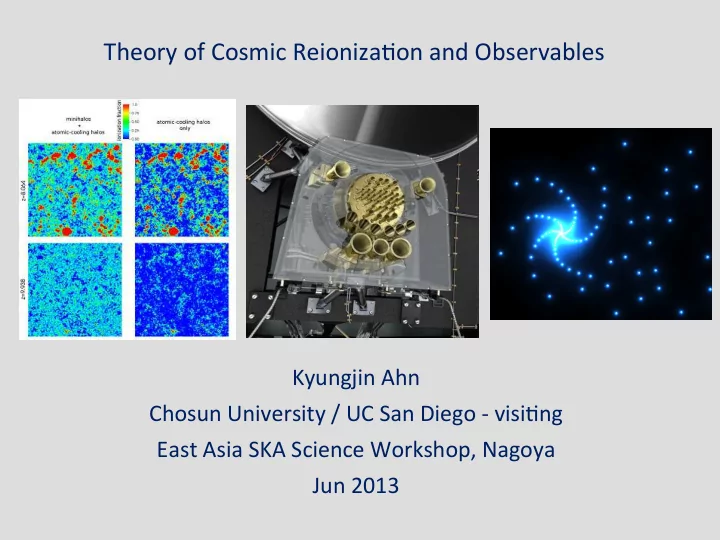
Theory ¡of ¡Cosmic ¡Reioniza2on ¡and ¡Observables ¡
Kyungjin ¡Ahn ¡ Chosun ¡University ¡/ ¡UC ¡San ¡Diego ¡-‑ ¡visi2ng ¡ East ¡Asia ¡SKA ¡Science ¡Workshop, ¡Nagoya ¡ Jun ¡2013 ¡
SLIDE 2
Collaborators: ¡ Paul ¡Shapiro, ¡Texas ¡ Ilian ¡Iliev, ¡Sussex ¡ Garrelt ¡Mellema, ¡Stockholm ¡ Yi ¡Mao, ¡IAP ¡ Dongsu ¡Ryu, ¡Korea ¡ Hyunbae ¡Park, ¡Texas ¡ Mike ¡Norman+, ¡UCSD ¡ and ¡others ¡ ¡ ¡
SLIDE 3 Outline ¡(z>~7 ¡science) ¡
- ¡High-‑z ¡& ¡Cosmic ¡Reioniza2on ¡– ¡brief ¡intro ¡
- ¡Observa2onal ¡constraints ¡
- ¡New ¡developments ¡in ¡theory ¡
- ¡Simula2on ¡(w/ ¡first ¡stars) ¡
- ‑ What’s ¡been ¡limi2ng ¡
- ‑ How ¡we ¡overcame ¡limita2on ¡/ ¡result ¡
- ¡Observa2onal ¡prospects ¡
- ‑ Large ¡scale ¡CMB ¡polariza2on ¡anisotropy ¡
- ‑ Small ¡scale ¡CMB ¡polariza2on ¡anisotropy ¡
- ‑ 21cm ¡background ¡
- ¡Summary/Conclusion ¡
SLIDE 4
High-‑z ¡& ¡Cosmic ¡Reioniza2on ¡– ¡brief ¡intro ¡
SLIDE 5
Cosmic ¡History ¡in ¡a ¡Nutshell ¡
SLIDE 6
- Dark Ages: z =~ 1100 to ~40
– Structure mostly linear – (almost) no stars
- Epoch of Reionization: z =~ 40 to ~7
– Radiation sources emit hydrogen-ionizing radiation – Global ionized fraction <x> increases in time, to reach ~1 at z~7 – Universe stays ionized afterwards
Breakdown ¡of ¡High-‑z ¡Universe ¡ ¡
SLIDE 7
- precision cosmology achieved, will get better
– WMAP, Planck, SPT, ACT, POLARBEAR, … à cosmological initial condition
- chance for astrophysics in cosmological perspective!
- big impact imprinted on IGM
- understanding properties of high-redshift objects
- unseen directly
- linking small (stars) to large (IGM)
Why ¡study ¡cosmic ¡reioniza2on ¡
SLIDE 8
Observa2onal ¡constraints ¡
SLIDE 9
- When reionization completed (from high-z QSO spec
tra)
– GP effect: zov ~ 6.5 ??? (only lower limit to neutral fraction at z>6.5) – z=7 objects: QSO(Mortlock+ 2011), LAE in LBGs(Pentericci+ 2011), LAEs(Ota+ 2010) à all indicating neutral fraction > 10 % at z=7 !!!!!!
Current ¡observa2onal ¡constraints ¡on ¡Reioniza2on ¡
SLIDE 10
Gunn-Peterson Trough (high-z QSO spectrum) Abrupt ¡change ¡of ¡ intergalac2c ¡Lyα ¡op2cal ¡ depth ¡across ¡z≈6. ¡ f(HI) ¡> ¡1e-‑3 ¡at ¡z ¡= ¡6.3 ¡vs. ¡ <1e-‑4 ¡at ¡z= ¡5.7 ¡ à ¡End ¡of ¡reioniza2on ¡at ¡z≈6 ¡
(weak ¡constraint ¡though) ¡
Lyα ¡forest ¡
when ¡reioniza2on ¡completed: ¡
z~6 ¡QSO ¡spectra ¡(Fan+ ¡2006) ¡
SLIDE 11
when ¡reioniza2on ¡completed: ¡
z=7.085 ¡QSO ¡(Mortlock+ ¡2011) ¡
very small proximity zone à high neutral fractio n of >~0.1 at z=7 (Bolton+ 2011)
SLIDE 12
when ¡reioniza2on ¡completed: ¡
z=7 ¡LBG ¡ ¡(Pentericci+ ¡2011) ¡
FLyα ¡= ¡ ¡ ¡ Decline ¡of ¡FLyα ¡at ¡z≈7. ¡ ¡ à ¡large ¡HI ¡frac2on ¡at ¡z ¡≈7 ¡ à ¡reioniza2on ¡ended ¡at ¡z ¡< ¡7 ¡!! ¡
SLIDE 13
- Electron content + bulk movement
– kinetic Sunyaev-Zeldovich effect on CMB – South Pole Telescope: z(x=99%)-z(x=20%) ~ 4.4 – 7.9 (2σ level, Zahn+ 2011)
- Electron content, in terms of Thomson scattering optical depth
- f CMB
– τ = 0.089 ± 0.014 (WMAP9, 1σ level) – τ = 0.089 +0.012 -0.014 (Planck+WMAP polarization, 1σ level)
Current ¡observa2onal ¡constraints ¡on ¡Reioniza2on ¡
SLIDE 14
New ¡Developments ¡in ¡Theory ¡
SLIDE 15
- 1 star / 1 halo paradigm (Abe
l, Yoshida, Bromm, …)
– star ~ 100 M¤ – until 5 years ago
- paradigm shift? (e.g. Turk, A
bel, O’Shea 2009)
– 1 binary / 1 halo – stars ~ 7 M¤ + ~ 20 M¤ à wea ker UV output? – stellar binary à x-ray binary à x-ray source? – caveat: universality unknown
New ¡developments ¡-‑ ¡First ¡star ¡forma2on ¡
SLIDE 16
- baryon moving against dark matter
– velocity offset @ recombination (Na
– ~ a few km/s velocity offset @ z~2 0 (Tseliakhovich & Hirata 2010)
– velocity offset à formation offset ( O’Leary & McQuinn 2012) – Jeans mass up à suppression of st ar formation (Greif+ 2011) – heating à 21cm boost (McQuinn & O’Leary 2012)
New ¡developments ¡– ¡baryon-‑DM ¡offset ¡
SLIDE 17
Simula2on ¡(w/ ¡first ¡stars) ¡
SLIDE 18
- Process is nonlinear and directional: need simulation
- Status of state-of-art numerical simulation so far
– Need big box for statistics (H II bubble ~ 20 Mpc) – numerical resolution limited – Minihalos (<~108 M¤) not resolved – Minihalos are the cradle for the first stars!! (Norman, Wise, Y
- shida, Bromm, Abel, …) Most abundant halo type.
- In this talk, Minihalos ~ First Stars
Numerical ¡Simula2ons ¡of ¡Reioniza2on ¡
SLIDE 19
Simula2on ¡of ¡Cosmic ¡Reioniza2on ¡– ¡1. ¡N-‑body ¡simula2on ¡ ¡
density ¡field ¡
SLIDE 20
Simula2on ¡of ¡Cosmic ¡Reioniza2on ¡– ¡2. ¡Halo ¡Iden2fica2on ¡ ¡
Halo ¡à ¡Star ¡à ¡ ionizing ¡photon ¡
SLIDE 21 Simula2on ¡of ¡Cosmic ¡Reioniza2on ¡– ¡3. ¡Ray ¡tracing ¡ ¡
n Draw ¡rays ¡into ¡all ¡
direc2ons ¡from ¡ each ¡source ¡
n Along ¡each ¡ray, ¡
perform ¡radia2ve ¡ transfer ¡+ ¡ chemistry ¡ calcula2on ¡
SLIDE 22
– first stars in minihalos
- Late reionization(zov<7) & high
τ conditions: hard to match si multaneously w/o first stars
– hard in numerical simulations (Ili ev+; Zahn+; Trac & Cen) – hard with observed galaxies (Rob ertson+ 2013, HUDF12) à
– hints from semi-analytical studie s by Haiman & Bryan (over-boos ting τ); Wyithe & Cen; … – inhomogeneous physical proces ses à Yes, we still need numeric al simulations!!
Mo2va2on/Puzzle/Our ¡answer ¡
SLIDE 23
– first stars in minihalos
- Late reionization(zov<7) & high
τ conditions: hard to match si multaneously w/o first stars
– hard in numerical simulations (Ili ev+; Zahn+; Trac & Cen) – hard with observed galaxies (Rob ertson+ 2013, HUDF12) à
– hints from semi-analytical studie s by Haiman & Bryan (over-boos ting τ); Wyithe & Cen; … – inhomogeneous physical proces ses à Yes, we still need numeric al simulations!!
Mo2va2on/Puzzle/Our ¡answer ¡
SLIDE 24 What’s ¡new? ¡
- Populating grid with minihal
- s (first stars!)
– small-box (6.3/h Mpc) simulati
– correlation between density & minihalo population (nonlinear bias: KA+ in preparation) – put one Pop III star per minihal
SLIDE 25 What’s ¡new? ¡
- Populating grid with minihalo
s (first stars!)
– small-box (6.3/h Mpc) simulati
– correlation between density & minihalo population (nonlinear bias: KA+ in preparation) – put one Pop III star per minihal
- Considering photo-dissociat
ion of coolant
– calculate transfer of Lyman-W erner Background (KA+ 2009) – remove first star from minihalo s, if LW intensity over-critical
SLIDE 26 n Sources ¡distributed ¡inhomogeneously: ¡Need ¡to ¡sum ¡individual ¡
contribu2on ¡ ¡
n One ¡single ¡source ¡is ¡observed ¡as ¡a ¡picket-‑fence ¡in ¡spectrum ¡ n Obtain ¡pre-‑calculated ¡“picket-‑fence ¡modula2on” ¡factor ¡and ¡mul2ply ¡it ¡
to ¡L/DL
- 2. ¡This ¡becomes ¡mean ¡intensity ¡to ¡be ¡distributed ¡among ¡H2 ¡ro-‑
vibra2onal ¡lines. ¡
- ‑ ¡Rela2ve ¡flux ¡averaged ¡over ¡E=[11.5 ¡– ¡13.6] ¡eV ¡
- ‑ ¡mul2-‑frequency ¡phenomenon ¡à ¡single-‑frequency ¡calcula2on ¡with ¡pre-‑
calculated ¡factor ¡à ¡Huge ¡allevia2on ¡computa2onally. ¡
How ¡LW ¡transfer ¡done: ¡Picket-‑Fence ¡Modula2on ¡Factor ¡ (KA+ ¡2009) ¡
SLIDE 27
- More extended reionization
- Same xe but different morphology, with and w
ithout minihalos (c.f. McQuinn+ 2007)
- More electron content à stronger polarization
- f CMB
- Earlier heating of intergalactic medium
- Earlier Lyα pumping on 21cm
- result in KA+ 2012
What ¡do ¡we ¡expect ¡
SLIDE 28
114/h Mpc, w/ Minihalo+ACH, M(Pop III star)=300M¤, JLW,th=0.1x10⁻²¹ erg cm-2 s-1 sr-1
SLIDE 29
With and Without Minihalos
SLIDE 30
– starts reionization – very extended reionization history – 20% ionization, boost in optical depth by ~40% possible
- Massive halos (>~108 M¤)
– determines when reionization is completed
- Late-reionization-completion prior (z<~7)
– small emissivity in massive halo sources required – not large enough optical depth ONLY with massive halo sources
- Early reionization models
– large optical depth possible only with massive halo sources – reionization completes too early (z>~8), violating observational con straint
- Late reionization, large optical depth: both can be achieved only
with help of minihalo sources, or namely the first stars
Storyline ¡
SLIDE 31
Early ¡vs. ¡Late ¡Reioniza2on ¡Models ¡ No-‑minihalo ¡vs. ¡Minihalo ¡Models ¡
SLIDE 32
Observa2onal ¡prospects ¡– ¡ ¡ large-‑scale ¡CMB ¡(E-‑mode ¡polariza2on) ¡
SLIDE 33
– Aimed at CMB / matter power spectrum (linked with CAMB, also at Antony’s shop at http://cosmologist.info) – Does it all – Can be tailored for generic application – Can be tailored for your custom universe – Publicly available – Parallelized
- COSMOMC allowing for generic ionization histories (Mortonson
& Hu)
– Principal component analysis
Q: ¡Can ¡Planck ¡smell ¡first ¡stars? ¡ ¡ (WMAP ¡not ¡that ¡accurate) ¡ ¡
SLIDE 34
Planck ¡Forecast ¡
Hu & Holder; Motonson & Hu: PCA for reionization
SLIDE 35
Planck ¡Forecast ¡
SLIDE 36
Planck ¡Forecast ¡
SLIDE 37
Observa2onal ¡prospects ¡– ¡ ¡ small-‑scale ¡CMB ¡(temperature) ¡
SLIDE 38
Sunyaev-Z’eldovich effect thermal kinetic
Dominant ¡process ¡
SLIDE 39 Reichardt+ 2012 South Pole Telescope (SPT)
CMB ¡temperature ¡anisotropy ¡at ¡small ¡scale ¡
SLIDE 40 Reichardt+ 2012 South Pole Telescope (SPT)
CMB ¡temperature ¡anisotropy ¡at ¡small ¡scale ¡
Zahn+ 2012
SLIDE 41 CMB ¡temperature ¡anisotropy ¡at ¡small ¡scale ¡
Park+ 2013
SLIDE 42
Observa2onal ¡prospects ¡– ¡21cm ¡background ¡
SLIDE 43 What ¡determines ¡21cm ¡strength ¡
– 21cm absorption/emission
– kinetic 21cm excitation/deexcitation
- Lyα pumping (Wouthysen-Field effect)
– 1s à 2p à 1s
SLIDE 44
– cosmological parameters: May improve on cosmology through CMB
– source emissivity – source clustering
- But two physics appear mixed
- Separation possible in the linear regime
– μ-decomposition scheme
Separa2ng ¡Cosmology ¡: ¡Astrophysics ¡ ¡(Mao+ ¡2012) ¡
SLIDE 45
- works in “linear” regime in
– matter density fluctuation – ionization density fluctuation
Separa2ng ¡Cosmology ¡: ¡Astrophysics ¡ ¡(Mao+ ¡2012) ¡
SLIDE 46
- Calculating 21cm background
– get IGM temperature (adiabatic) – do Lya transfer (with retarded time; convolving Pritcha rd’s compilation with source luminosity) – get δTb (Lya coupling, kinetic coupling, dr, dx, dTK, dg ) – just for z=15 (89MHz), not filtered yet, no P(k) yet – image resolution: 0.2’, 0.03 MHz – image size: 51’ – science maybe not suitable for SKA phase 1 Low, but definitely suitable for final SKA
21cm ¡forecast ¡from ¡minihalo-‑included ¡simula2on ¡ ¡ (KA+ ¡in ¡prepara2on, ¡preliminary) ¡
SLIDE 47
21cm ¡forecast ¡from ¡minihalo-‑included ¡simula2on ¡(z=15) ¡
SLIDE 48
21cm ¡forecast ¡from ¡minihalo-‑included ¡simula2on ¡(z=15) ¡
SLIDE 49
21cm ¡forecast ¡from ¡minihalo-‑included ¡simula2on ¡(z=15) ¡
SLIDE 50
21cm ¡forecast ¡from ¡minihalo-‑included ¡simula2on ¡(z=15) ¡
SLIDE 51
21cm ¡forecast ¡from ¡minihalo-‑included ¡simula2on ¡(z=15) ¡
SLIDE 52
21cm ¡forecast ¡from ¡minihalo-‑included ¡simula2on ¡(z=15) ¡
SLIDE 53 Average ¡21cm ¡predic2on ¡
- 21cm observation (prelim)
– minihalo-dominated era (30~>z>~10): if no X-ray , δTb~mK, some ~10mK peaks, absorption – minihalo-dominated era (30~>z>~10): if X-ray, δT
b~10mK, emission
– hard to get strong Lya coupling to generate ~100 mK signal – needs strong Lya coupling to generate ~100 mK si gnal à atomic-cooling halo era
SLIDE 54
Of ¡course ¡big-‑H ¡II ¡bubble ¡structure ¡easier ¡to ¡probe ¡
Iliev+ 2012 (see also Baek+ for 21cm power spectrum during EoR)
SLIDE 55 Summary ¡
- New theoretical, observational developments in cosmic r
eionization (see Ichiki’s talk & Baek’s talk too)
- microphysics: MH (first stars) included simulation
– z~7 Lya + CMB observations matched – very extended Δz~6.5, debunking SPT claim Dl=3000, kSZ= or Δz<4 (by Zahn+): Park+2013 (fuzzy partial ionization field) – Planck can smell the first stars! (polarization, 2014) – post-Planck EoR language: not just {τ, zreion}: m1, m2, m3, …
- 21cm observation (prelim)
– minihalo-dominated era (30~>z>~10): if no X-ray, δTb~mK, abs
– minihalo-dominated era (30~>z>~10): if X-ray, δTb~10mK, emi ssion
- Prospects for SKA (Low frequency 21cm measure)
– cosmology : astrophysics separation from early-EoR signal – cosmology possible but seems difficult during EoR (minihalo cor ruption: ruining e.g. Inoue’s prediction?) – astrophysics possible – new developments in theory à needs work, work, work!