Theory Based Group Counseling Kristin ODonnell, PhD, LSSP Assistant - - PowerPoint PPT Presentation

theory based group counseling
SMART_READER_LITE
LIVE PREVIEW

Theory Based Group Counseling Kristin ODonnell, PhD, LSSP Assistant - - PowerPoint PPT Presentation

Theory Based Group Counseling Kristin ODonnell, PhD, LSSP Assistant Professor of Psychology Our Lady of the Lake University Region XX Presentation May 21, 2015 Agenda Importance of Theoretical Foundations Steps for Group Development


slide-1
SLIDE 1

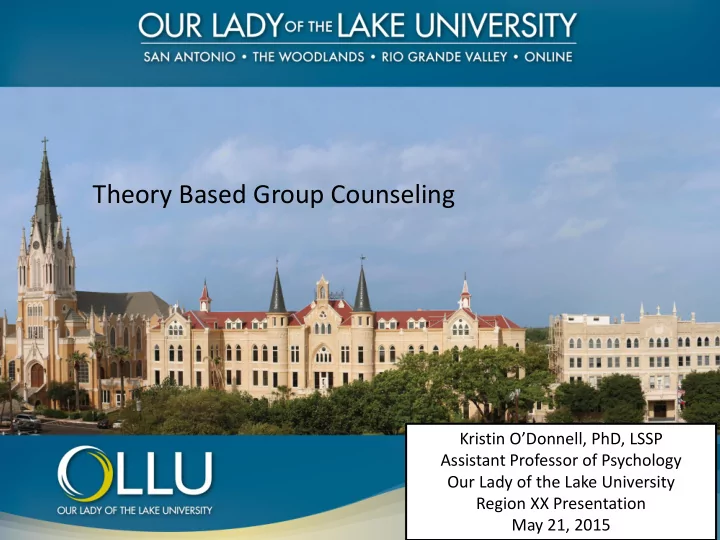
Kristin O’Donnell, PhD, LSSP Assistant Professor of Psychology Our Lady of the Lake University Region XX Presentation May 21, 2015

Theory Based Group Counseling
slide-2
SLIDE 2

Agenda

  • Importance of Theoretical Foundations
  • Steps for Group Development
  • Narrative Therapy

–Sample Group

slide-3
SLIDE 3

Benefits of Group Counseling

  • Young people and group effectiveness

– Groups are the treatment of choice for adolescents, why? – Are groups successful with young children?

slide-4
SLIDE 4

An Equation for Change

  • Client Factors
  • Relationship Factors
  • Hope of Expectancy
  • Model of Theoretical Orientation
  • The Group
slide-5
SLIDE 5

Client Factors

  • Strengths
  • Talents
  • Resources
  • Gifts
  • Social Supports
  • Values
slide-6
SLIDE 6

Relationship Factors

  • Alliance & perceived support between the

practitioner and participant

  • Includes:

– Level of respect – Acceptance – Warmth

  • Complex as leader has a relationship with

each member

slide-7
SLIDE 7

Hope of Expectancy

  • Group leaders are in a unique position to

ignite hope (sometimes the students have yet to see strengths in themselves)

  • By identifying the best in students they begin

to see it for themselves

slide-8
SLIDE 8

Model of Theoretical Orientation

  • Model directly impacts relationship factors

and hope of expectancy

  • Model should enhance other factors and fit

well in the school setting

  • Model should match student expectations and

leader’s personal style

slide-9
SLIDE 9

The Group

  • Interactions & feedback can be powerful to

members

  • Using research can make groups a safe,
  • rganized and productive endeavor
slide-10
SLIDE 10

The Importance of a Theoretical Model

  • Strong potential for affecting the other areas
  • f the equation for change
  • Factor over which we have the most control
  • Provides a foundation for the group so that

activities are not fragmented

  • Provides for integrated experiences
  • Places us in a great position to effect change
slide-11
SLIDE 11

How a Theoretical Orientation Directly Affects Students

  • Becomes a framework around which we

understand students and their group

  • Helps us to have a guide as groups are created

which in turn helps students to have structure

slide-12
SLIDE 12

Which Model?

  • The model we choose depends upon

– The goals and theme of the group – Developmental needs of the members – The setting – Leader’s training & experience

slide-13
SLIDE 13

No “Perfect” Theoretical Model

  • Ask yourself which model is best for this

specific situation

  • No single approach has proven to be more

effective than others.

slide-14
SLIDE 14

Getting a Group Started

  • Get Administrative Approval
  • Meet With Teachers
  • Get Parental Permission
  • Choose Developmentally Appropriate

Activities

slide-15
SLIDE 15

Facilitating a Group

  • Select a scope and sequence of topics

dependent upon:

– Group members – Relationships – Politics of the school

  • Select a theoretical model based on:

– Comfort level and knowledge of the theoretical model – Best fit for the factors mentioned above

slide-16
SLIDE 16

Sample Session Outline

  • Suggested Session Outline for a Cultural

Identity Group:

1) Getting to know each other/Setting goals 2) Who am I? 3) Family identity 4) Heroes and Sheroes 5) Music 6) Fairness in our school 7) Discrimination in our town

slide-17
SLIDE 17

Sample Session Outline

  • Suggested session outline for a social skills

group focusing on communication:

1) Getting to know each other/Setting goals 2) Learning to Listen 3) Eye contact 4) Don’t interrupt 5) Active listening 6) Waiting 7) Group closure session

slide-18
SLIDE 18

Facilitating a Group

  • 1st Session:

– Discussion of what this group is all about (should be tailored to developmental level of the group) – Get to know each other activities (Icebreakers) – Build Group Cohesion

  • Choose a name for the group
  • Have group create rules for participation
slide-19
SLIDE 19

Narrative Therapy

The epitome of creating the life story Accomplished by the choices or perceived lack of choices for people Therapist attempts to create a new story of personal empowerment New stories lead to increased satisfaction of client and new hopefulness

slide-20
SLIDE 20

Assumptions about Problems in Narrative Therapy

  • Person is situated in their or others stories and

they see no alternative

  • Person is an active participant in this

unsatisfying story

  • Story is insufficient in representing person’s

experiences

slide-21
SLIDE 21

Types of Stories

  • Oppressive Stories
  • Alternative Stories
  • Gaps
slide-22
SLIDE 22

Focus of Narrative Therapy

  • Create alternate stories
  • Alternate stories contain a more positive

perspective

  • Narratives are representations of identities
slide-23
SLIDE 23

Narrative Maps

  • This is the term that refers to how people
  • rganize important aspects of their life to

“weave the tapestry of their life’s story” (social constructs)

– Social constructs: interactions and experiences with others in a historical context

slide-24
SLIDE 24

Deconstruction

  • Deconstructive listening
  • Deconstructive questioning
slide-25
SLIDE 25

Practices in Narrative Therapy

  • Position Collaboratively
  • Externalize the Problem
  • Excavate Unique Outcomes

– Opening space – Exception questions – Hypothetical questions

slide-26
SLIDE 26

Sample Group

  • 6 week, Keep Calm counseling group focusing
  • n emotions:

1) Keep Calm & Bond: Getting to know each

  • ther/Setting goals

2) Keep Calm & Find Happiness 3) Keep Calm & Find Peace 4) Keep Calm & Find Hope 5) Keep Calm & Find Honesty 6) Group Closure

slide-27
SLIDE 27

Session 2: Keep Calm and Find Happiness

  • Introduce the topic for the day (happiness vs. sadness)
  • Have the group define each feeling
  • Read the book “Little Miss Happy”
  • Once the book is read have members identify the main

themes of the character’s stories and discuss the feedback loop that each character is stuck in. Also discuss the sign that states the rules of Miseryland and how these rules help to construct the townspeople’s stories. – Have members develop a sign that guards their own city and keeps happiness away (things in their lives that make it difficulty to be happy).

slide-28
SLIDE 28

2nd Session Continued

  • Ask those who are willing to share their sign.
  • Discuss how Little Miss Happy changed the

rules and helped the city to rewrite their stories.

  • Have members turn their papers over and

rewrite their signs to let happiness in.

  • To close the group discuss how we can live by

rules that cause us to not be happy but with a little bit of re-writing things can change dramatically.

slide-29
SLIDE 29

References

  • Cooley, L. (2009). The power of groups:

Solution-focused group counseling in schools.

  • Corwin. Thousand Oaks, CA.
  • Corey, G. (2013). Theory and practice of

counseling and psychotherapy (9th Ed). Belmont, CA: Brooks/Cole.

  • Khalsa, S.S. (1996). Group exercises for

enhancing social skills and self-esteem. Professional Resource Exchange. Sarasota, FL

slide-30
SLIDE 30

References (continued)

  • Parsons, R.D. (2007). Counseling strategies that

work! Evidenced-based interventions for school

  • counselors. Pearson Education, Inc. Boston, MA.
  • Plotts, C.A. & Lasser, J. (2013). School psychologist

as counselor: A practitioner’s handbook. National Association of School Psychologists. Bethesda, MD.

  • Winslade J.M. & Monk, G.D. (1999). Narrative

counseling in the schools: Powerful and brief, 2nd

  • Edition. Corwin Press. Thousand Oaks, CA.
slide-31
SLIDE 31

Contact Information

  • Kristin O’Donnell, PhD, LSSP

klodonnell@lake.ollusa.edu (210) 528 - 6728