
SLIDE 1
Thematic Network: Global Ecological and Economic Connections in - - PowerPoint PPT Presentation
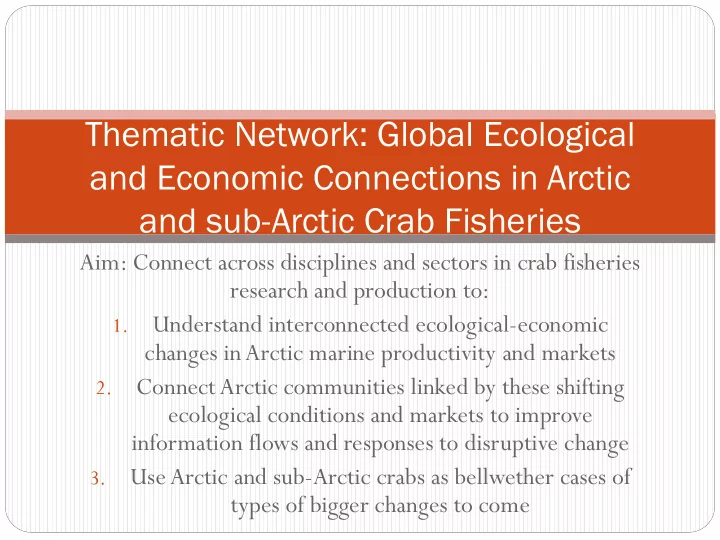
Thematic Network: Global Ecological and Economic Connections in Arctic and sub-Arctic Crab Fisheries Aim: Connect across disciplines and sectors in crab fisheries research and production to: Understand interconnected ecological-economic 1.
Eastern Russia USA Japan Korea Atlantic Canada (SC)
Norway Western Russia Greenland (SC)
Known Unknowns:
decision-making tools are reasonably developed E.g. temp, reproduction, prices, costs within historical bounds (somewhere); lab study conceivable
Challenge: Bringing together pan-Arctic + Asian representatives for information sharing,
research synergies
Solutions: Workshops, visits (own + piggy-back for subsets)
Juneau + Anchorage May 2017 (visits + Wakefield Symposium) Toyama June 2017 (visits) Incheon + Busan July 2017 (visits) Copenhagen Dec 2017 (own) Seattle Jul 2018 (IIFET – International Institute of Fisheries Economics and Trade) Seattle Jan 2019 (own) Halifax May 2019 (NAAFE – North American Association of Fisheries Economists) Tromso November 2019 (ICES/IMR Shellfish Symposium – Invaders and Resources in the
North)
Challenge: Collecting / Integrating data from multiple countries / agencies Solutions:
Student intern with, inter alia, Chinese language skills and fisheries economics knowledge Research collaborations in sub-groups
Challenge: ‘touchiness’ of Barents Sea stakeholders regarding input to the tradeoffs
involved in the development and exploitation of invasive species as a fisheries resource
Solutions: Build personal relationships; work carefully and systematically with both
qualitative and quantitative data to capture the big picture impacts of local, regional, and global differences in perspective
Institutions (formal* and informal): Representing main Producing and Consuming Nations University of Southern Denmark* Toyama University* UAK – Fairbanks* Greenland Institute of Natural Resources* KMI* + KOPRI* NOFIMA Virginia Commonwealth University IMR + PINRO DFO Canada Gulf of Maine Fisheries Institute Simeone Consulting
People (subset) Brooks A. Kaiser* M Kourantidou D Ahsan S Bakanev A Burmeister G Eckert L.M. Fernandez H.P
John Simeone A.A. Monsalve D. Mullowney A. Nielsen B.H. Nøstvold H. Park E. Poulsen L. Ravn-Jonsen C. Siddon J.H. Sundet K. Tokunaga M.
Asia, CA data start CDN prod’n jumps Gap shows inc. imports Missing? USSR/Russian Fed. Domestic Consumption Non-commercial uses …
Tastes and preferences Incomes Relative prices Information: health, external costs and benefits…
Kourantidou (2019) PhD Kaiser, Fernandez and Kourantidou Journal of Environmental Management
(2018)
Kourantidou and Kaiser ICES Journal of Marine Science (2019)
Set of papers in progress