What is ecological inference ( EI )? eiPack : Tools for R C - - PowerPoint PPT Presentation

what is ecological inference ei
SMART_READER_LITE
LIVE PREVIEW

What is ecological inference ( EI )? eiPack : Tools for R C - - PowerPoint PPT Presentation

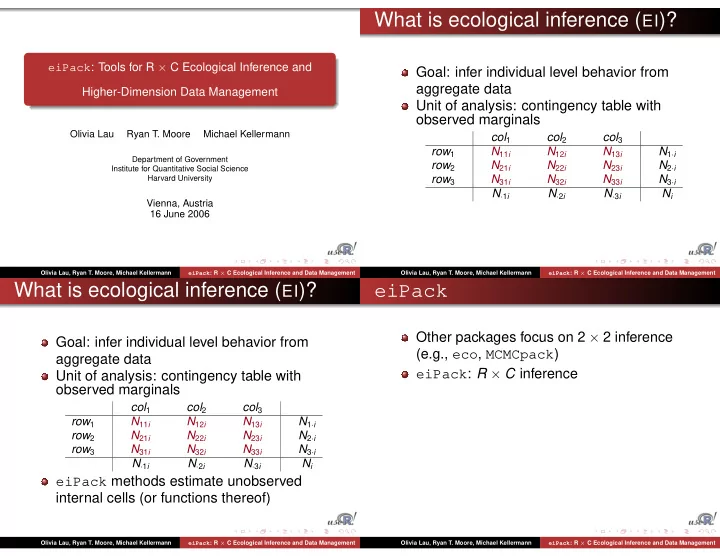
What is ecological inference ( EI )? eiPack : Tools for R C Ecological Inference and Goal: infer individual level behavior from aggregate data Higher-Dimension Data Management Unit of analysis: contingency table with observed marginals


slide-1
SLIDE 1

eiPack: Tools for R × C Ecological Inference and Higher-Dimension Data Management

Olivia Lau Ryan T. Moore Michael Kellermann

Department of Government Institute for Quantitative Social Science Harvard University

Vienna, Austria 16 June 2006

Olivia Lau, Ryan T. Moore, Michael Kellermann eiPack: R × C Ecological Inference and Data Management

What is ecological inference (EI)?

Goal: infer individual level behavior from aggregate data Unit of analysis: contingency table with

  • bserved marginals

col1 col2 col3 row1 N11i N12i N13i N1·i row2 N21i N22i N23i N2·i row3 N31i N32i N33i N3·i N·1i N·2i N·3i Ni

Olivia Lau, Ryan T. Moore, Michael Kellermann eiPack: R × C Ecological Inference and Data Management

What is ecological inference (EI)?

Goal: infer individual level behavior from aggregate data Unit of analysis: contingency table with

  • bserved marginals

col1 col2 col3 row1 N11i N12i N13i N1·i row2 N21i N22i N23i N2·i row3 N31i N32i N33i N3·i N·1i N·2i N·3i Ni

eiPack methods estimate unobserved internal cells (or functions thereof)

Olivia Lau, Ryan T. Moore, Michael Kellermann eiPack: R × C Ecological Inference and Data Management

eiPack

Other packages focus on 2 × 2 inference (e.g., eco, MCMCpack) eiPack: R × C inference

Olivia Lau, Ryan T. Moore, Michael Kellermann eiPack: R × C Ecological Inference and Data Management

slide-2
SLIDE 2

eiPack

Other packages focus on 2 × 2 inference (e.g., eco, MCMCpack) eiPack: R × C inference eiPack methods:

Method of bounds Ecological regression Multinomial-Dirichlet model

Olivia Lau, Ryan T. Moore, Michael Kellermann eiPack: R × C Ecological Inference and Data Management

eiPack

Other packages focus on 2 × 2 inference (e.g., eco, MCMCpack) eiPack: R × C inference eiPack methods:

Method of bounds Ecological regression Multinomial-Dirichlet model

eiPack data: senc

Individual level party affiliation Black, White, and Native American voters 8 counties (212 precincts) in SE North Carolina Cell counts known

Olivia Lau, Ryan T. Moore, Michael Kellermann eiPack: R × C Ecological Inference and Data Management

eiPack

The models implemented in eiPack share:

Olivia Lau, Ryan T. Moore, Michael Kellermann eiPack: R × C Ecological Inference and Data Management

eiPack

The models implemented in eiPack share: A common input syntax of the form:

cbind(col1, ..., colC) ∼ cbind(row1, ...,rowR)

Functions to calculate proportions of some subset of columns Appropriate print, summary, and plot functions

Olivia Lau, Ryan T. Moore, Michael Kellermann eiPack: R × C Ecological Inference and Data Management

slide-3
SLIDE 3

Method of bounds

Quantity of interest: proportion of row members in each column for each unit Observed row and column marginals determine upper and lower bounds

Olivia Lau, Ryan T. Moore, Michael Kellermann eiPack: R × C Ecological Inference and Data Management

Method of bounds

Quantity of interest: proportion of row members in each column for each unit Observed row and column marginals determine upper and lower bounds Row thresholds implemented for extreme case analysis

Olivia Lau, Ryan T. Moore, Michael Kellermann eiPack: R × C Ecological Inference and Data Management

Method of bounds

Quantity of interest: proportion of row members in each column for each unit Observed row and column marginals determine upper and lower bounds Row thresholds implemented for extreme case analysis Output: $white.dem lower upper 18 0.519 0.559 25 0.450 0.469 28 0.392 0.487

Olivia Lau, Ryan T. Moore, Michael Kellermann eiPack: R × C Ecological Inference and Data Management

Method of bounds

Precincts at least 90% White Proportion Democratic 0.0 0.2 0.4 0.6 0.8 1.0

18 25 28 29 30 31 34 35 37 39 51 52 54 58 61 63 65 67 68 71 75 85 86 88 89 90 91 92 94 95 96 97 98 99 104 110 111 113 115 117 118 120 122 123 127 128 129 130 131 137 139 144 145 147 200 207 212

Olivia Lau, Ryan T. Moore, Michael Kellermann eiPack: R × C Ecological Inference and Data Management

slide-4
SLIDE 4

Method of bounds

Precincts at least 90% White Proportion Democratic 0.0 0.2 0.4 0.6 0.8 1.0

18 25 28 29 30 31 34 35 37 39 51 52 54 58 61 63 65 67 68 71 75 85 86 88 89 90 91 92 94 95 96 97 98 99 104 110 111 113 115 117 118 120 122 123 127 128 129 130 131 137 139 144 145 147 200 207 212

  • Olivia Lau, Ryan T. Moore, Michael Kellermann

eiPack: R × C Ecological Inference and Data Management

Ecological regression

Express data as proportions of row totals Regress each column on all row proportions (C regressions) Coefficients estimate cell proportions

Olivia Lau, Ryan T. Moore, Michael Kellermann eiPack: R × C Ecological Inference and Data Management

Ecological regression

Express data as proportions of row totals Regress each column on all row proportions (C regressions) Coefficients estimate cell proportions eiPack: freq. and Bayesian regression

Olivia Lau, Ryan T. Moore, Michael Kellermann eiPack: R × C Ecological Inference and Data Management

Ecological regression

Express data as proportions of row totals Regress each column on all row proportions (C regressions) Coefficients estimate cell proportions eiPack: freq. and Bayesian regression lambda functions calculate shares of a subset of columns – e.g. “among Blacks,

  • Dem. share of 2-party registration”

Olivia Lau, Ryan T. Moore, Michael Kellermann eiPack: R × C Ecological Inference and Data Management

slide-5
SLIDE 5

Ecological regression

−0.2 0.2 0.6 1.0 20 40 Proportion Democratic Density −0.2 0.2 0.6 1.0 20 40 Proportion Republican Density

Olivia Lau, Ryan T. Moore, Michael Kellermann eiPack: R × C Ecological Inference and Data Management

Multinomial-Dirichlet (MD) model

Express data as counts Fit hierarchical Bayesian model

Level 1: column marginals ∼ Multinomial, ⊥ ⊥ across units Level 2: rows of cell fractions ∼ Dirichlet, ⊥ ⊥ across rows and units Level 3: Dirichlet parameters ∼ Gamma, i.i.d.

Olivia Lau, Ryan T. Moore, Michael Kellermann eiPack: R × C Ecological Inference and Data Management

Multinomial-Dirichlet (MD) model

Express data as counts Fit hierarchical Bayesian model

Level 1: column marginals ∼ Multinomial, ⊥ ⊥ across units Level 2: rows of cell fractions ∼ Dirichlet, ⊥ ⊥ across rows and units Level 3: Dirichlet parameters ∼ Gamma, i.i.d.

lambda and density.plot functions

Olivia Lau, Ryan T. Moore, Michael Kellermann eiPack: R × C Ecological Inference and Data Management

Multinomial-Dirichlet (MD) model

  • 0.0

0.2 0.4 0.6 0.8 1.0 0.0 0.2 0.4 0.6 0.8 1.0 Proportion White in precinct Proportion of White Democrats

  • Olivia Lau, Ryan T. Moore, Michael Kellermann

eiPack: R × C Ecological Inference and Data Management

slide-6
SLIDE 6

Data Management

Reasonable-sized problems produce unreasonable amounts of data

Olivia Lau, Ryan T. Moore, Michael Kellermann eiPack: R × C Ecological Inference and Data Management

Data Management

Reasonable-sized problems produce unreasonable amounts of data E.g., a model for voting in Ohio includes

11000 precincts 3 racial groups 4 party options

Olivia Lau, Ryan T. Moore, Michael Kellermann eiPack: R × C Ecological Inference and Data Management

Data Management

Reasonable-sized problems produce unreasonable amounts of data E.g., a model for voting in Ohio includes

11000 precincts 3 racial groups 4 party options

1000 iterations yields about 1.3 × 10⁸ parameter draws Draws occupy ≈ 1GB of RAM; probably not enough iterations

Olivia Lau, Ryan T. Moore, Michael Kellermann eiPack: R × C Ecological Inference and Data Management

Data Management

Reasonable-sized problems produce unreasonable amounts of data E.g., a model for voting in Ohio includes

11000 precincts 3 racial groups 4 party options

1000 iterations yields about 1.3 × 10⁸ parameter draws Draws occupy ≈ 1GB of RAM; probably not enough iterations eiPack allows users to write chains to disk, or discard chains not of interest

Olivia Lau, Ryan T. Moore, Michael Kellermann eiPack: R × C Ecological Inference and Data Management

slide-7
SLIDE 7

Visit our poster for more!

Olivia Lau, Ryan T. Moore, Michael Kellermann eiPack: R × C Ecological Inference and Data Management