
SLIDE 1
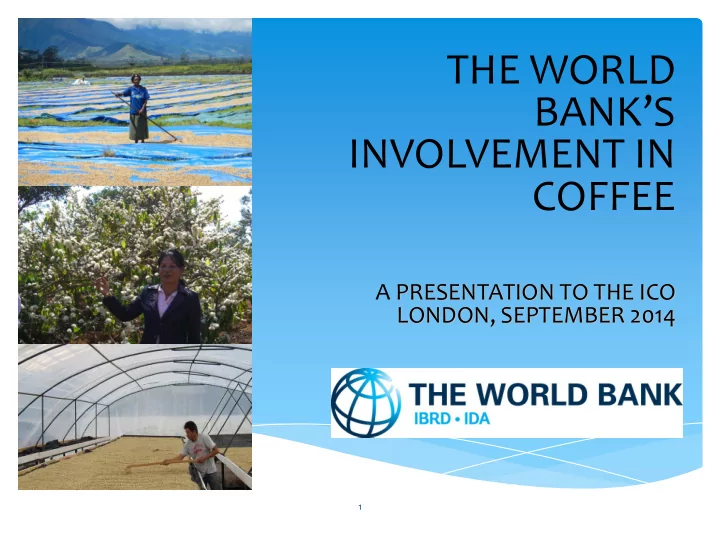
THE WORLD BANK’S INVOLVEMENT IN COFFEE
A PRESENTATION TO THE ICO LONDON, SEPTEMBER 2014
1
THE WORLD BANKS INVOLVEMENT IN COFFEE A PRESENTATION TO THE ICO - - PowerPoint PPT Presentation
THE WORLD BANKS INVOLVEMENT IN COFFEE A PRESENTATION TO THE ICO LONDON, SEPTEMBER 2014 1 Coffee Sector Engagement Thematic Focus Raising productivity (climate-smart agriculture; improving the enabling environment) Linking farmers to
1
2
(climate-smart agriculture; improving the enabling environment)
(cross-cutting focus on gender, nutrition and longer-term risk management and improved resilience)
(promoting landscape approaches)
3
Provide support for national programs Combination of
Analytical work Technical assistance Investment Project Financing (sector investment loans) Development Policy Lending (budget support)
Differentiated approach across countries Selectivity, in partnerships with others
4
Latin America
Colombia, Panama and Haiti: farm upgrading, certification and improved processing through productive alliance projects
mainstreaming biodiversity protection in productive landscapes
chain risk assessment
East Asia and the Pacific
rejuvenation strategy; support for new Coffee Coordination Board; scaling-up sustainable coffee
project focusing on replanting and promoting good agricultural practices through credit lines
Support for improving productivity and sustainability, market linkages and institutional strengthening
Assistance
Africa
Mainstreaming biodiversity protection in coffee landscapes - shaded coffee, watershed management, certification; coffee sector policy dialogue
significant stand-alone coffee investment project in preparation
Knowledge Exchange with Colombia (Burundi, Rwanda and Ethiopia)
chain risk assessment
Global
management training module
World Bank Loans and Grants to Governments Private Sector Farmers Non- Governmental Organizations Research Institutions & Organizations
5
6
∗ Public-private alliances to improve productivity and market linkages ∗ Coffee component co-financed by IDA (approx. $27.5 million) and IFAD ($7 million) ∗ Typical partnership comprises of a lead partner (exporter, processor, NGO), co-partners (various service providers) and a groups of farmers ∗ Project provides grants to partnerships through a competitive process ∗ Individual partnerships have between 300 – 1,500 smallholder farmers ∗ Support for farm upgrading, certification, improved processing, a range of institutional strengthening, capacity building and management activities and rehabilitation of access roads in areas serving the partnerships
7
∗ Currently 19 partnerships involving 13,791 coffee farmers; end of project target is 30,000 farmers ∗ 12,679 coffee gardens profiled; tools distributed to farmers ∗ 32 nurseries constructed; 192 model gardens established ∗ 18 groups have applied for certification and 5 have been certified ∗ 3,500 farmers have received some training on agronomic practices; 16% are women ∗ 2,755 farmers have received training on post-harvest aspects ∗ 699 farmers, including 229 women have received personal viability training ∗ 59 extension workers trained; 8% are women
8