
SLIDE 1
AMERICAN PUBLIC TRANSPORTATION ASSOCIATION
STRATEGIC PLAN 2015-2019
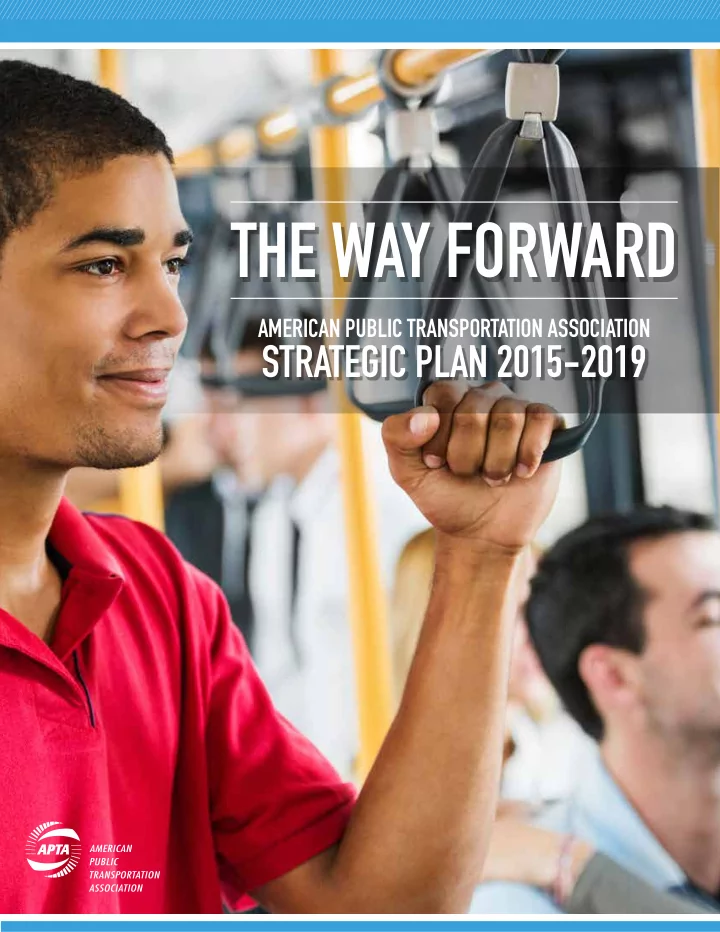
THE WAY FORWARD AMERICAN PUBLIC TRANSPORTATION ASSOCIATION - - PDF document
THE WAY FORWARD AMERICAN PUBLIC TRANSPORTATION ASSOCIATION STRATEGIC PLAN 2015-2019 TODAY INTRODUCTION FOR EVERY $1 INVESTED IN 2013, 10.7 BILLION IN PUBLIC TRANSPORTATION, $4 IS GENERATED TRIPS WERE IN ECONOMIC RETURNS. TAKEN ON PUBLIC
AMERICAN PUBLIC TRANSPORTATION ASSOCIATION
STRATEGIC PLAN 2015-2019
The public transportation industry is in the midst of exciting change, as people are both supporting it and riding at increasing
both opportunities and challenges. The 2015-2019 APTA Strategic Plan addresses the main challenges and
Strategic goals have been identified to address these key areas following extensive discussion with a broad representation of APTA’s membership as well as its main external stakeholders. The strategic plan outlines how APTA will address the goals and support its membership in meeting the challenges and leveraging the opportunities ahead. In conclusion, it establishes desired
will measure progress on an annual basis.
The 2015-2019 APTA Strategic Plan aims to bring APTA and its membership a step closer to realizing APTA’s TransitVision
core values, using and building upon the array of existing member services (see Appendix A).
VISION
Be the leading force in advancing public transportation.
MISSION
To strengthen and improve public transportation, APTA serves and leads its diverse membership through advocacy, innovation and information sharing.
CORE VALUES
RESOURCE ADVOCACY WORKFORCE DEVELOPMENT DEMOGRAPHIC SHIFTS TECHNOLOGICAL INNOVATION SAFETY & SECURITY FIRST
IN 2013, 10.7 BILLION
TRIPS WERE TAKEN ON PUBLIC TRANSPORTATION IN THE UNITED STATES, WHICH IS THE
HIGHEST ANNUAL PUBLIC TRANSIT RIDERSHIP IN 57 YEARS. PUBLIC TRANSPORTATION IS A
$61 BILLION INDUSTRY
THAT EMPLOYS MORE THAN
400,000 PEOPLE
IN THE PUBLIC AND PRIVATE SECTORS.
FOR EVERY $1 INVESTED
IN PUBLIC TRANSPORTATION,
$4 IS GENERATED
IN ECONOMIC RETURNS.
SINCE 2009
PUBLIC TRANSIT RIDERSHIP IS UP 4.1 PERCENT,
OUTPACING POPULATION GROWTH, WHICH IS UP 3 PERCENT, AND VEHICLE MILES TRAVELED (VMT), WHICH IS UP .5 PERCENT.
BY 2050,
MORE THAN 70 PERCENT
OF THE NATION’S POPULATION GROWTH AND AN EVEN HIGHER PERCENTAGE OF ITS ECONOMIC GROWTH ARE
CONCENTRATED IN 10 EXTENDED METROPOLITAN REGIONS.
SOURCE: AMERICA 2050, REGIONAL PLAN ASSOCIATIONPublic transportation is essential to keeping metropolitan economies healthy, productive and prosperous, and for providing people access to these economic opportunities.
THE DEMAND FOR ADA PARATRANSIT AND OTHER SENIOR SPECIALIZED SERVICES
WILL GROW FROM 217 MILLION TRIPS IN 2012 TO 282 MILLION TRIPS IN 2020 AND 393 MILLION TRIPS IN 2030.
SOURCE: FUNDING THE PUBLIC TRANSPORTATION NEEDS OF AN AGING POPULATION, MARCH 2010 e. Increase the visibility of APTA safety and security award programs f. Continue to be a forum for the development and dissemination of state of the art safety and security practices, standards, products, and services g. Advocate for a collaborative regulatory environment that engages all stakeholders h. Support members in striving for safety excellence and continual improvement through safety and security resources, including APTA’s Safety Management Audit and Peer Review programs
Public transportation is one of the safest forms
transportation industry continue to place safety, security, and the wellness of our passengers and
vibrant “safety and security first culture” is a key initiative of the industry. In the next five years, the public transportation industry will be working within an invigorated regulatory environment. In parallel, public transportation worldwide remains one of the primary targets for terrorist activity. This requires consistent investment in enhanced safety and security measures.
GOAL
Promote, develop and support continuous improvement of safe and secure public transportation systems. STRATEGIES
a. Strengthen and reinforce the development and implementation of safety and security standards b. Advocate for enhanced analysis and commonality of available safety data sources to guide future goals and objectives c. Develop a “safety and security first culture” initiative d. Continue to advocate for increased safety and security funding
Since its inception, APTA and its predecessor associations have been vocal advocates and active instigators for safety improvements...the people involved in the operations and management
completely committed to the safety
employees.
– Michael P. Melaniphy APTA President & CEO Testimony before Congress, February 2014
DECLINE IN TRAIN ACCIDENTS AND DERAILMENTS FROM FY2004-FY2013 TRAVELING BY BUS IS 28 TIMES SAFER THAN BY AUTOMOBILE
SOURCE: FRA SOURCE: FTA (2009)
The public transportation industry has been challenged with constrained resources. It faces the imperative of maintaining aging systems while also investing in necessary growth and upgrades of all modes of public transportation to meet customer needs in a reliable, safe and secure manner. The need to build systems that are resilient to natural disasters will be an additional demand on resources. Robust and stable long-term federal, state and local funding is critical. In addition, new business models and project delivery approaches, including public-private partnerships, as well as financing options, are required to ensure public transportation’s integral role in developing the sustainable transportation network North America needs. Ensuring that these imperatives are understood and action is taken at the federal, state, and local levels remain top priorities for APTA and its membership.
GOAL
Support the growth of federal and other funding and financing resources, improved project delivery approaches, and a more efficient regulatory environment. STRATEGIES
a. Make the case for long-term federal funding in public transportation, focusing
funding and expanded programmatic
b. Make the case for long-term federal funding in intercity passenger rail, including high-speed rail, focusing on both guaranteed long-term formula funding and expanded programmatic opportunities for discretionary funding c. Advocate for public transportation program and project access to all federal innovative financing and project delivery initiatives d. Continue to effectively position and brand public transportation as key to
Transportation Goes, Community Grows” campaign e. Advocate to encourage funding for state and local agencies commensurate with the cost to implement federal mandates, technological advances or policy initiatives f. Maintain and build on existing legislative
g. Provide advocacy tools for members’ state and local outreach h. Continue to activate grassroots public transportation advocates i. Disseminate lessons learned nationally/ internationally j. Promote inclusion of public transportation in successful financing strategies, project
Federal investment in transportation is vital for economic growth, competitiveness and jobs.
U.S. Chamber of Commerce February 2014
delivery approaches, including public- private partnerships, and business models that are alternatives, or additions to, traditional federal and local funding k. Lead the industry’s regulatory advocacy efforts l. Continue to develop the research and communication products that tie public transportation to overarching regional benefits and national goals
SHORTFALL BETWEEN TOTAL CURRENT FUNDING FROM ALL SOURCES FOR PUBLIC TRANSPORTATION AND ACTUAL NEED (2014)
g. Support members in leveraging and implementing structured and systematic approaches to workforce development and strategies for improving the diversity of their workforces h. Leverage the resources of the American Public Transportation Foundation in supporting the next generation of public transportation professionals i. Align with other interest groups advocating for science, technology, engineering and math education
The transportation industry will need to hire and train one new worker every minute in the 10 year period (from 2012-2022) in
replacement needs.
2014
Workforce demographics in public transportation are shifting dramatically as the industry faces a wave of retirements, with a commensurate loss
need to attract a workforce with increasingly diverse skill sets for a technologically more complex and customer service-focused industry. Investment in education systems and training programs covering the breadth of the industry and geared toward attracting and retaining a quality workforce is paramount, as is effectively communicating the value and personal reward of working in the industry.
GOAL
Help members attract, develop, and retain a diverse workforce. STRATEGIES
a. Turn APTA into a hub for workforce development models and resources b. Leverage both the public and private sectors to showcase successful practices c. Develop more public transit-specific education and training programs with partners and through alliances d. Support the development of local and regional mentoring and internship programs e. Continue to enhance industry attractiveness through branding and image development f. Strategically maximize national/federal, regional, and local partnerships and programs
PROJECTED JOB OPENINGS IN THE NEXT 10 YEARS IN PUBLIC TRANSIT PUBLIC TRANSIT JOB OPENINGS ARE ESTIMATED AT 1.25 TIMES CURRENT EMPLOYMENT
SOURCE: TRANSPORTATION LEARNING CENTER
As demographics shift with population growth, an aging society with greater longevity, and a large millennial generation taking a significant place in the workforce, lifestyle changes are dramatically reshaping the American landscape. There is movement away from cars and toward more urbanized, multimodal lifestyle choices. This leads to the development of Transit-Oriented Communities with opportunities for public transit, intercity rail, bicycle and pedestrian transportation, first mile/last mile service, and emerging mobility services. Changes in travel patterns mean many public transit systems are experiencing ridership increases during off-peak hours and on weekends. The public transportation industry needs to respond to these shifts and meet customer expectations for increased services, quality of experience, and availability for all.
GOAL
Assist members in addressing ever-evolving lifestyles and mobility needs. STRATEGIES
a. Help APTA members build their knowledge and capacity to influence land use decisions/meet customer expectations b. Promote the development of Transit- Oriented Communities incorporating active transportation, first mile/last mile service, and emerging mobility services that provide equitable opportunities for all c. Understand the usage, impact, and
technologies and how to maximize their synergies with public transit d. Identify customer-focused approaches/ technologies to accommodate a variety of mobility options/services and continue to maximize accessibility e. Continue to underscore the relevance of public transportation f. Help members engage all generations in the adaptation of public transit systems and services g. Continue leadership on promoting accessibility for all, including people with disabilities, returning veterans with mobility challenges, older adults—many of whom are aging in place—and those who are not native English speakers
The baby boom generation has been accustomed to a high level of mobility and will expect that level of mobility to continue into their later years...Public transportation programs are vitally important to helping older persons maintain their independence and connection to their community.
– AARP President Testimony before Congress, June 2011
PERCENTAGE OF MILLENNIALS WHO USE MULTIPLE TRAVEL OPTIONS SEVERAL TIMES A DAY
PERCENTAGE OF MILLENNIALS WHO RANK PUBLIC TRANSIT AS THE BEST MODE TO CONNECT TO ALL OTHER MODES
SOURCE: MILLENNIALS & MOBILITY: UNDERSTANDING THE MILLENNIAL MINDSET (2013)
e. Promote standards implementation and develop a way to quantify it f. Manage regulatory and funding factors g. Engage with and integrate alternative mobility services and technology providers h. Leverage existing partnerships with
A transit app...is a transformative urban-planning tool that can convert car commuters into regular transit users.
August 2014
Technological innovations are accelerating exponentially, creating more opportunities for customer-facing technology solutions, new mobility services, systems integration, data collection, energy efficiency and new methods for optimizing vehicle and infrastructure design. With these innovations come issues of service integration, data ownership and management, and proprietary designs as well as cyber security. In addition, more
with public and private services to address first mile/last mile access and for supportive use of emerging mobility services and technologies. This includes web-based applications and autonomous and connected vehicle technologies.
GOAL
Lead and serve member efforts to evaluate, develop and adapt to emerging technologies. STRATEGIES
a. Advance members’ knowledge of evolving technology and address members’ needs and concerns b. Support members in assessing, developing, and implementing technology, as well as technology management and integration c. Serve as the industry portal for new and emerging technologies and innovative practices d. Facilitate the development of advanced research into applied products
PRIVATE INVESTMENT IN TRANSPORTATION APP COMPANIES
SOURCE: 1776
APTA represents all modes of public transportation: bus, paratransit, light rail, commuter rail, subways, waterborne services, and intercity and high-speed passenger rail. This includes transit systems; planning, design, construction, and finance firms; product and service providers; academic institutions; transit associations; and state departments
APTA must ensure it is well-positioned structurally and organizationally to meet the 2015-2019 strategic goals, as well as to continue to fulfill its overall mission.
GOAL Provide world-class member services through a vital and robust
STRATEGIES
a. Align APTA’s daily operations and the annual business plan with APTA’s Strategic Plan b. Quantify resource needs, including human capital and financial, to achieve strategic goals c. Analyze and convey the resource vs. goal gaps and present this information to the Board of Directors for policy prioritization and rationalization d. Focus on staff proficiency, professional development, process management, agility, and effectiveness e. Emphasize committee development/ training/processes f. Continue to develop APTA’s membership, including incorporation of new modes and services g. Strategically assess and implement technological enhancements to APTA business practices and infrastructure h. Continue to build on APTA brand awareness
APTA members will have access to comprehensive safety and security standards, the needed knowledge and technical assistance to implement best practices and regulations, and the necessary data to assess and articulate the high level of safety and security in the public transportation industry: a. APTA will review and update the Safety and Security Standards as needed to keep them current b. Major conferences will have a minimum of one session devoted to either state-of-the-art safety or security, or both c. APTA will periodically report on the high level of safety and security currently being delivered by the public transportation industry d. To ensure that our federal partners are engaged in safety and security goals, APTA will continue to use its formal and informal mechanisms including the FTA TRACS, FRA RSAC, and TSA SCC working groups APTA will remain an effective and respected advocate for robust, long- term federal public transportation funding, innovative financing, and project delivery approaches. It will give its members policy and advocacy tools and guidance to make the funding case at the state and local levels, as well as a formidable grassroots advocacy
project delivery mechanisms: a. APTA’s number one legislative priority remains having in place a multi-year, federal transportation bill that increases funding across the board, including long-term guaranteed funding as well as expanded programmatic
funding b. APTA staff will regularly attend state and regional conferences to promote the message on a local level c. APTA will make available materials for use in national, regional, and local advocacy efforts d. APTA will periodically report
alternative financing streams and project delivery approaches
SAFETY & SECURITY FIRST
APTA will be the industry-recognized go-to place for workforce development guidance, resources, and models, including education and training programs, internship and mentorship program models, and advocacy support, all tied together with a strong partner network: a. Best practices materials will be disseminated on internships and mentoring and on innovative models
transportation and other industries b. APTA will continue to partner with higher education programs to encourage training in the necessary skills the industry requires c. Programs will be created to educate and encourage people to consider public transportation as a career choice; attract a wide variety of disciplines; and appeal to millennials’ sense of service
WORKFORCE DEVELOPMENT RESOURCE ADVOCACY
APTA members will have the knowledge, understanding, and technical and policy expertise to be strong partners in developing Transit- Oriented Communities, to integrate new mobility services and to build, maintain, and engage a diverse customer base: a. APTA will articulate and communicate a compelling vision
b. Best practices will be disseminated in land- use planning and service development, which support the kinds of mobility services and lifestyles both baby boomers and millennials are demanding APTA will be a thought-leader on new and existing technological developments that can facilitate and enhance customer service, design, development, operations and maintenance: a. A regular review of new technologies and their current and potential uses in public transportation systems will be carried out with key partners b. Standards development
with emerging technologies to best promote innovation and efficient implementation of technology APTA will pursue its goals with the necessary human and financial resources, infrastructure, business processes and governance structure: a. APTA will secure the necessary resources to pursue the strategic goals, to the extent possible, and will adjust the goals, deliverables, timelines and expectations as needed b. Areas that require skills development or enhancement will be identified c. Business goals and programs will be matched to the goals of this strategic plan and APTA staff will be held accountable for adhering to them
DEMOGRAPHIC SHIFTS TECHNOLOGICAL INNOVATION ASSOCIATION DEVELOPMENT
APTA STRATEGIC PLAN: 2015-2019 | 15 14 | APTA STRATEGIC PLAN: 2015-2019 Information Sharing & Networking
(yearly)
Conference* (yearly)
Workshops and Seminars
and Working Groups
Technical Expertise
Publications
Technical Publications
Industry Recognition
Workforce Development
Development – Front-line Workforce
Public Transportation Foundation
Ambassador Program To achieve the 2015-2019 goals, APTA will build upon its existing membership services and draw from a vast array of services and tools it has developed and successfully implemented. A list of these existing resources can be found below.
Career Awareness: Youth Summit & National Public Transportation Career Day Advocacy and Outreach
Transportation Goes, Community Grows” campaign
– Twitter – Facebook – Videos and YouTube
Transportation Advocates (NAPTA)
Excellence Partnerships
Coalitions
APPENDIX A APPENDIX B
Chair: Phil Washington Regional Transportation District Denver, CO Susannah Kerr Adler SYSTRA Consulting Inc./SYSTRA Engineering Inc. New York, NY Helen Callier Bradlink LLC Kingwood, TX Natalie Cornell LTK Engineering Services Ambler, PA Fred Daniels Metropolitan Atlanta Rapid Transit Authority Atlanta, GA Kevin Desmond King County Metro Transit Division/Department
Seattle, WA Lee Gibson Regional Transportation Commission of Washoe County Reno, NV Sharon Greene HDR/Sharon Greene + Associates Laguna Beach, CA Andrew Johnson Connect Transit Normal, IL Valarie J. McCall Greater Cleveland Regional Transit Authority Cleveland, OH Jerome C. Premo AECOM Orange, CA Catherine Rinaldi Metropolitan Transportation Authority New York, NY Robin Stimson Siemens Infrastructure & Cities, Rail Systems Division Sacramento, CA Gary Thomas Dallas Area Rapid Transit Dallas, TX Tom Waldron HDR Engineering Inc. New York, NY For more information about APTA’s Strategic Plan, contact: Petra Mollet APTA Chief of Staff Phone: 202-496-4852 Email: pmollet@apta.com
APTA STRATEGIC PLAN: 2015-2019 | 17 16 | APTA STRATEGIC PLAN: 2015-2019 www.apta.com