The Story of Chief Standing Bear
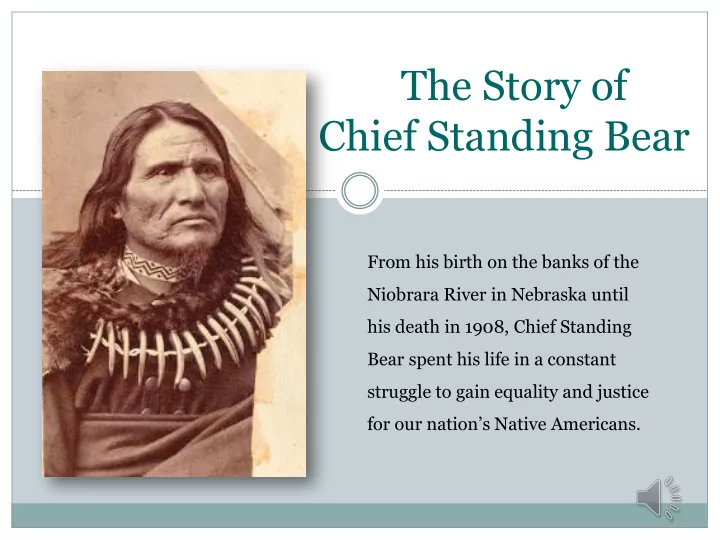
From his birth on the banks of the Niobrara River in Nebraska until his death in 1908, Chief Standing Bear spent his life in a constant struggle to gain equality and justice for our nation’s Native Americans.
The Story of Chief Standing Bear From his birth on the banks of the - - PowerPoint PPT Presentation
The Story of Chief Standing Bear From his birth on the banks of the Niobrara River in Nebraska until his death in 1908, Chief Standing Bear spent his life in a constant struggle to gain equality and justice for our nations Native Americans.
From his birth on the banks of the Niobrara River in Nebraska until his death in 1908, Chief Standing Bear spent his life in a constant struggle to gain equality and justice for our nation’s Native Americans.
Chief Standing Bear and the Ponca Tribe were forced in 1877 by federal treaty to leave their homeland in Nebraska for Indian Territory in what is now Oklahoma.
The hardship of travel, illness and the conditions of Indian Territory caused many members of the tribe to perish, including Chief Standing Bear’s son Bear Shield.
Determined to fulfill his son’s dying wish to be buried back in his homeland, Chief Standing Bear led thirty members of his tribe through subzero cold and storms back to their home in Nebraska.
The group was apprehended on the Omaha reservation by General Crook and moved to Fort Omaha in Omaha, Nebraska to await a forced return back to Oklahoma.
Chief Standing Bear with the assistance of local newspaperman Thomas Henry Tibbles and prominent Omaha attorneys filed for a writ of habeas corpus in Federal Court. Judge Elmer Dundy’s decision meant that Standing Bear became the first Native American to be recognized as a person in a federal court.
On October 20, 1977 Chief Standing Bear was selected for inclusion in the Nebraska Hall of Fame. The bust was created by artist Ted Long and dedicated
The Trial of Standing Bear is a 90 minute PBS program that was produced for national broadcast late in 1987. The Script for the movie was written by Vine Deloria, Jr. The Trial of Standing Bear is a docudrama that covers the journey of the 30 Poncas, their arrest by General George Crook, and their subsequent trial in Omaha, Nebraska.
The Chief Standing Bear Bridge built across the Missouri River between Nebraska and South Dakota near Niobrara, Nebraska homeland of Chief Standing Bear and the Ponca Tribe.
Beginning in 2007 McDonalds Corporation has partnered with NCIA to offer the Chief Standing Bear Essay Contest. Winning youth from around the state are honored at the Breakfast Commemoration
Winning essays are printed on thousands of McDonalds Tray Liners and distributed at stores across the state.
The Standing Bear Scholarship Fund was established to provide scholarships for Native American students at the University of Nebraska College
Ponca Chief Standing Bear whose name and deeds commemorate the importance
that are guaranteed under our Constitution.
Wakonda’s Dream is an opera that explores tensions that arise within contemporary Ponca society more than a century after the 1879 trial of Standing Bear, which serves as a conceptual backdrop to the main story. It delves into the fractured life of a contemporary Native American family who are emotionally torn by social prejudices and simultaneously shadowed by the memories of a tortuous Native American history.
The new medallion features Chief Standing Bear on one side and Abraham Lincoln on the other. The medallion will serve as a “Key to the City” for Lincoln.
"I Am a Man" chronicles what happened when Standing Bear set off on a six-hundred-mile walk to return the body of his only son to their traditional burial ground. Along the way, it examines the complex relationship between the United States government and the small, peaceful tribe and the legal consequences of land swaps and broken treaties, while never losing sight of the heartbreaking journey the Ponca endured. It is a story of survival---of a people left for dead who arose from the ashes of injustice, disease, neglect, starvation, humiliation, and termination. On another level, it is a story of life and death, despair and fortitude, freedom and patriotism. A story of Christian kindness and bureaucratic evil.
The Roman L. Hruska Courthouse is home to a historical display commemorating the trial of Ponca Chief Standing Bear. The display is located on the first floor of the Roman L. Hruska Courthouse in Omaha.
This story is the remarkable journey of legendary warrior Chief Standing Bear of the Ponca Nation, who fought injustice not with guns and arrows - but with
Footsteps" weaves storytelling, re-creations and present-day scenes to explore a little-known chapter in American history. "The film has much to say about present-day issues of human rights and what it means to be an American," says producer Christine Lesiak.
Standing Bear of the Ponca tells the story of this historic leader, from his childhood education in the ways and traditions of his people to his trials and triumphs as chief of the Bear Clan of the Ponca tribe. “Virginia Driving Hawk Sneve has told a terribly important, complex story of what it means to be human—to be a father, a leader, a civil rights hero— in simple, powerful, unadorned language accessible to one and all, but especially to children.”—Joe Starita, author of “I Am a Man”: Chief Standing Bear’s Journey for Justice
Trail Group Meeting at Omaha National Park Service Office
2013-LR 171 NOW, THEREFORE, BE IT RESOLVED BY THE MEMBERS OF THE ONE HUNDRED THIRD LEGISLATURE OF NEBRASKA, FIRST SESSION: …..That the Legislature supports the development and designation of a continuous Chief Standing Bear Trail from Nebraska to Oklahoma and recognizes that the story of Nebraska's
promoting the cultural well-being of all Nebraskans. 2014-HR 6042 …..Be it resolved by the House of Representatives of the State of Kansas: That we support the development and designation of a continuous Chief Standing Bear Trail from Nebraska to Oklahoma and recognize that the story of original Native American inhabitants is vital to understanding the rich history of Kansas and promoting the cultural well-being of all Kansans. 2015-House Resolution 1008 NOW, THEREFORE, BE IT RESOLVED BY THE HOUSE OF REPRESENTATIVES OF THE 1ST SESSION OF THE 55TH OKLAHOMA LEGISLATURE, THE SENATE CONCURRING THEREIN: THAT in further recognition of the important role of Chief Standing Bear in American history, the State of Oklahoma supports HCR1008 the development and designation
S.479 Introduced 2015 by US Senator Deb Fischer
A bill to amend the National Trails System Act to direct the Secretary
Chief Standing Bear National Historic Trail, and for other purposes.
H.R. 984 National Historic Trail Feasibility Study (Passed 2015) The United States House of Representatives has passed legislation directing the Secretary of the Interior to conduct a feasibility study for the Chief Standing Bear National Historic
American and United States history. Establishing a trail in his name would be an outstanding way to recognize his contributions to our great land. The bill was approved by the House in April and is now awaiting action in the Senate. Nebraska Congressman Jeff Fortenberry
2015-Symposium in Partnership with UNL Center for Great Plains Studies
The Center for Great Plains Studies at the University of Nebraska and the Nebraska Commission on Indian Affairs teamed up to bring this exceptional gathering of Native American talent to Lincoln, Neb., on May 14-15. The 2015 Great Plains Symposium “Standing Bear and the Trail Ahead” explored the status, challenges, and especially the opportunities and prospects that Native Americans and First Peoples face going forward.
The Ponca Tribe of Nebraska, which had its land taken away in the late 1800s, is getting a trace back: a 19.5-mile trail segment in Southeast
Trails Foundation and the Homestead Conservation and Trail Association to assume ownership of the trail segment, which stretches from just south of Beatrice to the Nebraska-Kansas border. Lincoln Journal-Star
The Nebraska Commission on Indian Affairs is collaborating with the Mid-America Transportation Center (MATC) and the University of Nebraska-Lincoln’s (UNL) History Department, institutions with a history of outreach and education relating to Nebraska’s Native American tribes. Through this partnership, MATC and UNL will develop education and outreach initiatives, such as building a prototype digital archive and creating educational apps for Chief Standing Bear Trail. These applications would provide travelers physical and virtual information about the story of Chief Standing Bear and the trail that he traveled. These materials will also direct local and regional travelers to a variety of trail locations where historic markers and additional educational materials will be available.
The trail will provide the opportunity to be
associations can be made. Additionally, it will provide an opportunity for tribal members, descendants, the local and regional community and others to promote the Ponca culture. The project was in the final stages of completion as of winter 2015. The spring growing season will transform the area with native prairie sprouting all through the site. This will include the earth lodge and the establishment of the native plants, which will create a memorable experience.
The Ponca Relocation Journey will be illustrated outside of the State Office Building on Centennial Mall by a series of markers indicating point by point the tribe’s journey through the state.