The status of LHCb Construction The status of LHCb Construction R. - - PowerPoint PPT Presentation

the status of lhcb construction the status of lhcb
SMART_READER_LITE
LIVE PREVIEW

The status of LHCb Construction The status of LHCb Construction R. - - PowerPoint PPT Presentation

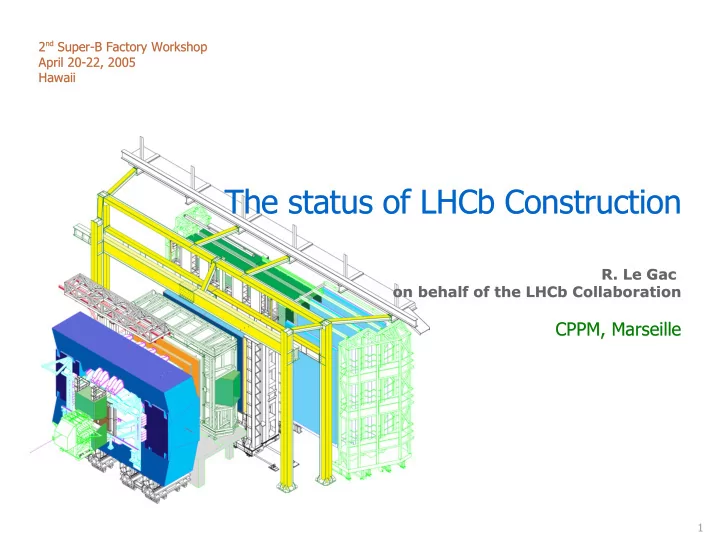
2 nd 2 nd Super-B Factory Workshop Super-B Factory Workshop April 20-22, 2005 April 20-22, 2005 Hawaii Hawaii The status of LHCb Construction The status of LHCb Construction R. Le Gac R. Le Gac on behalf of the LHCb Collaboration on


slide-1
SLIDE 1

1

The status of LHCb Construction The status of LHCb Construction

  • R. Le Gac
  • R. Le Gac
  • n behalf of the LHCb Collaboration
  • n behalf of the LHCb Collaboration

CPPM, Marseille CPPM, Marseille

2 2nd

nd Super-B Factory Workshop

Super-B Factory Workshop April 20-22, 2005 April 20-22, 2005 Hawaii Hawaii

slide-2
SLIDE 2

2

LHC Environment LHC Environment

LHC: LHC:

Proton-proton collision Proton-proton collision Bunch crossing rate 40 MHz Bunch crossing rate 40 MHz

Luminosity: Luminosity:

(first two years) (first two years) (nominal) (nominal)

At high luminosity, pile-up of pp At high luminosity, pile-up of pp interactions per bunch crossing: interactions per bunch crossing:

LHCb chooses LHCb chooses Should be available from day one Should be available from day one 2fb 2fb-1

  • 1 per year (

per year (10 107

7 second)

second)

LHC machine had a problem with cryogenic plumbing, now resolved. LHC machine had a problem with cryogenic plumbing, now resolved. First beam expected in 2007. First beam expected in 2007. s=14 TeV

1−2×10

33cm −2s −1

10

34cm −2s −1

inel=80mb 2×10

32cm −2s −1

pp interaction/crossing

slide-3
SLIDE 3

3

b-production b-production

Pair of quarks are mostly produced Pair of quarks are mostly produced in the forward/backward direction: in the forward/backward direction:

produced per year produced per year

LHCb is a forward spectrometer: LHCb is a forward spectrometer:

Acceptance 10-300 mrad Acceptance 10-300 mrad Efficient B Efficient B-mesons

  • mesons trigger

trigger Good Kaon/pion identification Good Kaon/pion identification Good invariant mass resolution Good invariant mass resolution Good proper time resolution Good proper time resolution bb=500b 10

12bb

bb

slide-4
SLIDE 4

4

LHCb LHCb

slide-5
SLIDE 5

5

UX85

UX85...

...

The UX85 cavern mid April '05

slide-6
SLIDE 6

6

Magnet

Warm magnet Coil shape follows acceptance ∫Bdl = 4 Tm Power 4.2 MW Iron yoke 1500 Tons Nominal current Nov 'O4

slide-7
SLIDE 7

7

Beam Pipe Beam Pipe

Located in the high rapidity region Located in the high rapidity region where particle density is high. where particle density is high. Main source of secondary particles ! Main source of secondary particles ! Minimize the amount of material using Be. Minimize the amount of material using Be.

slide-8
SLIDE 8

8

Status of the Beam Pipe Status of the Beam Pipe

Al window (prototype) UX85/1 Al bellows (prototype)

In production. In production. Installation in UX85 in Q2 '06 Installation in UX85 in Q2 '06

slide-9
SLIDE 9

9

Vertex locator... Vertex locator...

Key element surrounding the IP: Key element surrounding the IP:

Measure the position of the primary Measure the position of the primary and the B and the Bd,s

d,s vertexes

vertexes Used in L1 trigger. Used in L1 trigger.

slide-10
SLIDE 10

10

Overview of the vertex locator Overview of the vertex locator

21 pairs of silicon strip detectors 21 pairs of silicon strip detectors arrange in two retractable halves: arrange in two retractable halves:

Strips with an R- Strips with an R-φ φ geometry: geometry:

— R strip pitch: 40-102 µm

R strip pitch: 40-102 µm

— φ

φ strip pitch: 36-97 µm strip pitch: 36-97 µm 172k channels. 172k channels.

Operated: Operated:

In vacuum In vacuum separated from beam vacuum by an Al foil separated from beam vacuum by an Al foil Close to the beam line (7 mm) Close to the beam line (7 mm) Radiation Radiation ≤ ≤ 1.5 1.5× ×10 1014

14 n

neq

eq/cm² per year

/cm² per year Cooled at -5 °C Cooled at -5 °C

slide-11
SLIDE 11

11

Status of the vertex locator Status of the vertex locator

Many others pieces in production. Many others pieces in production. Installation in UX85: November '05 Installation in UX85: November '05

slide-12
SLIDE 12

12

Sensors Sensors

Characteristics: Characteristics:

n+n type n+n type Double metal layers Double metal layers thickness 300 µm thickness 300 µm Laser cut Laser cut

Front-end electronics (beetle chip) Front-end electronics (beetle chip) mount on a thin kapton sheet mount on a thin kapton sheet connected to the sensor via pitch connected to the sensor via pitch adapters adapters Alignment of complete half detectors in Alignment of complete half detectors in test beam in June ’06 test beam in June ’06

slide-13
SLIDE 13

13

Tracking... Tracking...

Key elements to find tracks and to measure Key elements to find tracks and to measure their momentum. their momentum.

slide-14
SLIDE 14

14

Overview of the tracking system Overview of the tracking system

Trigger Tracker: Trigger Tracker:

— Microstrip silicon detector

Microstrip silicon detector

— 144k channels

144k channels

Three T stations: Three T stations:

Inner tracker: Inner tracker:

— Microstrip Silicon detector

Microstrip Silicon detector

— 130k channels

130k channels Outer tracker: Outer tracker:

— Straw tube (5 mm)

Straw tube (5 mm)

— 56k channels

56k channels

Trigger Tracker T Stations Outer Inner

slide-15
SLIDE 15

15

Trigger Tracker Trigger Tracker

1.4 m 1.2 m 0° layer

Microstrips silicon detector Microstrips silicon detector

Two groups of two layers Two groups of two layers (0°, +5°, -5°, 0°) separated by 30 cm (0°, +5°, -5°, 0°) separated by 30 cm Strip pitch 198 µm Strip pitch 198 µm Strip length 11, 22 and 33 cm Strip length 11, 22 and 33 cm Radiation Radiation ≤ ≤ 9 9× ×10 1012

12 n

neq

eq/cm² over 10 years

/cm² over 10 years Cooled at -5 °C Cooled at -5 °C

Installation in UX85: July '06 Installation in UX85: July '06

slide-16
SLIDE 16

16

T Station: inner tracker part T Station: inner tracker part

Microstrips silicon detector: Microstrips silicon detector:

Same sensors as Trigger Tracker Same sensors as Trigger Tracker Four layers (0°, +5°, -5°, 0°) Four layers (0°, +5°, -5°, 0°) Strip length 11, 22 cm Strip length 11, 22 cm Radiation Radiation ≤ ≤ 9 9× ×10 1012

12 n

neq

eq/cm² over 10 years

/cm² over 10 years Cooled -5 °C Cooled -5 °C

Installation in UX85 June '06 Installation in UX85 June '06

1.2 m 0.4 m

slide-17
SLIDE 17

17

T station: outer tracker part T station: outer tracker part

Straw tubes: Straw tubes:

Four double layers (0°,+5°,-5°,0°) Four double layers (0°,+5°,-5°,0°) Staw length 5 m read on both sides Staw length 5 m read on both sides Ar/CF Ar/CF4

4/CO

/CO2

2

Installation in UX85 start November '05 Installation in UX85 start November '05

5 m

slide-18
SLIDE 18

18

Tracking performances for long tracks Tracking performances for long tracks

<Efficiency>: 94% <Ghost rate>: 3% <δp/p>: 0.37%

B-decay spectrum

slide-19
SLIDE 19

19

RICH... RICH...

Key elements to identify pion and kaon in Key elements to identify pion and kaon in the momentum range the momentum range p∈[2,100]GeV/c

slide-20
SLIDE 20

20

Overview of the RICH Overview of the RICH

RICH system divided in two detectors equipped RICH system divided in two detectors equipped with 3 radiators to cover the full acceptance and momentum range: with 3 radiators to cover the full acceptance and momentum range:

RICH1: RICH1:

— Acceptance:

Acceptance:

— Aerogel + C

Aerogel + C4

4F

F10

10 radiators

radiators

— 200k channels

200k channels RICH2: RICH2:

— Acceptance:

Acceptance:

— CF

CF4

4 radiator

radiator

— 295k channels

295k channels V 2−250 mrad p 2−60 GeV/c V 15−100 mrad p 17−100 GeV/c

slide-21
SLIDE 21

21

RICH1 RICH1

RICH1 in production RICH1 in production Installation in UX85 start end April '05 Installation in UX85 start end April '05

slide-22
SLIDE 22

22

RICH2 RICH2

7 m

Transport and installation in July '05 Transport and installation in July '05

slide-23
SLIDE 23

23

Photon detector HPD Photon detector HPD

Novel photodetector: Novel photodetector:

32 32× ×32 pixel sensor array (500 32 pixel sensor array (500× ×500 µm²) 500 µm²) 20 kV operation voltage 20 kV operation voltage Demagnification factor ~5 Demagnification factor ~5

Production of ~500 tubes started. Production of ~500 tubes started.

N2 radiator

slide-24
SLIDE 24

24

Particle Identification Particle Identification

Kaon identification efficiency: <K Efficiency>: 88% <π misidentification> 3%

slide-25
SLIDE 25

25

Calorimeters... Calorimeters...

Key element to identify Key element to identify ,  ,  and to measure their energy. and to measure their energy. Used in L0 trigger. Used in L0 trigger.

slide-26
SLIDE 26

26

Overview of the Calorimeters Overview of the Calorimeters

System subdivided in 3 parts: System subdivided in 3 parts:

Scintillating Pad Detector (SPD) Scintillating Pad Detector (SPD) and Preshower: and Preshower:

— Two plans of scintillator pads

Two plans of scintillator pads separated by a 1.5cm lead separated by a 1.5cm lead converter converter Electromagnetic Calorimeter (ECAL): Electromagnetic Calorimeter (ECAL):

— Shashlik types,

Shashlik types,

— Lead+ scintillator tiles

Lead+ scintillator tiles

— 25 X

25 X0 Hadronic calorimeter (HCAL): Hadronic calorimeter (HCAL):

— Iron + scintillator tiles

Iron + scintillator tiles

— 5.6

5.6 λ λI

I

A total of 19k channels readout by A total of 19k channels readout by Wave Length Shifter fibres connected Wave Length Shifter fibres connected to PMs or MaPMTs. to PMs or MaPMTs.

particles PMT scintillators fibers
slide-27
SLIDE 27

27

Status of the Calorimeters Status of the Calorimeters

Installation is going on in UX85 Installation is going on in UX85

~13 m

slide-28
SLIDE 28

28

11 April 2005

slide-29
SLIDE 29

29

Reconstruction efficiency for Reconstruction efficiency for  0

Resolved Merged

slide-30
SLIDE 30

30

Muons... Muons...

Key elements to identify muon Key elements to identify muon Used in L0 trigger. Used in L0 trigger.

slide-31
SLIDE 31

31

Overview of the Muon detector Overview of the Muon detector

Subdivided in 5 muon stations Subdivided in 5 muon stations equipped with: equipped with:

MWPC with 4 gaps MWPC with 4 gaps Triple GEM (M1R1) Triple GEM (M1R1) 1368 chambers, 20 different types 1368 chambers, 20 different types 26k logical channels 26k logical channels

Geometry is projective in Geometry is projective in x x and y to and y to ease the search of muon candidates in ease the search of muon candidates in the L0 Trigger. the L0 Trigger. M1 is equipped with pads M1 is equipped with pads M2-M5 with strips M2-M5 with strips

M1 M2 M3 M4 M5

Cross-section of a MWPC

slide-32
SLIDE 32

32

Status of the Muon detector Status of the Muon detector

Chambers are in production Chambers are in production Start installation in January '06 Start installation in January '06

slide-33
SLIDE 33

33

Triggers... Triggers...

40 MHz 1 MHz 40 kHz 2 kHz to tape Level-1: Impact parameter Rough pT ~ 20% HLT: Final state reconstruction Calorimeter Muon system Pile-up system Vertex Locator Trigger Tracker Level 0 objects Full detector information Level-0: Level-0: p pT

T of

  • f

µ, e, h, µ, e, h, γ γ

}

}

Custom Electronics Events Filter Farm

slide-34
SLIDE 34

34

HLT Output rate HLT Output rate

HLT rate Event type Use for physics 200 Hz Exclusive B Control channels (tagging,...) B (core program) 600 Hz High mass dimuon Tracking 300 Hz D* Hadron PID Charm (mixing+CPV) 900 Hz Trigger B (data mining) Use for calibration/systematics bJ/ψX (unbiased) Inclusive b (eg bµ)

slide-35
SLIDE 35

35

Summary Summary

LHCb is a single arm forward detector LHCb is a single arm forward detector to study CP violation and rare decays in to study CP violation and rare decays in the beauty sector. the beauty sector. The installation is progressing well. The installation is progressing well. We will be ready for the first proton- We will be ready for the first proton- proton collisions in 2007. proton collisions in 2007.