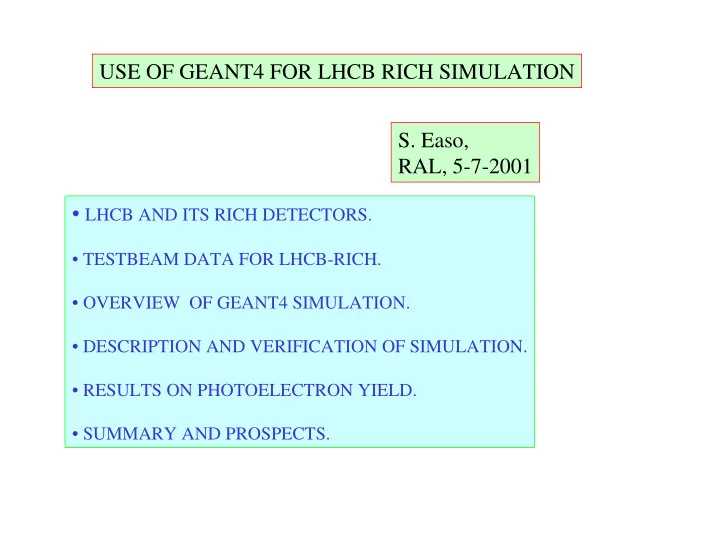
USE OF GEANT4 FOR LHCB RICH SIMULATION S. Easo, RAL, 5-7-2001 LHCB - - PowerPoint PPT Presentation

use of geant4 for lhcb rich simulation s easo ral 5 7 2001
SMART_READER_LITE
LIVE PREVIEW

USE OF GEANT4 FOR LHCB RICH SIMULATION S. Easo, RAL, 5-7-2001 LHCB - - PowerPoint PPT Presentation

USE OF GEANT4 FOR LHCB RICH SIMULATION S. Easo, RAL, 5-7-2001 LHCB AND ITS RICH DETECTORS. TESTBEAM DATA FOR LHCB-RICH. OVERVIEW OF GEANT4 SIMULATION. DESCRIPTION AND VERIFICATION OF SIMULATION. RESULTS ON PHOTOELECTRON


slide-1
SLIDE 1

USE OF GEANT4 FOR LHCB RICH SIMULATION

  • S. Easo,

RAL, 5-7-2001

  • LHCB AND ITS RICH DETECTORS.
  • TESTBEAM DATA FOR LHCB-RICH.
  • OVERVIEW OF GEANT4 SIMULATION.
  • DESCRIPTION AND VERIFICATION OF SIMULATION.
  • RESULTS ON PHOTOELECTRON YIELD.
  • SUMMARY AND PROSPECTS.
slide-2
SLIDE 2

Introduction to LHCb and its RICH Detectors

  • LHCb : Precision Μeasurements of CP Asymmetries in B-Decays.
  • Particle ID: Essential component of LHCb. Ex: Separate Pions and Kaons in data.
  • Signal: Bd --> pi+ pi - . Backgrounds: Bd -->K+ pi - ,

Bs-->K+ pi- , Bs -->K+K- .

  • Signal: Bs --> Ds

+ K - Background: Bs --> Ds + pi - .

slide-3
SLIDE 3

LHCB Detector

  • Two RICH detectors covering polar angles 10 - 330 mrad.
  • Upstream Detector, RICH1 : Aerogel + C4F 10 for momentum 1- 65 GeV/c.
  • Downstream Detector, RICH2: CF4 for particles upto 100 GeV/c.
  • Combination of Tilted Spherical mirrors and plane mirrors.
  • Photon Detection: HPDs which cross-focus electrons on Silicon pixel detectors.
  • HPD coverage 2.9 sq. meters : granularity 2.5 sq. mm, 340000 channels.
slide-4
SLIDE 4

RICH TESTBEAM SETUP

slide-5
SLIDE 5

TESTBEAM DATA SET

  • Data Taken in June 1999.
  • RICH1 Geometry, C410 Radiator, 120 GeV/c Pion(-) Beam.
  • Three 80 mm Hpds with 61- pixel Silicon Anodes.
  • Analogue Readout.
  • Run Used: Pressure= 164 mbar, Temp = 19 degree C.

(ring entirely on one of the HPDs).

  • Results from data Analysis and Fortran Simulation are

in an LHCb internal note and are quoted in the RICH TDR.

slide-6
SLIDE 6

OVERVIEW OF THE SIMULATION Simulation:GEANT4 Graphics: OPENGL

slide-7
SLIDE 7

OVERVIEW OF THE GEANT4 SIMULATION

  • I used the standard GEANT4 procedures as much as possible.
  • Some of the GEANT4 ‘Physics Processes’ depend on the

atomic properties of the materials used in the program.

  • Certain ‘ process customizations’ were necessary

for simulating specific aspects of the RICH Test Beam Detector. I shall be describing these during this presentation.

  • All Histograms from GEANT4 are made using LIZARD.
  • The main parts of the Simulation procedure are:

Photon Generation, Photon transportation, Photoelectron generation and creation of hits by the electrons.

slide-8
SLIDE 8

Generation of Photons

Mean in Simulation=20.87 mrad. (Using HERA-B parametrization for Ref. Index of C4F10 ) In Real Data: Cherenkov Angle=20.42 + 1.02mrad Cherenkov Angle in Radians at Photon Generation.

  • Some of the photons generated,

are killed before they reach the Photo Detector by processes which depend on the Photon energy.

slide-9
SLIDE 9

Optical Reflection at the Mirror

Red: Photons Before Reflection at Mirror. Blue: Photons After Reflection at Mirror.

Photon Wave Length in nm Number

  • f Photons

nm nm

Solid Curve: After Mirror/Before Mirror. Dots: Mirror Reflectivity.

Ratio: Blue/Red

slide-10
SLIDE 10

Optical Transmission Through Quartz

Number

  • f Photons

nm nm Photon Wave Length in nm

Red: Photons before entering Quartz. Blue: Photons just before exiting quartz.

Ratio: Blue/Red Loss from Reflection at Quartz Entrance and from Transmission.

slide-11
SLIDE 11

HPD Simulation

  • We have the data for the Quantum Efficiency and the data for

parametrizing the cross-focussing of the photoelectrons.

  • The Standard Geant4 Photoelectric process is not suitable for this
  • application. (It relies on the atomic properties of the photocathode.)
  • I implemented a process which generates electrons using

the above data as input. (This process is a class derived from the G4DiscreteProcess class.)

slide-12
SLIDE 12

HPD SIMULATION Green Lines: Photons. Red Lines: Photoelectrons. Blue Circles: Frame of HPD. Quartz Window, Photocathode and Silicon Detector are shown also. Simulation Picture using OPENGL.

slide-13
SLIDE 13

Hpd Photoelectric Effect Number of Photons

Red: Photons incident on Photocathode. Blue: Photons converted to Photoelectrons.

nm nm Photon Wave Length in nm Ratio: Blue/ Red

Solid Line: Ratio Red Boxs: Quantum Efficiency

slide-14
SLIDE 14

HPD Hit creation

  • The standard Geant4 Process uses the material properties of

Silicon to calculate the energy loss. For the current application, I just wanted to create hits from the photoelectrons which have upto 20 keV/c momentum.

  • I created a special simple process for the Hpd Silicon

by which, low momentum charged particles loose all their momentum and die. This shall be modified in the future. It also takes care of the effects of backscattering.

  • The Silicon pixels are constructed as sensitive volumes

in the ‘Geant4 ReadOut’ geometry so that the standard Geant4 digitization procedure finds the correct pixel hit. (The few dead pixels in the data are kept insensitive).

slide-15
SLIDE 15

Preliminary Estimate of Simulation uncertainty

  • Ref. Index

parametrization 0.52 0.48 Hpd1 Hpd2 Quantum Efficiency 5% 0.44 0.43 change Cathode non-uniformity 0.10 0.02 Total 0.69 0.64 Main sources of uncertainty

slide-16
SLIDE 16

Photoelectron Yield Real data GEANT4 Fortran Simulation Simulation Hpd1 8.50 + 0.08 8.67 + 0.69 8.53 + 0.61 Hpd 2 7.27 + 0.04 7.01 + 0.64 7.19 + 0.56

slide-17
SLIDE 17

Summary and Prospects

  • The LHCb-RICH testbeam is simulated using GEANT4.
  • The Simulated photoelectron yield agrees with that from data.
  • Some of the processes developed for this testbeam simulation

are useful for LHCb - RICH detector simulation as well.

  • The simulation all the detectors in LHCb is expected to be done

using GEANT4 in the GAUDI framework. Hence more interaction between the GEANT4 collaboration and LHCb software group are expected in the future.