
SLIDE 1
The Six-Day Spacecraft: Creating a Plug-and-play approach for aerospace systems y
James Lyke Air Force Research Laboratory 23 September 2008
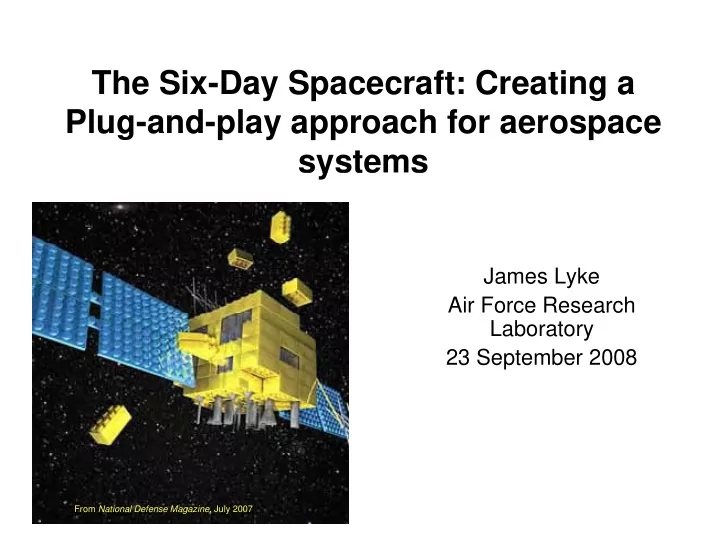
From National Defense Magazine, July 2007
The Six-Day Spacecraft: Creating a Plug-and-play approach for - - PowerPoint PPT Presentation
The Six-Day Spacecraft: Creating a Plug-and-play approach for aerospace systems y James Lyke Air Force Research Laboratory 23 September 2008 From National Defense Magazine , July 2007 Create a spacecraft in less than one week Problem
From National Defense Magazine, July 2007
Source: http://www.ssloral.com/html/products/satint.html
Courtesy of Michael Enoch, LM
DESIGN FABRICATE TEST/INT
3 Months 6 Months 2 Months 11 months
+ + =
DESIGN
TEST/INT
3 Months 0 Months 2 Months 5 months
+ + =
Eliminate wiring harnesses ith b ilt bl
with pre-built programmable wiring Integrate plug and play Integrate plug-and-play components into sockets of pre-built panels Modularize power system components, add “smart p combiners” Programmable communications with communications with software radio technology
Component Icons Connections
Mission Goals and Requirements Component Capabilities 2 3
Drag & Drop Design Automa
2.
SPACE- CRAFT PROFILER
3.
AUTO- GENERATE “EVERYTHING”
tic Verifica erate
PROFILER
************************************************************************* * CATEGORY RULES * ************************************************************************* predCategory( catidReferenceFrame ). predElementOf( catidReferenceFrame, catidReferenceFrame ). predCategory( catidCoordinateSystem ).
ules Engine
ation Ite
1.
predElementOf( catidCoordinateSystem, catidCoordinateSystem ). ************************************************************************* * INTERFACE RULES * ************************************************************************* predInterface( iidIEnvironmentObject ). predElementOf( iidIEnvironmentObject, catidEnvironment ). predInterface( iidIMomentumStorage ). predElementOf( iidIMomentumStorage, catidActuator ). *************************************************************************
Verification Ru
Performance Modeling
MISSION CAPTURE
4.
COMPARE SIM VS THE
* COMPONENT RULES * ************************************************************************* predComponent( clsidCEarth ). predElementOf( clsidCEarth, catidReferenceFrame ). predElementOf( clsidCEarth, catidEnvironment ). fncIn( iidIEnvironmentObject, clsidCEarth ).
Design V
SIM VS. THE ORIGINAL MISSION
“ l tf ” “platform”
“platform” plug-and-play component plug-and-play component
driver
USB interface chip component
electronic datasheet
component
Appliqué Sensor Interface Module (ASIM)
interface module USB interface chip interface module
Payload
SPA-U link adio SPA U link SPA-S link
Hi h d
a-h spacecraft bus components
Command and data handling
ra
High-speed downlink
p
g
e f c d h g a b
Spacecraft bus
e f
Payload
SPA U link
ay oad
ensor
ra d io SPA-U link SPA-S link
High-speed downlink
a-h spacecraft bus components
Appliqué Se nterface Mo (ASIM)
Command and data handling
downlink
A In
e f c d h g a b
Spacecraft bus
Your
nsor dule
Your Device here
Appliqué Sen Interface Mo (ASIM)
Test bypass engine state Test bypass
8031 memory map Bypass storage Non-volatile memory: (XTEDS) Time
synchronization
state machine machine x-interface SPA-x Non-volatile memory: RAM memory 8 Processor (ex. 8031) Power mgt (ex. “U” = USB) ser t ut put ser er t memory: program/data Digital Use in/output Analog User inpu Analog User outp Power Use
Misc.Use in/output
RXN X Hub C&DH RXN Y C&DH RXN Z H b Therm Hub Simple Hub Hub Camera Therm S ft R di Software Radio
ASIM USB1.1hub ASIM Synchronization Physical Layer Power Synchronization distribution Physical Layer Matrix Power distribution
Interhub
Mission Code / Scripts
Application #1 Application #2 Application #N Application #i
Data Model
S M (SM) SM SM SM
Processor Manager
Task Manager Data Manager
Satellite
Sensor Manager (SM) SM SM SM
Manager
GNC Comp C t RF CPU Camera Thermometer Current Monitor
To simplify the testing of complex systems, a “test bypass” feature is integrated in the SPA plug-and-play interfaces. Test bypass allows an external control (simulation) to provide substituted values during test, similar to the test/debug methods used in
SPA (plug-and-play) thermometer
g g developing software. Test bypass is particular useful in cases where an actual test involving a device’s native sensors and actuators is impractical.
embedded face data source Applique sensor interface module A/D
pre-amp / filter
xTEDS processor SPA interf
normal normal bypass
test bypass
normal
interface
Plug and play space Approved SPA Interface Standards Plug-and-play space components Hardware in-the-loop Automated Mission & S/c Design
Adaptive Wiring Manifold Appliqué
p
Flt Demos
Rapid Satellite Cell Technology Cell
Sensor Interface Module (ASIM) SPA-U Hub
“Flat-Sat” Cell
RESE-1 TS-3 SAE PnPSat
Th GNC Comp Current RF Application #1 Application #2 Application #N Mission Code / Scripts Application #i Sensor Manager (SM) SM SM SM CPU Processor Manager Task Manager Data Manager Satellite Data ModelXML-based Electronic Data Sheet (xTEDS)
Objectives
– Dissect and examine every process – Develop modular systems & automated tools
Your
sor ulePlug-and-play Technology
Camera Thermometer Current MonitorValidate plug-and-play architectures
and operational concepts prior to build
Your Device here
Appliqué Sens Interface Mod (ASIM)RIMS Ground Station
RESE 1 S b bit l Fli ht E i t RESE-1 Suborbital Flight Experiment – Sounding Rocket: Single stage Terrier – Launch Site: White Sands L h D t S t 2007 – Launch Date: Sept 2007 – Max Altitude: ~ 250,000 ft – Duration above 90,000 ft: ~100 sec
RESE-1 Plug-and-Play Experiment
4 SPA-U spacecraft sensors: SPA hardware integrated into controller cards and configured for space in 4 months
Magnetometer Two controller cards with integrated SPA-U hub and ASIMs integrated on Magnetometer Tri-axial S G Thermistors bottom of composite deck Accelerometer Strain Gauges
AFRL “Smart Deck”
SPA-U PnP Reaction Wheel Electronics SPA-U PnP Rate Sensor (Specific PnP exp’ts TBD based on delivery by May 07) AeroAstro SPA-U Sun Sensor PnP Rate Sensor
2007
y y y )
MSI PnP IPDR Avionics
Dimensions: 9 x 9 x 5.75
multiple processing nodes for redundancy S i /SPA S li k b t S P d C&DH f b k – Spacewire/SPA-S link between Sensor Processor and C&DH for backup downlink capability of HSI data
– Reaction wheel electronics rate sensor memory stick data storage AeroAstro – Reaction wheel electronics, rate sensor, memory stick data storage, AeroAstro Sun Sensor, or other (selection in progress)
configurations to support requirements for g pp q different stages of the project – Flatsat configuration – Assembled configuration – Other configurations possible
panels to be rotated from horizontal (flat) to vertical (folded) – Securing hinged joints with precision pins
integrated and tested in parallel before final integrated and tested in parallel before final assembly
ASIM Accelerometers, thermostats, etc. ASIM TT&C ASIM Star Tracker
Spacecraft Panel
SPA U/ S
Spacecraft Panel
SPA-U/-S Network Backbone
ASIM ASIM WSSP 6GFlop Processor WSSP 6GFlop Processor
Spacecraft Panel
Sun Sensors Reaction Wheels
Battery Assembly (2) Magnetometer
components shown components shown
– By recessing electrical infrastructure and harnessing, we significantly increase flexibility for component and experiment mounting
Coarse Sun Sensor Module (2) Transceiver and Comsec Primary Experiment (Example Only)
– Initial version of PnPSat may have fewer spacecraft components than the version shown
Solar Array T R d (2) HPCOO (2) y Torque Rod (3) Charge Control Electronics Reaction Wheel and Electronics (3)
HCB
Hub Hub HWIL
HCB
SpW HWIL
HCB
SpW HWIL
HCB
SpW
HCB
(a) (b)
HCB
(c)
C B A C A B A C B A C B B programmed blank programmed
C B A B A B C
C B A B A B C V
Faulty connection C B A B C Faulty connection A C New good connection
E D E E D
E D F E D F F E D
AFRL developed a simple demonstration of the adaptive wiring technology using two large “panels” and over 100 latching microelectromechanical switches grouped into several sw We were able to successfully move switches,grouped into several sw. We were able to successfully move persistent (non-volatile) copper pathways from port to port
Control ASIC MEMS switch
Switchbox Switchbox Manifold
Adaptive Wiring
Wiring Manifold
RF
RF
RF
RF
IF-conv IF-conv decrypt
RF
IF-conv En/d
high data rate (< 620 Mbit/sec) Very high data rate <10 Gbit/sec “SPA-10” (future) ponents ( 620 Mbit/sec) SPA-S e of comp low data rate (< 1 Mbit/sec) erformanc ( ) SPA-U Pe Very low data rate (< 10 kilobit/sec) “SPA-1” (future) N b f t Number of components
SPA-y Network Bridge Node SPA-x Network
PowerPC PowerPC PowerPC PowerPC DDR2 DDR2 DDR2 DDR2 Space system ace Space system ace node configuration
C
C
User portal
SPA-10
User portal User portal
SPA-10 SPA-10
BRAM BRAM BRAM BRAM
User-available FPGA fabric
SPA-10
User-available FPGA fabric
SPA-10
10gbps 10gbps 10gbps
10gbps Core MPP block
p1 p2 p3 p18 p19
XTEDS
Code bases FPGA static
User l i
PowerPC PowerPC
User User User
PowerPC PowerPC DDR2 DDR2 DDR2 DDR2 Space system ace Space system ace node configuration
XTEDS
bases static
logic
User portal
SPA-10
User portal User portal
SPA-10 SPA-10 User-available FPGA fabric
SPA-10
User-available FPGA fabric
SPA-10 BRAM BRAM BRAM BRAM
10gbps 10gbps 10gbps Core MPP block
User input/output
time
Test bypass
User Device power
p1 p2 p3 p18 p19
– Standard drafts – Education / training – Workshop coordination – Community indexes D t b f ft t lib i d i id – Databases for software, component libraries, design aids
– Secretariat administrative roles for brokering the standards to a publishable form publishable form – Supplemental IT support to create the public and member only sections of the website and support the databases necessary – Manpower to create the documents, evolve to a useable form p (ex. In PnP, anyone smart enough to create the document is dedicated to creating the technology – sound familiar?)
S t i t f lf d i ti l t f t k – Smart interfaces, self-description, casual arrangement of network element, complexity hiding and encapsulation, robust software infrastructure (SDM) – Push-button toolflow (embodied in the Mission Sattelite Design Toolkit) – Push-button toolflow (embodied in the Mission Sattelite Design Toolkit)