Plug-In Folly Part 5 by Pat Murphy, Plan Curtail Part 5A: Conclusion - - PDF document

plug in folly part 5 by pat murphy plan curtail part 5a
SMART_READER_LITE
LIVE PREVIEW

Plug-In Folly Part 5 by Pat Murphy, Plan Curtail Part 5A: Conclusion - - PDF document

Plug-In Folly Part 5 by Pat Murphy, Plan Curtail Part 5A: Conclusion Plug-In Vehicles the Score C1 A 2012 Congressional Budget Office report on plug-ins says that the lifetime costs to consumers of an electric vehicle are generally


slide-1
SLIDE 1

Plug-In Folly Part 5 by Pat Murphy, Plan Curtail November 2015 Conclusion Page 1 of 9

Part 5A: Conclusion – Plug-In Vehicles – the Score

C1

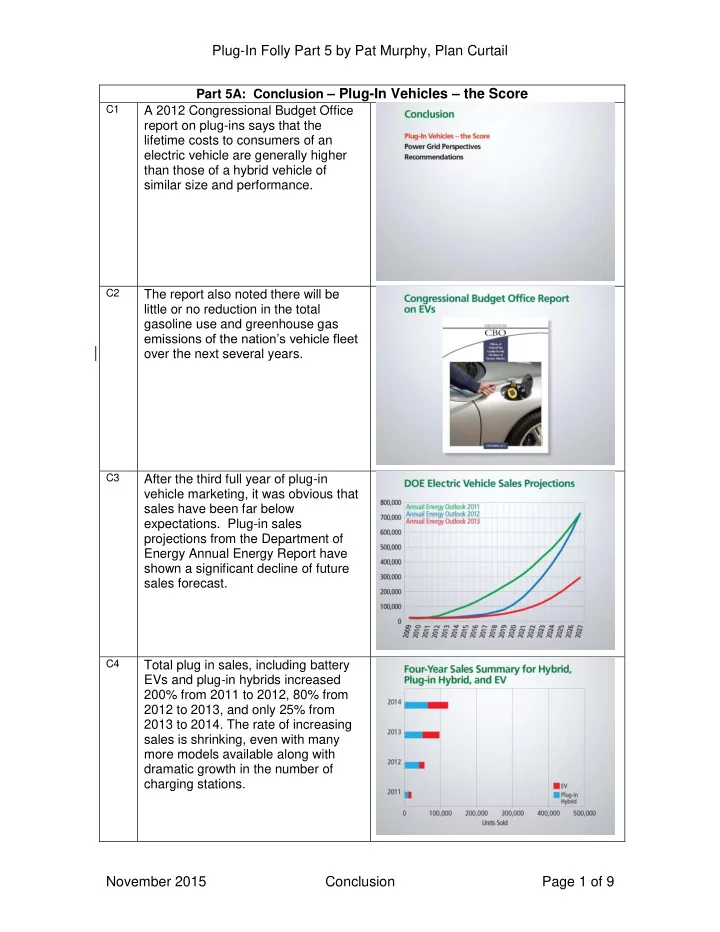
A 2012 Congressional Budget Office report on plug-ins says that the lifetime costs to consumers of an electric vehicle are generally higher than those of a hybrid vehicle of similar size and performance.

C2

The report also noted there will be little or no reduction in the total gasoline use and greenhouse gas emissions of the nation’s vehicle fleet

  • ver the next several years.

C3

After the third full year of plug-in vehicle marketing, it was obvious that sales have been far below

  • expectations. Plug-in sales

projections from the Department of Energy Annual Energy Report have shown a significant decline of future sales forecast.

C4

Total plug in sales, including battery EVs and plug-in hybrids increased 200% from 2011 to 2012, 80% from 2012 to 2013, and only 25% from 2013 to 2014. The rate of increasing sales is shrinking, even with many more models available along with dramatic growth in the number of charging stations.

slide-2
SLIDE 2

Plug-In Folly Part 5 by Pat Murphy, Plan Curtail November 2015 Conclusion Page 2 of 9

C5

Over the same time period, hybrid car sales increased 60 percent from 2011 to 2012 and 20 percent from 2012 to

  • 2013. Hybrid cars decreased from

2013 to 2014 largely due to the delay

  • f the next generation Prius into late

2015.

C6

There are four main reasons for low plug-in sales. First, although plug-ins compare favorably to conventional gasoline cars in miles per gallon and CO2 emissions, they do not compare favorably to hybrids such as the Prius when using well-to-wheels analysis.

C7

Second, positioning the plug-in hybrid as an improved next generation technology that would leapfrog over standard hybrids such as the Prius was a misrepresentation. Plug-in hybrids are not improvements over

  • hybrids. They are compromised

battery electric cars

C8

Third is the ongoing improvement in hybrid fuel economy. The Prius miles per gallon increased from 41 to 46 in the first five years and from 46 to 50 in the following six years. The car’s MPG improvement rate has been an impressive 2 percent per year, well above industry standards.

slide-3
SLIDE 3

Plug-In Folly Part 5 by Pat Murphy, Plan Curtail November 2015 Conclusion Page 3 of 9

C9

At the same time, the efficiency of electric drive trains has not improved

  • substantially. The miles-per-gallon

equivalent for the 2013 RAV4 EV is less than the original 2002 RAV4 EV version.

C10

Fourth, the cost of lithium-ion batteries did not come down as much as was

  • projected. Worldwide, 8.7 billion

dollars were invested over a five-year period in battery development and manufacturing that resulted in a decrease in battery costs of about 50 percent, well below expectations. Lithium-ion batteries are still too costly for mass market vehicles.

C11

The luxury Karma plug-in hybrid required a total investment of 1.4 billion dollars. After a few hundreds were sold, the company stopped production and laidoff its staff.

C12

The U.S. government has been the main promoter of the cars, giving plug ins massive amounts of funding – yet success has been limited. Toyota, on the other hand, has spent 20 years developing the gasoline hybrid which still outperforms plug-ins on most measures.

slide-4
SLIDE 4

Plug-In Folly Part 5 by Pat Murphy, Plan Curtail November 2015 Conclusion Page 4 of 9

Part 5B: Conclusion – Power Grid Perspectives

C13

The performance and metrics of electric cars are intertwined with the performance of the power grid.

C14

The main benefit of improved electric vehicle batteries is to increase the vehicle range. But batteries have little effect on energy consumption and CO2 emissions which are determined by the efficiency of the power plants and electricity transmission networks.

C15

Power plant efficiency does not improve rapidly. Projections for conventional coal and natural gas plants show marginal potential

  • improvements. It will be decades

before the national grid is efficient enough to justify the extra costs of plug-in cars.

C16

Wind and solar photovoltaic are the most rapidly growing renewable

  • technologies. But their combined

percent share of electricity generation is still very small in the US, about 3 percent in 2013.

slide-5
SLIDE 5

Plug-In Folly Part 5 by Pat Murphy, Plan Curtail November 2015 Conclusion Page 5 of 9

C17

Renewables will gradually reduce the average amount of carbon dioxide generated per kilowatt-hour. But change will be slow. Increasing the share of all renewables, including hydroelectric, to 11 percent of electricity will likely take 30 years.

C18

Homes and buildings consume a great deal of electrical energy – far more than is used to operate electric

  • cars. Since most cars will be charging

in the evening, renewable electricity generated during the day will be used primarily in buildings.

C19

The grid is often portrayed as a storage battery for renewables; but electricity must be used as it is

  • created. Often an electric car is not

available for charging when electricity from renewables is being generated. As a result electricity from wind and solar will be applied first to buildings and industry rather than transportation.

C20

Ultimately the allocation of electricity between building machinery and cars will be determined by the advances in the efficiency of the machinery as compared to advances in the efficiency of cars. If the conventional hybrid car improves efficiency faster than building machines, then clean electrons are best applied in the home rather than in transport.

slide-6
SLIDE 6

Plug-In Folly Part 5 by Pat Murphy, Plan Curtail November 2015 Conclusion Page 6 of 9

Part 4C: Conclusion - Recommendations

C21

Customer expectations have been inflated by power companies, environmental groups, and national and state governments. The misleading car window stickers have added to the misrepresentations

C22

U.S. government policy should shift to supporting conventional hybrids over plug-in vehicles. Hybrid sales today are still only about 3 percent of all cars sold in the US. But they are about 40 percent more efficient than their conventional gasoline counterparts.

C23

Hybrids should be made as small and as light as possible, continuing in the direction set by the Prius c,…

C24

…the Yaris Hybrid in Europe,…

slide-7
SLIDE 7

Plug-In Folly Part 5 by Pat Murphy, Plan Curtail November 2015 Conclusion Page 7 of 9

C25

…and the Honda Hybrid Fit, yet to be introduced into the U.S.

C26

Toyota will continue to represent the gold standard for fuel economy with its steady year-to-year improvement in

  • efficiency. The lightweight Toyota 4

seater FT bH hybrid concept car gets

  • ver 100 miles per gallon.

C27

Toyota will likely improve hybrid fuel economy at a 1.5 to 2 percent yearly rate, with cars equivalent to the size of the Prius C getting 80 miles per gallon by 2050. This is higher than the historical improvement of about 1% per year for conventional cars.

C28

The company’s new Lift-back version

  • f the Prius will obtain 55 miles per

gallon first customer shipments with first shipments likely to be in early 2016.

slide-8
SLIDE 8

Plug-In Folly Part 5 by Pat Murphy, Plan Curtail November 2015 Conclusion Page 8 of 9

C29

Toyota dominates the hybrid market with its large number of models

  • ffered. It may take decades for

American car makers to catch up. The U.S. focus on fuel cell cars and then plug-in hybrids has resulted in a lost

  • pportunity for American car makers.

C30

The EPA needs to clear up the confusion surrounding well-to-wheels versus tank-to-wheels on the window

  • sticker. And, the agency needs to

provide regional data for miles-per- gallon measurements and carbon dioxide emissions. Accurate information would accelerate the public’s move to more and more efficient hybrids.

C31

Dynamic Ride Sharing and carpooling is growing in the U.S. and should be a priority for the nation as the best way to reduce CO2 emissions. This means 4 to 5 people in a car rather than 1 to 2.

C32

Ride sharing combined with hybrids will make it possible to cut carbon dioxide emissions from passenger transport by 80 percent within two decades.

slide-9
SLIDE 9

Plug-In Folly Part 5 by Pat Murphy, Plan Curtail November 2015 Conclusion Page 9 of 9

C33

With accurate window stickers, plug-in cars can be marketed in particular regions where they have a significant advantage over hybrids. This will keep the technology alive but require less investment than trying to compete with hybrids across the country.

C34

The electric vehicle experiment that began in 1990 with the General Motors Impact has just about run its course. The hope of a two to three times the mile per gallon improvement over conventional cars was not realized. The challenge for Americans is to shift to smaller hybrid cars as fast as possible in order to halve CO2 emissions by 2030. By that time new batteries and a revamp of the electrical grid could make plug-ins more competitive with hybrids.