
SLIDE 1
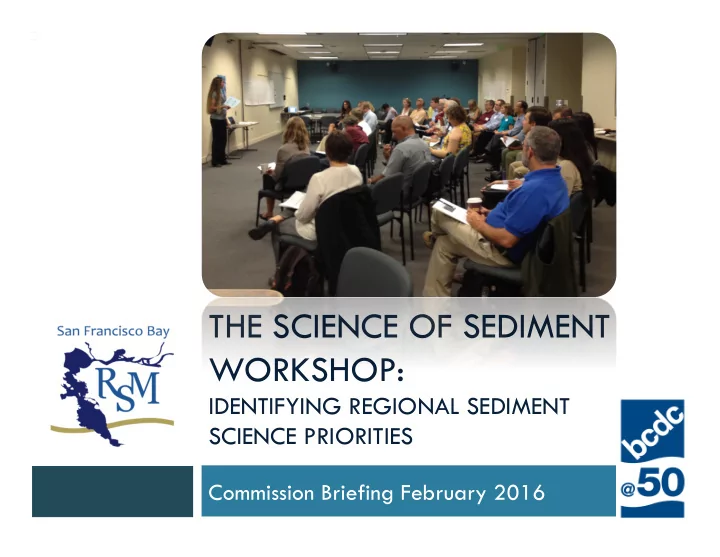
THE SCIENCE OF SEDIMENT WORKSHOP:
IDENTIFYING REGIONAL SEDIMENT SCIENCE PRIORITIES
Commission Briefing February 2016
THE SCIENCE OF SEDIMENT WORKSHOP: IDENTIFYING REGIONAL SEDIMENT - - PowerPoint PPT Presentation
THE SCIENCE OF SEDIMENT WORKSHOP: IDENTIFYING REGIONAL SEDIMENT SCIENCE PRIORITIES Commission Briefing February 2016 Outline 2 Context Background and Goals Preparation Execution Initial Outcomes Next Steps
THE SCIENCE OF SEDIMENT WORKSHOP:
IDENTIFYING REGIONAL SEDIMENT SCIENCE PRIORITIES
Commission Briefing February 2016
Outline
2
Why should we care about sediment?
Context
3
We have a serious sediment deficit
Commissioner McGrath (March 19th, 2015)
“We have put dams on most of the rivers and we’ve known for about the last 20 years, through the work of Phil Williams and Associates and through the USGS, that we are facing a fairly serious sediment deficit in the Bay. And that [sediment] is needed to deal with sea level rise, deal with sustaining wetlands and, more recently, the importance of mineral deposits, that is the coarser sediment, as a base for those systems.”
2100
4
Commissioner Zwissler: January 15th 2015
“How are we to go about reconciling the inherent conflicts within the various policies, ‘Don’t dredge,’ ‘get sand’ and ‘restore beaches?’ ”
Balancing conservation and development with constrained resources
5
Commissioner Pine: January 15th 2015
“I think this is going to be one of the more difficult decisions for the Commission to assess particularly given how much science and technical expertise is involved….It is very hard for me to know how to look at this given the complexities.” Complexities of Science and Technical Expertise
6
Bay Plan Policies
Tidal Marsh and Tidal Flats The Commission should support comprehensive Bay sediment research and monitoring to understand sediment processes necessary to sustain and restore wetlands. Monitoring methods should be updated periodically based on current scientific information.
7
Bay Plan Policies
8
Subtidal Areas The Commission should continue to support and encourage expansion of scientific information on the Bay's subtidal areas, including: (a) inventory and description of the Bay's subtidal areas; (b) the relationship between the Bay's physical regime and biological populations; (c) sediment dynamics, including sand transport, and wind and wave effects on sediment movement; (d) areas of the Bay used for spawning, birthing, nesting, resting, feeding, migration, among others, by fish, other aquatic organisms and wildlife; and (e) where and how restoration should occur.
Bay Plan Policies
9
Dredging The Commission should continue to participate in the LTMS, the Dredged Material Management Office, and
sediment movement, the effects of dredging and disposal on Bay natural resources, alternatives to Bay aquatic disposal, and funding additional costs of transporting dredged materials to non-tidal and
Background and Goals
10
Workshop Background
2010
BCDC & USGS co-host State of Sediment Science Workshop
2011
BCDC receives Coastal Impact Assistance Plan (CIAP) grant BCDC conducts literature review for RSM plan
2013
LTMS 12-year Program Review
2014
BCDC hosts Sand Mining Science Panel
2015
BCDC hosts Sediment Strategy Workshop
11
Workshop Goals
¨ Establish an understanding between practitioners
and scientists about information needs and management decision considerations.
¨ Identify priority management issues by area related
to the physical processes of sediment in the Bay.
¨ Develop a research strategy for how to address the
highest priority sediment management issues.
12
Preparation
13
Workshop Preparation
¨ With the advice of two
scientists (SFEI and USGS), BCDC’s sediment management team began developing the structure for the workshop
¨ Solicited feedback from
managers and regulators around the Bay who work with sediment to gather a baseline of existing management questions Engagement with scientists Engagement with practitioners
14
Sediment ¡Management ¡Ques/ons ¡ Related ¡to ¡Dredging ¡
Number ¡of ¡Responses ¡
Highly ¡ Relevant ¡ Somewhat ¡ ¡ Relevant ¡ Irrelevant ¡
Will ¡placing ¡dredged ¡material ¡in ¡Bay ¡work ¡to ¡augment ¡marshes ¡
10 ¡ 0 ¡ 3 ¡
Would ¡dumping ¡dredged ¡sediment ¡in ¡the ¡Bay ¡help ¡minimize ¡ the ¡impacts ¡of ¡clearing? ¡
8 ¡ 2 ¡ 3 ¡
Does ¡the ¡water ¡coming ¡into ¡the ¡Bay ¡equate ¡to ¡less ¡sediment ¡in ¡
7 ¡ 4 ¡ 2 ¡
Is ¡the ¡bay ¡really ¡clearing? ¡(decreasing ¡in ¡sediment) ¡
7 ¡ 4 ¡ 1 ¡
Where ¡is ¡my ¡sediment ¡coming ¡from? ¡
7 ¡ 3 ¡ 3 ¡
What ¡do ¡we ¡consider ¡the ¡sediment ¡system? ¡What ¡is ¡the ¡ "whole"? ¡
7 ¡ 1 ¡ 4 ¡
Is ¡the ¡Bay ¡moving ¡to ¡a ¡new ¡normal ¡in ¡terms ¡of ¡a ¡sediment ¡ balance? ¡When ¡or ¡will ¡it ¡stabilize? ¡
6 ¡ 6 ¡ 1 ¡
What ¡is ¡the ¡shoaling ¡rate ¡of ¡sediment ¡in ¡my ¡berth/project ¡ area? ¡
6 ¡ 4 ¡ 3 ¡
What ¡is ¡the ¡effect ¡of ¡removing ¡sediment ¡from ¡the ¡Bay? ¡
6 ¡ 3 ¡ 4 ¡
What ¡is ¡the ¡long-‑term ¡fate ¡of ¡aqua:c ¡disposal ¡of ¡dredged ¡ material ¡and ¡disposal ¡plumes? ¡Is ¡an ¡eelgrass ¡bed ¡buffer ¡ needed/effec:ve? ¡
5 ¡ 7 ¡ 1 ¡
How ¡do ¡adjacent ¡projects ¡impact ¡my ¡project? ¡
5 ¡ 5 ¡ 3 ¡
What ¡will ¡clearing ¡mean ¡nearshore ¡and ¡in ¡deeper ¡water? ¡
5 ¡ 6 ¡ 2 ¡
Respondents ¡
¡
Salt ¡Ponds ¡
County ¡Flood ¡ Control ¡District ¡
County ¡Flood ¡ Control ¡and ¡ Water ¡ Conserva:on ¡ District ¡-‑ ¡ Livermore-‑ Amador ¡Valley) ¡
Valley ¡Water ¡ District ¡
County ¡Flood ¡ Control ¡District ¡
Na:onal ¡Parks ¡ Conservancy ¡
Scien/sts ¡ Prac//oners ¡
Watersheds, ¡Tributaries, ¡and ¡Flood ¡Control ¡Channels ¡ Lester ¡McKee ¡-‑ ¡SFEI ¡ Liang ¡Xu ¡-‑ ¡SCVWD ¡ Dave ¡Schoellhamer ¡-‑ ¡USGS, ¡ ¡ Phillip ¡Trowbridge ¡-‑ ¡SFEI ¡ Carl ¡Morrison ¡-‑ ¡BAFPAA ¡ Laurel ¡Collins ¡-‑ ¡Watershed ¡Sciences ¡ Beth ¡Chris:an ¡-‑ ¡Regional ¡Water ¡Board ¡ Maureen ¡Downing-‑Kunz ¡-‑ ¡USGS ¡ Dan ¡Cunning ¡-‑ ¡EBRPD ¡Delta ¡Region, ¡ ¡ Luisa ¡Valiela ¡-‑ ¡EPA ¡ Beaches ¡and ¡Shorelines ¡ Doug ¡George ¡-‑ ¡Applied ¡Marine ¡Sciences ¡ Caroline ¡Christman ¡-‑ ¡Golden ¡Gate ¡Na:onal ¡Park ¡Conservancy, ¡ ¡ Mark ¡Johnsson ¡-‑ ¡CCC ¡ Louis ¡White ¡-‑ ¡ESA ¡ Ian ¡Wren ¡-‑ ¡Baykeeper ¡ ¡ ¡ Kristen ¡Ward ¡-‑ ¡GGNRA ¡ ¡ Marshes ¡and ¡Mudflats ¡ John ¡Callaway ¡-‑ ¡USF ¡ John ¡Bourgeois ¡-‑ ¡Coastal ¡Conservancy ¡ Jessie ¡Lacy ¡-‑ ¡USGS, ¡ ¡ Stuart ¡Siegel ¡-‑ ¡SF ¡Bay ¡NERR ¡ Sandra ¡Scoggin ¡-‑ ¡SFBJV, ¡ ¡ Chris ¡Barr ¡-‑ ¡USFWS ¡-‑ ¡SF ¡Bay ¡NWRC ¡ Jeremy ¡Lowe-‑ ¡SFEI ¡ Bob ¡Batha ¡-‑ ¡BCDC ¡ Mike ¡Vasey ¡-‑ ¡SFB ¡NERR ¡ Melissa ¡Amato ¡-‑ ¡USFWS ¡ Open ¡Bay ¡and ¡Sub/dal ¡ Theresa ¡Fregoso ¡-‑ ¡USGS ¡ ¡ Brian ¡Baird ¡-‑ ¡Aquarium ¡of ¡the ¡Bay ¡ Michael ¡MacWilliams ¡-‑ ¡Anchor ¡QEA ¡ Brian ¡Ross ¡-‑ ¡EPA, ¡ ¡ ¡ Sarah ¡van ¡der ¡Schalie ¡-‑ ¡NOAA ¡ Lissa ¡MacVean ¡-‑ ¡Stanford, ¡UCB ¡ Rob ¡Lawrence ¡-‑ ¡USACE ¡ Jeff ¡Steevens ¡-‑ ¡ERDC ¡ Anne ¡Whigngton ¡-‑ ¡Port ¡of ¡Oakland ¡ 16
Categories of Sediment Areas and Activities
Watersheds, Tributaries, and Flood Control Channels Marshes and Mudflats Open Water and Subtidal Bay Beaches and Non-wetland Shorelines Monitoring of Sediment Status and Trends
17
Execution
18
Workshop Structure
Day 1
37
Participants (Scientists + Practitioners)
¨ Introductory presentations
from workshop team and practitioners
¨ Generation of list of most important
management questions
¨ Prioritization of management questions
within each of the 4 categories
19
Votes ¡ Watershed, ¡Tributaries, ¡and ¡Flood ¡Control ¡ Top ¡Question ¡
18 ¡ How ¡can ¡we ¡design ¡channels ¡to ¡help ¡ convey ¡sediment ¡to ¡marshes ¡and ¡ baylands ¡rather ¡than ¡into ¡the ¡Bay? ¡
21
Votes ¡ Marshes ¡and ¡Mud:lats ¡ ¡ Top ¡Question ¡
18 ¡ How ¡can ¡we ¡verify ¡or ¡test ¡(i.e., ¡through ¡ pilot ¡study) ¡the ¡modeling ¡results ¡of ¡in-‑Bay ¡ placement ¡naturally ¡redistributing ¡to ¡ marsh ¡plains, ¡leading ¡to ¡more ¡efFicient ¡ beneFicial ¡reuse? ¡
22
Votes ¡ Beaches ¡and ¡Non-‑wetland ¡Shoreline ¡ ¡ Top ¡Question ¡
11 ¡ Are ¡there ¡particular ¡shoreline ¡areas ¡ that ¡are ¡most ¡at ¡risk ¡from ¡erosion ¡and ¡ sea ¡level ¡rise? ¡ ¡
23
Votes ¡ Open ¡Bay ¡and ¡Subtidal ¡Areas ¡ ¡ Top ¡Question ¡
18 ¡ Does ¡the ¡placement ¡of ¡dredged ¡ sediment ¡at ¡in-‑Bay ¡disposal ¡sites ¡ beneFit ¡shores ¡and ¡wetlands? ¡ ¡
24
Workshop Structure
Day 2
22
Participants (Mostly scientists)
¨ Reorganization of priority management
questions into scientific research groups
¤ Fate and Transport ¤ Budget and Supply ¤ Status, Risk, and Resilience
¨ Development of research strategy
components for each group
¨ Identification of overlapping study ideas
between groups
25
discussions that took place
Initial Outcomes
26
In Summary, this work will allow us to:
¨ Understand how much of what type of
sediment we have, and where,
¨ Increase fluvial and tidal connections to
improve sediment conveyance,
¨ Increase the beneficial reuse of sediment in the
context of a limited incoming supply in order to maintain our wetlands,
¨ Identify shorelines at risk from sea level rise
and ways to reinforce them through sustainable means, mimicking natural systems
27
Next Steps
28
Potential Next Steps
I. Sediment Fate and Transport II. Sediment Budget and Supply
I. Series of meetings from February through April
29
Summary
¨ We have a sediment deficit in the Bay, so need to
use what we have wisely, in a way that benefits the region
¨ This workshop was successful in identifying top
priority management and research questions
¨ The research strategy will require follow-up work
from participants
¨ Funding for studies related to this work exists
30
Thank you!
Questions? 31