Toledo Sediment Management and Use Solutions Evaluation of Sediment - - PowerPoint PPT Presentation

toledo sediment management and use solutions
SMART_READER_LITE
LIVE PREVIEW

Toledo Sediment Management and Use Solutions Evaluation of Sediment - - PowerPoint PPT Presentation

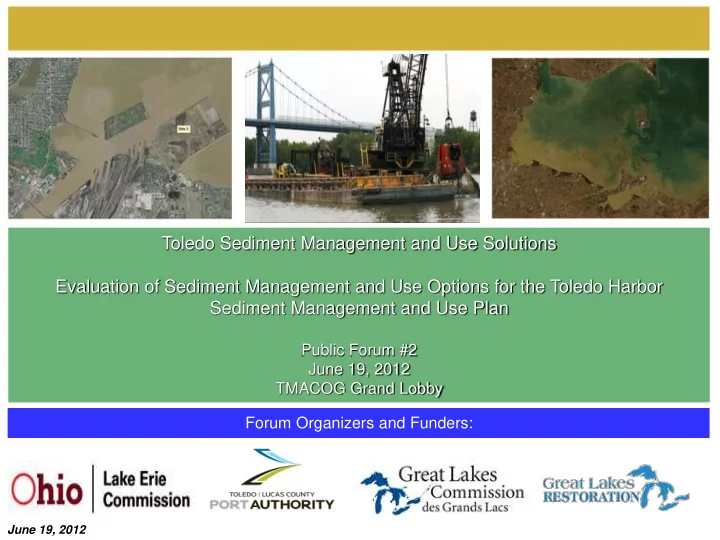
Toledo Sediment Management and Use Solutions Evaluation of Sediment Management and Use Options for the Toledo Harbor Sediment Management and Use Plan Public Forum #2 June 19, 2012 TMACOG Grand Lobby Forum Organizers and Funders: June 19, 2012


slide-1
SLIDE 1

June 19, 2012

Toledo Sediment Management and Use Solutions Evaluation of Sediment Management and Use Options for the Toledo Harbor Sediment Management and Use Plan

Public Forum #2 June 19, 2012 TMACOG Grand Lobby Forum Organizers and Funders:

slide-2
SLIDE 2

June 19, 2012

Great Lakes Commission

2

Dave Knight Special Projects Manager Great Lakes Commission

2805 S. Industrial Hwy, Suite 100 Ann Arbor, MI 48104-6791 734.971.9135 dknight@glc.org glc.org/dredging

slide-3
SLIDE 3

June 19, 2012

Logistics

  • Restrooms
  • Snacks/Beverages
  • Health & Safety
  • Agenda/Notes Page
  • Survey
  • Forum Rules

– Please let the speaker know if something needs repeated – Please hold comments and questions pertaining to the content until the Q&A session

  • Thank you for attending!

3

slide-4
SLIDE 4

June 19, 2012

Today’s Schedule

  • Introduction to the issues from a regional, state,

and local perspective

– Dave Knight, Great Lakes Commission – Gail Hesse, Ohio Lake Erie Commission – Joe Cappel, Toledo-Lucas County Port Authority

  • Presentation of Toledo Harbor Sediment

Management and Use Options

– John Hull, Hull & Associates, Inc.

  • Question and Answer Session

4

slide-5
SLIDE 5

June 19, 2012

Great Lakes Commission

  • The GLC interest historically

The Great Lakes Dredging Team is a partnership of federal and state agencies created to assure that the dredging of U.S. harbors and channels throughout the Great Lakes, connecting channels and tributaries is conducted in a timely and cost effective manner while meeting environmental protection, restoration, and enhancement goals.

5

slide-6
SLIDE 6

June 19, 2012

Great Lakes Commission

6

slide-7
SLIDE 7

June 19, 2012

Great Lakes Commission

  • Products:
  • “Testing and Evaluating Dredged Material for Upland

Beneficial Uses: A Regional Framework”

  • “Open Water Disposal of Dredged Materials in the Great

Lakes-St. Lawrence River Basin”

  • “Waste “Beneficially Using Dredged Materials to

Resource: Beneficial Use of Great Lakes Dredged Material”

  • “Decision Making Process for Dredged Material

Management”

  • “Regional Approach for Dredging Windows

Determination”

  • “Create/Restore Habitat and Restore Brownfields”

7

slide-8
SLIDE 8

June 19, 2012

Great Lakes Commission

  • The GLC interest going forward

– Ongoing viability and growth for the Port of Toledo: Jobs – Environmental quality of the Lake Erie basin: Sustainability – Lessons for all Great Lakes navigation dredging projects: Technology transfer – Refinement of best management practices: Collaboration

8

slide-9
SLIDE 9

June 19, 2012

State Perspective

Gail Hesse Executive Director Ohio Lake Erie Commission

lakeerie.ohio.gov 111 Shoreline Drive Sandusky, Ohio 44870 419-621-2040 gail.hesse@lakeerie.ohio.gov

9

slide-10
SLIDE 10

June 19, 2012

Lake Erie Economic Values

  • Lake Erie

– $10.7 Billion Lake Erie Tourism – $1 Billion Lake Erie Fishing – 3 million Ohio drinking water users

10

slide-11
SLIDE 11

June 19, 2012 11

Sediment Entering Lake Erie – April 2008

11

slide-12
SLIDE 12

June 19, 2012 12

Algal Blooms in Lake Erie – August 2011

Photo: NOAA Satellite Image

12

slide-13
SLIDE 13

June 19, 2012

WWTP Effluent vs. Dredged Sediment

For Quantity Perspective Only

Parameter Toledo Bay View WWTP Effluent (based on 2008 data) Toledo Harbor Dredged Sediment (based on 2004 data & 1.25 million CY)

Cadmium Samples below detection limit 2.50 tons/yr Lead Samples below detection limit 48.03 tons/yr Mercury 2.18 pounds/yr 620 pounds/yr Silver Samples below detection limit 0.61 tons/yr Zinc 5.1 tons/yr 250.74 tons/yr Total Phosphorus 69.4 tons/yr 1096 tons/yr (2010) Total Suspended Solids 983 tons/yr 2,062,500 tons/yr (total solids) Selenium Samples below detection limit 1.25 tons/yr Ammonia 20.4 tons/yr 311.65 tons/yr Operating Expenses $41 million based on 2007 Annual Report FY10 Budget - $5 million

Ohio EPA Comparative Analysis

13

slide-14
SLIDE 14

June 19, 2012

Ohio’s Regulatory Role

  • Ohio EPA issues a Section 401 Water Quality

Certification to the Corps of Engineers

– Historically issued on a 5 year cycle – Recently issued annually

  • Status of 2012 WQC

– Will include sampling in the open-lake placement area

14

slide-15
SLIDE 15

June 19, 2012

Ohio’s Position

  • Toledo Harbor must be kept open
  • Lake Erie must be restored
  • Best approaches include beneficial use and

source reduction

  • Support cooperative partnerships
  • Sustainable practices

15

slide-16
SLIDE 16

June 19, 2012

The Economic Impact of the Port of Toledo

Joseph Cappel Director of Cargo Development Toledo-Lucas County Port Authority

toledoportauthority.org toledoseaport.org tourtheport.com toledoexpress.com One Maritime Plaza, Suite 701 Toledo, Ohio 43604 419.243.8251 jcappel@toledoportauthority.org

16

slide-17
SLIDE 17

June 19, 2012

Great Lakes Shipping: Environmental Benefits

  • Toledo’s 15 Marine Terminals handle over 700 vessel calls and 12

million tons of cargo per year.

  • Ships help preserve North American energy resources: Ships

carry vast amounts of cargo long distances using significantly less fuel than trains and trucks. They are 4 times more efficient than trucks and 1.75 times more efficient than trains.

  • Ships have the smallest carbon footprint: A Great Lakes freighter

produces 70 percent less carbon dioxide per metric ton/kilometer compared to trucks.

  • Ships remove congestion from roadways: The largest Great lakes

vessel can carry 70,000 metric tons- the equivalent to 3000 truckloads or 700 rail cars.

17

slide-18
SLIDE 18

June 19, 2012

Great Lakes Shipping: Economic Benefits

  • The shipping industry employs 227,000 people in the U.S. and

Canada and produces business revenue of $33.5 billion.

  • Shipping contributes $4.6 billion in federal, state and local taxes

each year.

  • Electrical utilities, steel mills, construction companies, mining

companies, manufacturers and farmers all depend on the 164 million tons of cargo delivered by Great Lakes ships each year.

  • Marine transportation on the System provides $3.6 billion in

annual savings compared to the next best all land transportation alternative.

18

slide-19
SLIDE 19

June 19, 2012

The Port of Toledo’s Economic Impact

  • 6,971 jobs are supported by the cargo moving via Toledo’s

marine terminals. 2,521 jobs were directly generated by the maritime activity at the terminals with wages and salaries totaling over $109 million.

  • Direct business revenue received by the firms dependent upon

the cargo handled at the Port totaled $381.3 Million in 2010.

  • A total of $154.7 million in state and federal taxes were

generated by cargo and vessel activity in 2010.

19

slide-20
SLIDE 20

June 19, 2012

Regional Transportation Investment

Sy Systems ms Interchange

  • I-75/475 Systems Interchange Ph 1

$98 M

  • Toledo Seaport Improvements

$35 M

  • I-280 Veterans Glass City

$300 M Skyway Bridge & Roadway Proj.

  • NS Airline Yard Intermodal

$13 M

  • FedEx Ground Facility

$87 M

  • Toledo Express Airport

$7 M

  • US 24 Fort-to-Port Highway

$490 M

  • CSX Northwest OH Intermodal $175 M

Regional Investment $1,205 M

20

slide-21
SLIDE 21

June 19, 2012

But…

  • Investments in infrastructure & economic impact won’t matter unless

Toledo’s dredging issues are addressed with sustainable solutions considering the needs of industry, community and environment.

  • For every one inch of reduced draft, a lake trading vessel forfeits 50

to 270 tons of cargo from their payload. Ocean vessels lose 115 tons of cargo for each inch of lost draft.

  • The International Reputation of the Port of Toledo is on the Line!

One bad experience can cause a vessel never to return.

  • This is a complex issue and there is no silver bullet solution. We

need the best and brightest to collaborate - this plan is a result of the efforts of many stakeholders.

  • If we can continue to work together to address the needs of

commerce and the environment we will achieve great things!

21

slide-22
SLIDE 22

June 19, 2012

Toledo Harbor Dredging Task Force

  • Membership
  • Toledo-Lucas County Port Authority
  • State agencies
  • Federal agencies
  • Local officials
  • Non-governmental organizations

(environmental, commercial, and recreational)

22

slide-23
SLIDE 23

June 19, 2012

23

John H. Hull, P.E. Principal Hull & Associates, Inc.

Overview of Options

hullinc.com 3401 Glendale Ave Toledo, Ohio 43614 419.385.2018 jhull@hullinc.com

slide-24
SLIDE 24

June 19, 2012

  • Issues and Opportunities
  • Technical Approaches
  • Project Identification
  • Prioritization for Implementation

Toledo Harbor Sediment Management and Use

24

slide-25
SLIDE 25

June 19, 2012

Open Lake Placement Area Island 18 – Confined Disposal Facility Confined Disposal Facility Cell 2 Confined Disposal Facility Cell 1

slide-26
SLIDE 26

June 19, 2012

  • Introduction to the Project

– The Ohio Lake Erie Commission was awarded a GLRI grant to create a sediment management strategy/plan for the Toledo Harbor that identifies and addresses:

  • recommended short-term (1-5 years)
  • ptions
  • recommended long-term (30 year)
  • ptions
  • funding needs/sources/mechanisms
  • timelines for implementation of

recommended approaches

Toledo Harbor Sediment Management and Use Planning

26

slide-27
SLIDE 27

June 19, 2012

27

Toledo Harbor Sediment Management and Use Planning

  • Sediment management and use plan status:

– Solicited input on potential options and gathered value judgments from stakeholders on the importance of relative criteria to evaluate options (weighting factors)

  • Completion of June 2011 public forum
  • Completion of December 2011 Task Force consensus

– Evaluation of short term (1-5 years) and long term (5-30 years) options

  • Compiled relevant data and information
  • Estimated dredge capacity needs
  • Completed preliminary screening of potential
  • ptions identified internally and by

stakeholders

slide-28
SLIDE 28

June 19, 2012

28

  • Review potential sediment use
  • ptions
  • Present Technical Team’s

evaluation process and results

  • Present prioritized

approaches for sediment management

  • ptions
  • Solicit input from

stakeholders

Today’s Objectives

slide-29
SLIDE 29

June 19, 2012

29

Potential Sediment Use Options

  • Solicited input on potential options from

stakeholders at June 2011 Public Forum

– Create Wetlands – Create Islands – New Metropark – Use of Geotubes – Erosion Control – Beneficial Use – Floodplain Berms

slide-30
SLIDE 30

June 19, 2012

30

Identification of Options

  • Ideas from the 1st Public Forum were evaluated

by the Technical Team

  • Technical Team identified options/conceptual

approaches to carry forward in the detailed evaluation using best professional judgment with respect to the conditions of Toledo Harbor and surrounding areas

slide-31
SLIDE 31

June 19, 2012

31

Major Assumptions

  • No programmatic constraints
  • A combination option is likely a better solution
  • Option Costs

– Basic recognition of major capital improvement and O&M costs – Used to serve as a relative comparison between

  • ptions - not to be used as comprehensive cost

estimate for each alternative – Approximate location of option used for estimating purposes

slide-32
SLIDE 32

June 19, 2012

Toledo Harbor Dredging

  • Federal Channel spans

RM 7 to LM 18 (25 miles, 400-500 ft. width)

  • Projected 1M CY Dredged

Annually, includes federal and non-federal channels

  • 30-year total of 30M CY
slide-33
SLIDE 33

June 19, 2012

33

Potential Sediment Management and Use Options

Upland Nearshore In-Water In-Water

slide-34
SLIDE 34

June 19, 2012

34

  • Use dredged materials in

productive ways as a resource that results in environmental, economic, or social benefits.

  • Examples:

– Brownfield revitalization – Strip mine reclamation & solid waste management – Construction and industrial use (port development, airports, urban, residential) – Material transfer (fill, dikes, levees, parking lots, roads)

Beneficial Use of Dredged Material as Non-Structural Fill

Sediment off-loaded from barge/scow near the shore

slide-35
SLIDE 35

June 19, 2012

35

Agricultural Field Improvements

  • Use dredged material to

raise the elevation of agricultural fields, thus, improving drainage and future productivity

– 5-mile radius – 10-mile radius

  • 4 ft. improvement height

Sediment pumped onto shore from dredging operations center

  • f gravity and subsequently

pumped to final site via booster pump structure(s)

slide-36
SLIDE 36

June 19, 2012

36

Agricultural Field Improvements

Relative Footprint of 30M CY for Single-Option

Not a proposed location (shown for relative size needed to accommodate all 30M CY)

slide-37
SLIDE 37

June 19, 2012

37

Wetland Restoration and Shoreline Protection

  • Use dredged material to

create additional wetland areas and a protective barrier for the existing shoreline

– Structure base 5-7 ft. below LWD – Final dike surface 4-12 ft. above LWD – Final wetland surface near LWD

Sediment pumped from dredging operations center of gravity to final location

Deer Island, MS (Source: GLC)

slide-38
SLIDE 38

June 19, 2012

38

Wetland Restoration and Shoreline Protection

Relative Footprint of 30M CY for Single-Option

Not a proposed location (shown for relative size needed to accommodate all 30M CY)

slide-39
SLIDE 39

June 19, 2012

39

Submerged Habitat Restoration Unit

  • Use of dredged material to assist in

the development of a Habitat Restoration Unit (HRU) that will provide future submerged wildlife refuge/habitat

– Deep water HRU

– Structure base 20 ft. below LWD – Final structure surface 10 ft. below LWD

– Shallow water HRU

– Structure base 7 ft. below LWD, – Final structure surface 3 ft. below

LWD

Dredged material transported from channel to final location via scow/barge and pumped or released into HRU diked area

slide-40
SLIDE 40

June 19, 2012

40

Submerged Habitat Restoration Unit

Relative Footprint of 30M CY for Shallow and Deep Single-Options

Not a proposed location (shown for relative size needed to accommodate all 30M CY)

slide-41
SLIDE 41

June 19, 2012

41

New Confined Disposal Facility

  • Construct a new

confined disposal facility (CDF) to contain the material

– Not specifically designed for habitat enhancement – Structure base 5 ft. below LWD – Final structure surface 30 ft. above LWD

Dredged material transported from channel to final location via scow/barge and pumped or released into contained area

slide-42
SLIDE 42

June 19, 2012

42

New Confined Disposal Facility

Relative Footprint of 30M CY for Single-Option

Not a proposed location (shown for relative size needed to accommodate all 30M CY)

slide-43
SLIDE 43

June 19, 2012

43

Emergent Habitat Restoration Unit

  • Deep water HRU

– Structure base 20 ft. below LWD – Final structure surface 30 ft. above LWD

  • Shallow water HRU

– Structure base 5 ft. below LWD, – Final structure surface 12.5 ft. above LWD

Dredged material transported from channel to final location via scow/barge and pumped or released into HRU diked area

  • Use of dredged material to assist in

the development of a Habitat Restoration Unit (HRU) that will provide a future emergent wildlife refuge/habitat

Poplar Island, MD (Source: USACE)

slide-44
SLIDE 44

June 19, 2012

44

Emergent Habitat Restoration Unit

Relative Footprint of 30M CY for Shallow and Deep Single-Options

Not a proposed location (shown for relative size needed to accommodate all 30M CY)

slide-45
SLIDE 45

June 19, 2012

45

Open-Lake Placement with Controls

  • Open-lake placement

with controls to decrease nutrient availability and/or increase shear strength of material

– Potential HRU aspect – Either at or near the current

  • pen lake placement area

Dredged material transported from channel to final location via scow/barge and released to placement area

slide-46
SLIDE 46

June 19, 2012

46

Open-Lake Placement with Controls

Relative Footprint of 30M CY for Single-Option

Not a proposed location (shown for relative size needed to accommodate all 30M CY)

slide-47
SLIDE 47

June 19, 2012

47

Open-Lake Placement without Controls

  • Relocated/new open-lake

placement from overall dredging operations center

– No controls – Minimizes the potential for individual redistribution of sediment in the Western Lake Erie Basin – Possible reduction in influence of algae blooms

Dredged material transported from channel to final location via scow/barge and released to placement area

slide-48
SLIDE 48

June 19, 2012

48

Open-Lake Placement without Controls

Relative Footprint of 30M CY for Single-Option

Not a proposed location (shown for relative size needed to accommodate all 30M CY)

slide-49
SLIDE 49

June 19, 2012

49

Single Option Relative Unit Costs

slide-50
SLIDE 50

June 19, 2012

Toledo Harbor Sediment Management and Use Options

  • Is one option that can accommodate all 30

million CY feasible?

– Complex logistics – Compounded eco-habitat uses/impacts – Unintended consequences – Programmatic constraints

50

slide-51
SLIDE 51

June 19, 2012

51

Evaluation Process

  • Each option evaluated to receive all of the 30-year estimated

dredged material volume (30M CY) – despite initial assumption that a Combination Option is likely a better solution

  • Initial evaluation did not consider
  • All aspects of a specific location of option
  • Current programmatic/regulatory restrictions
  • Funding availability and sources
  • Limitations on currently accepted practices
  • Inflation of current market costs
  • Initial evaluation did consider
  • Location relative to Center of Gravity of estimated volume of

material dredged between 2001-2010

  • Current lake bathymetry
  • Current market costs
slide-52
SLIDE 52

June 19, 2012

52

Evaluation Process (Continued)

  • Matrix to score the dredge material management and

use options across six major categories of technical criteria and sub-categories identified and discussed at the June 2011 Public Forum:

  • Feasibility
  • Ecological Benefits
  • Environmental Impacts
  • Human Benefits
  • Economic Benefits
  • Implementation Cost
slide-53
SLIDE 53

June 19, 2012

53

Evaluation Process (Continued)

  • Assigned by Task

Force members

  • 1-100, for each

technical criteria category

Weighting Factors

  • Assigned by Hull

Technical Team

  • 1-5, for multiple

technical criteria for each option

Technical Criteria

  • Avg. Weighting

Factor x

  • Avg. Technical

Criteria Score = Score for Each Option For each Technical Criteria category:

slide-54
SLIDE 54

June 19, 2012

June 2011 Public Forum Input

  • Summarized in public forum report and posted
  • nline and discussed at Task Force meeting

– Input on ranking of major factors was considered by the Task Force in weighting factor determination – Input on sub-categories was considered by technical team in development of technical criteria scoring

slide-55
SLIDE 55

June 19, 2012

Feasibility

Technical Criteria

Beneficial Use Emergent HRU - Deep Water Emergent HRU - Shallow Water Submerged HRU - Deep Water Submerged HRU - Shallow Water Wetland Restoration & Shoreline Protection Agricultural Field Improvements (5-mile radius) Agricultural Field Improvements (10-mile radius) Open-Lake - No Controls Open-Lake - With Controls New CDF

Placement Timing and Sequencing 1 5 5 5 4 3 3 4 5 4 5 Capacity Expansion Capability 5 5 4 5 3 2 5 5 5 5 4 Size of Overall Footprint 2 4 2 2 1 2 2 2 3 3 3 Implementation/Construction Complexity 4 1 2 2 2 3 4 3 5 4 3 Construction Duration 5 1 2 2 2 3 4 4 5 5 2 Site Accessibility 4 4 4 4 4 4 4 3 2 4 4

Average Score 3.5 3.3 3.2 3.3 2.7 2.8 3.7 3.5 4.2 4.2 3.5

Feasibility

Scale: 1 - Highly complicated 2 - Moderately to highly complicated 3 - Moderately complicated 4 – Minimally to moderately complicated 5 - Minimally complicated

slide-56
SLIDE 56

June 19, 2012

56

Feasibility

Technical Criteria

Beneficial Use Emergent HRU - Deep Water Emergent HRU - Shallow Water Submerged HRU - Deep Water Submerged HRU - Shallow Water Wetland Restoration & Shoreline Protection Agricultural Field Improvements (5-mile radius) Agricultural Field Improvements (10-mile radius) Open-Lake - No Controls Open-Lake - With Controls New CDF

Planktonic and Benthic Community/Habitat 3 2 2 4 4 4 3 3 2 2 2 Fish and Aquatic Inverterbrate species/habitat 3 4 4 4 4 4 3 3 2 2 2 Wetlands (tidal, non-tidal) 3 4 4 3 3 4 3 3 3 3 3 Protected Species/Habitat 3 3 4 3 3 4 3 3 3 3 3 Pelagic Birds/Habitat 3 4 4 3 3 4 3 3 3 3 4 Terrestrial Species/Habitat 3 4 4 3 3 4 3 3 3 3 3 Creation of Surface Water Features with Ecologically Beneficial Habitat 3 4 4 3 3 4 3 3 3 3 4

Average Score 3.0 3.6 3.7 3.3 3.3 4.0 3.0 3.0 2.7 2.7 3.0

Ecological Benefits/Effects

Scale: 1- negative overall effect, high level of effort to overcome 2- negative effect, moderate level of effort to overcome 3 - minimal effect 4 - positive effect, moderate degree of benefit 5 - positive effect, high degree of benefit
slide-57
SLIDE 57

June 19, 2012

57

Feasibility

Technical Criteria

Beneficial Use Emergent HRU - Deep Water Emergent HRU - Shallow Water Submerged HRU - Deep Water Submerged HRU - Shallow Water Wetland Restoration & Shoreline Protection Agricultural Field Improvements (5-mile radius) Agricultural Field Improvements (10-mile radius) Open-Lake - No Controls Open-Lake - With Controls New CDF

Hydro-dynamic Effects

5 4 4 4 4 4 4 4 1 3 2

Land Improvements

5 4 4 3 3 4 5 5 3 3 4

Surface Water Quality

3 3 3 3 3 3 4 4 1 4 2

Groundwater Quality

3 3 3 3 3 3 4 4 3 3 3

Average Score 4 3.5 3.5 3.25 3.25 3.5 4.25 4.25 2 3.25 2.75

Environmental Impacts/Effects

Scale: 1- negative overall effect, high level of effort to

  • vercome

2- negative effect, moderate level of effort to

  • vercome

3 - minimal effect 4 - positive effect, moderate degree of benefit 5 - positive effect, high degree of benefit

slide-58
SLIDE 58

June 19, 2012

58

Feasibility

Technical Criteria

Beneficial Use Emergent HRU - Deep Water Emergent HRU - Shallow Water Submerged HRU - Deep Water Submerged HRU - Shallow Water Wetland Restoration & Shoreline Protection Agricultural Field Improvements (5-mile radius) Agricultural Field Improvements (10-mile radius) Open-Lake - No Controls Open-Lake - With Controls New CDF

Recreation Opportunity

3 4 5 3 4 4 3 3 3 3 3

Flood Protection

3 3 3 3 3 5 5 5 3 3 3

Aesthetics

3 4 5 3 3 4 2 2 3 2 2

Human Health Risk

3 3 3 3 3 3 3 3 2 3 2

Navigational Safety

3 2 2 3 2 3 3 3 3 3 2

Average Score 3 3.2 3.6 3 3 3.8 3.2 3.2 2.8 2.8 2.4

Human Benefits/Effects

Scale: 1- negative overall effect, high level of effort to

  • vercome

2- negative effect, moderate level of effort to

  • vercome

3 - minimal effect 4 - positive effect, moderate degree of benefit 5 - positive effect, high degree of benefit

slide-59
SLIDE 59

June 19, 2012

59

Feasibility

Technical Criteria

Beneficial Use Emergent HRU - Deep Water Emergent HRU - Shallow Water Submerged HRU - Deep Water Submerged HRU - Shallow Water Wetland Restoration & Shoreline Protection Agricultural Field Improvements (5-mile radius) Agricultural Field Improvements (10-mile radius) Open-Lake - No Controls Open-Lake - With Controls New CDF

Revenue Generation - During Operation 5 3 3 3 3 3 4 4 3 3 5 Revenue Generation - Post- Operation 4 4 4 3 3 3 5 5 3 3 4 Public Need 5 4 4 4 4 4 4 4 3 3 3 Job Creation 5 4 4 4 4 4 4 4 3 3 4 Tourism 3 5 5 4 4 4 4 4 4 3 3 Local Commerce 4 5 5 4 4 4 5 5 3 3 3

Average Score 4.3 4.2 4.2 3.7 3.7 3.7 4.3 4.3 3.2 3.0 3.7

Economic Benefits

Scale: 1- negative overall effect, high level of effort to overcome 2- negative effect, moderate level of effort to overcome 3 - minimal effect 4 - positive effect, moderate degree of benefit 5 - positive effect, high degree of benefit

slide-60
SLIDE 60

June 19, 2012

60

Feasibility

Technical Criteria

Beneficial Use Emergent HRU - Deep Water Emergent HRU - Shallow Water Submerged HRU - Deep Water Submerged HRU - Shallow Water Wetland Restoration & Shoreline Protection Agricultural Field Improvements (5-mile radius) Agricultural Field Improvements (10-mile radius) Open-Lake - No Controls Open-Lake - With Controls New CDF

Score (Based on Estimated Cost per CY) 3.45 3.27 3.87 2.48 1.00 4.95 5.00 4.92 4.98 4.93 3.67

Implementation Costs

Scale: 1 - Highest relative cost 5 – Lowest relative cost Intermediate score values relatively based on range of costs per CY

slide-61
SLIDE 61

June 19, 2012

61

Feasibility

Average Technical Criteria Scores

Beneficial Use Emergent HRU - Deep Water Emergent HRU - Shallow Water Submerged HRU - Deep Water Submerged HRU - Shallow Water Wetland Restoration & Shoreline Protection Agricultural Field Improvements (5-mile radius) Agricultural Field Improvements (10-mile radius) Open-Lake - No Controls Open-Lake - With Controls New CDF

Feasibility Avg. Score 3.5 3.3 3.2 3.3 2.7 2.8 3.7 3.5 4.2 4.2 3.5 Ecological Benefits Avg. Score 3.0 3.6 3.7 3.3 3.3 4.0 3.0 3.0 2.7 2.7 3.0 Environmental Impacts Avg. Score 4 3.5 3.5 3.25 3.25 3.5 4.25 4.25 2 3.25 2.75 Human Benefits Avg. Score 3 3.2 3.6 3 3 3.8 3.2 3.2 2.8 2.8 2.4 Economic Benefits Avg. Score 4.3 4.2 4.2 3.7 3.7 3.7 4.3 4.3 3.2 3.0 3.7 Implementation Cost Score 3.45 3.27 3.87 2.48 1.00 4.95 5.00 4.92 4.98 4.93 3.67

Total Score 21.3 21.0 22.0 19.0 16.9 22.8 23.5 23.2 19.8 20.9 19.0

slide-62
SLIDE 62

June 19, 2012

62

Ranking of Options Based on Average Technical Scores

Rank Option Average Score

1 Agricultural Fields (5-mile Radius) 23.5 2 Agricultural Fields (10-mile Radius) 23.2 3 Wetland Restoration & Shoreline Protection 22.8 4 Emergent HRU - Shallow Water 22.0 5 Beneficial Use 21.3 6 Emergent HRU - Deep Water 21.0 7 Open-Lake - With Controls 20.9 8 Open-Lake - No Controls 19.8 9 Submerged HRU - Deep Water 19.0 9 New CDF 19.0 11 Submerged HRU - Shallow Water 16.9

slide-63
SLIDE 63

June 19, 2012

63

Weighting Factors

Category of Technical Criteria Public Forum #1 Rank (n=100) Task Force Rank (n=12) Task Force Assigned Weighting Factors Feasibility 4 3 17 Ecological Benefits 2 1 22 Environmental Impacts 1 2 20 Human Benefits 6 6 10 Economic Benefits 5 5 14 Implementation Costs 3 3 17

slide-64
SLIDE 64

June 19, 2012

64

Feasibility

Weighted Technical Criteria Scores

Beneficial Use Emergent HRU - Deep Water Emergent HRU - Shallow Water Submerged HRU - Deep Water Submerged HRU - Shallow Water Wetland Restoration & Shoreline Protection Agricultural Field Improvements (5-mile radius) Agricultural Field Improvements (10-mile radius) Open-Lake - No Controls Open-Lake - With Controls New CDF

Feasibility Weighted Score (17) 59.5 56.7 53.8 56.7 45.3 48.2 62.3 59.5 70.8 70.8 59.5 Ecological Benefits Weighted Score (22) 66.0 78.6 81.7 72.3 72.3 88.0 66.0 66.0 59.7 59.7 66.0 Environmental Impacts Weighted Score (20) 80 70 70 65 65 70 85 85 40 65 55 Human Benefits Weighted Score (10) 30 32 36 30 30 38 32 32 28 28 24 Economic Benefits Weighted Score (14) 60.7 58.3 58.3 51.3 51.3 51.3 60.7 60.7 44.3 42.0 51.3 Implementation Cost Weighted Score (17) 58.7 55.6 65.8 42.2 17.0 84.2 85.0 83.6 84.7 83.8 62.4 Total Weighted Score 354.8 351.2 365.7 317.4 281.0 379.7 391.0 386.8 327.5 349.4 318.2

slide-65
SLIDE 65

June 19, 2012

65

Ranking of Options Based on Weighted Technical Score

Rank Option Weighted Technical Score

1 Agricultural Fields (5-mile Radius) 391.0 2 Agricultural Fields (10-mile Radius) 386.8 3 Wetland Restoration & Shoreline Protection 379.7 4 Emergent HRU - Shallow Water 365.7 5 Beneficial Use 354.8 6 Emergent HRU - Deep Water 351.2 7 Open-Lake - With Controls 349.4 8 Open-Lake – No Controls 327.5 9 New CDF 318.2 10 Submerged HRU - Deep Water 317.4 11 Submerged HRU - Shallow Water 281.0

slide-66
SLIDE 66

June 19, 2012

66

Single-Option Challenges

  • Challenges of using only one alternative:

– Practicality/Logistics (low flexibility, seasonal limitations) – Costs (high initial capital investment, balance between capital and O&M) – Location (large overall footprint) – Optimization of alternative (compromise/tradeoff between technical categories) – Size (large structural requirements/site-specific impacts)

  • Both short-term and long-term plans will likely

consist of a combination of approaches due to the challenges of single-option

slide-67
SLIDE 67

June 19, 2012

67

Combination Option

  • Use a combination of options to minimize

challenges

  • Criteria for combination option:

– Weighted scores – Estimated costs – Practicality/feasibility – Shorter implementation time – Improved short-term benefits

slide-68
SLIDE 68

June 19, 2012

68

Selection of Combination Option

Rank Single Option (30M CY) Feasibility Weighted Score Weighted Technical Score Relative Total Cost

1 Agricultural Fields (5-mile Radius) 62.3 391.0 $305M 2 Agricultural Fields (10-mile Radius) 59.5 386.8 $336M 3 Wetland Restoration & Shoreline Protection 48.2 379.7 $326M 4 Emergent HRU - Shallow Water 53.8 365.7 $741M 5 Beneficial Use 59.5 354.8 $906M 6 Emergent HRU - Deep Water 56.7 351.2 $972M 7 Open-Lake - With Controls 70.8 349.4 $334M 8 Open-Lake – No Controls 70.8 327.5 $314M 9 New CDF 59.5 318.2 $820M 10 Submerged HRU - Deep Water 56.7 317.4 $1,280M 11 Submerged HRU - Shallow Water 45.3 281.0 $1,850M

slide-69
SLIDE 69

June 19, 2012

69

Selection of Combination Option

  • Options selected generally have a lower unit

cost increase when a smaller footprint / feasible quantity was analyzed

  • More feasible options
  • Options selected ranked the highest in at least
  • ne technical category
  • Arbitrary selection of volumes for purposes of

discussion

  • Will need a detailed design analysis completed
slide-70
SLIDE 70

June 19, 2012

70

Combination Option

  • Wetland Restoration and Shoreline Protection

(7M CY)

  • Agricultural fields (7M CY)
  • Beneficial Use (3M CY)
  • Open-lake with controls (13M CY)
slide-71
SLIDE 71

June 19, 2012

71

Conceptual Locations of Combination Option

For illustrative purposes

slide-72
SLIDE 72

June 19, 2012

72

Single and Combination Option Weighted Score Evaluation

Technical Criteria

Beneficial Use Emergent HRU - Deep Water Emergent HRU - Shallow Water Submerged HRU - Deep Water Submerged HRU - Shallow Water Wetland Restoration & Shoreline Protection Agricultural Field Improvements (5-mile radius) Agricultural Field Improvements (10-mile radius) Open-Lake - No Controls Open-Lake - With Controls New CDF Combination

Feasibility Weighted Score (17) 59.5 56.7 53.8 56.7 45.3 48.2 62.3 59.5 70.8 70.8 59.5 79.3 Ecological Benefits Weighted Score (22) 66.0 78.6 81.7 72.3 72.3 88.0 66.0 66.0 59.7 59.7 66.0 75.4 Environmental Impacts Weighted Score (20) 80 70 70 65 65 70 85 85 40 65 55 75 Human Benefits Weighted Score (10) 30 32 36 30 30 38 32 32 28 28 24 32 Economic Benefits Weighted Score (14) 60.7 58.3 58.3 51.3 51.3 51.3 60.7 60.7 44.3 42.0 51.3 56 Implementation Cost Weighted Score (17) 58.7 55.6 65.8 42.2 17.0 84.2 85.0 83.6 84.7 83.8 62.4 79.9 Total Weighted Score 354.8 351.2 365.7 317.4 281.0 379.7 391.0 386.8 327.5 349.4 318.2 397.7

slide-73
SLIDE 73

June 19, 2012

73

Single and Combination Option Final Ranking and Relative Costs

Rank Option Weighted Score Relative Unit Costs ($/CY)

1 Combination 397.7 $13.50 2 Agricultural Fields (5-mile Radius) 391.0 $10.20 3 Agricultural Fields (10-mile Radius) 386.8 $11.20 4 Wetland Restoration & Shoreline Protection 379.7 $10.90 5 Emergent HRU - Shallow Water 365.7 $24.70 6 Beneficial Use 354.8 $30.20 7 Emergent HRU - Deep Water 351.2 $32.40 8 Open-Lake - With Controls 349.4 $11.10 9 Open-Lake – No Controls 327.5 $10.50 10 New CDF 318.2 $27.30 11 Submerged HRU - Deep Water 317.4 $42.60 12 Submerged HRU - Shallow Water 281.0 $61.70

slide-74
SLIDE 74

June 19, 2012

74

Enhanced Environmental Dredging Techniques

  • Hydraulic Dredging with permanent discharge

lines

  • Enhanced open-lake placement techniques
slide-75
SLIDE 75

June 19, 2012

75

Short-term vs. Long-term Options

  • Short-term options have minimal delays

resulting from permitting, design, etc.

– Beneficial use of sediment from the river at upland locations – Enhanced open-lake placement

  • Long-term options promote activities with lower

habitat impacts and lower cost

– Agricultural use – Nearshore options

slide-76
SLIDE 76

June 19, 2012

Acknowledgements

  • Hull & Associates, Inc.
  • Moffat & Nichol
  • Proudfoot
  • Great Lakes Marketing
  • ARCADIS

76

slide-77
SLIDE 77

June 19, 2012

77

Questions and Answer Session

Toledo Harbor Sediment Management and Use Planning

slide-78
SLIDE 78

June 19, 2012

78

Next Steps

  • Survey – We would like your feedback!
  • For additional information or to provide follow up

input, please email lakeeriecommission@lakeerie.ohio.gov or call 419- 621-2040.

slide-79
SLIDE 79

June 19, 2012

79

Next Steps

  • Technical Team will:
  • Incorporate feedback from stakeholders and the

Toledo Harbor Task Force

  • Complete Final Plan in Summer 2012
  • Updates, forum results, and this presentation will

soon be available at www.lakeerie.ohio.gov

slide-80
SLIDE 80

June 19, 2012

80

toledoportauthority.org toledoseaport.org toledoexpress.com glc.org/dredging lakeerie.ohio.gov greatlakesrestoration.us

Thank You for Your Participation!