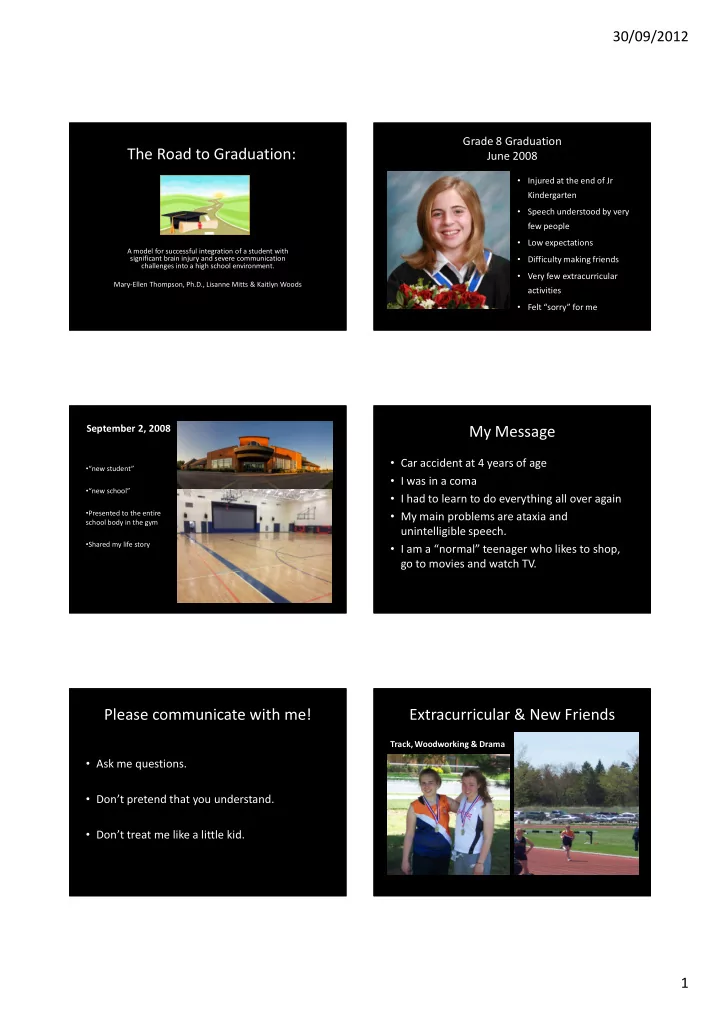
The Road to Graduation: June 2008 Injured at the end of Jr - - PDF document

the road to graduation
SMART_READER_LITE
LIVE PREVIEW

The Road to Graduation: June 2008 Injured at the end of Jr - - PDF document

30/09/2012 Grade 8 Graduation The Road to Graduation: June 2008 Injured at the end of Jr Kindergarten Speech understood by very few people Low expectations A model for successful integration of a student with significant brain


slide-1
SLIDE 1

30/09/2012 1

The Road to Graduation:

A model for successful integration of a student with significant brain injury and severe communication challenges into a high school environment. Mary-Ellen Thompson, Ph.D., Lisanne Mitts & Kaitlyn Woods

Grade 8 Graduation June 2008

  • Injured at the end of Jr

Kindergarten

  • Speech understood by very

few people

  • Low expectations
  • Difficulty making friends
  • Very few extracurricular

activities

  • Felt “sorry” for me

September 2, 2008

  • “new student”
  • “new school”
  • Presented to the entire

school body in the gym

  • Shared my life story

My Message

  • Car accident at 4 years of age
  • I was in a coma
  • I had to learn to do everything all over again
  • My main problems are ataxia and

unintelligible speech.

  • I am a “normal” teenager who likes to shop,

go to movies and watch TV.

Please communicate with me!

  • Ask me questions.
  • Don’t pretend that you understand.
  • Don’t treat me like a little kid.

Extracurricular & New Friends

Track, Woodworking & Drama

slide-2
SLIDE 2

30/09/2012 2

Co-op Placement

  • Brain Injury Association

Quinte District (BIAQD)

  • Created and maintained

Facebook page

  • Donated Christmas gifts

to BIAQD

  • Made many new friends

Graduation June 2012

  • Good experience
  • Opened many doors
  • Learned “Do not be

afraid!”

  • You can make many

friends

Goals for High School

  • Intelligible speech
  • Academic and Applied Level (not locally

developed)

  • Social interactions with school community
  • Self-advocacy

Ultimate Goal

Build and maintain an informed community

Steps to Graduation

Year One:

Principal meeting Grade 8 Orientation with support Staff Inservice Kate’s Introductory Letter Private tour of school and teacher visit First day presentation Reflection with school community and stakeholders

Summer Preparation

ILC Courses:

2 language and comprehension based courses. Test model to withdraw support and increase student independence and responsibility. Therapist evaluation and develop model of support for upcoming school year with family collaboration.

slide-3
SLIDE 3

30/09/2012 3

Steps to Graduation

Year Two:

Staff orientation Kate presented to all new students Meeting for review of goals and structuring of support

Steps to Graduation

Year Three:

Staff orientation Kate presented to new students and staff Meeting to review goals and structure support Challenge of “drama”

Drama – SLP’s nightmare! Steps to Graduation

Year Four:

Staff orientation Kate’s presentation Support meeting Challenge of “co-op” placement in the community Belleville DocFest Presentation School Presentation

Co-op – Community - Communication

Co-op: Identify stake holders & address their concerns. Community: Transportation Organization and time management. Communication: Facebook Social Interaction Recognition of needs of others

Summer after Graduation

  • Independence in community
  • Safety in community
  • Social network with age matched peers
  • Social network within community of ABI
  • Self-advocacy
  • Recognition of challenges of others
slide-4
SLIDE 4

30/09/2012 4

Response of the Community

School

Curriculum Expertise

School

Curriculum Expertise

Rehab Team

ABI Strategies

Rehab Team

ABI Strategies

Success for Kate Success for Kate

Principal's Perspective A Teacher Perspective A Fellow Graduate Changing Knowledge & Attitudes

0.1 0.2 0.3 0.4 0.5 0.6 0.7 0.8 0.9 1

Knowledge Change Attitude toward Disability Attitude toward ABI Percent Agreement

Grade 9 Grade 10 Grade 11 Graduate Teachers

Comments

Teacher:

“As a teacher, I have really appreciated Kate in my

  • classroom. She brings life, energy and wisdom to

the class. I respect her immensely.”

Graduate: “……Kate is so smart and brave and beautiful. I

have learned so much from her and I have enjoyed having her as a classmate. …..I think that she can achieve so much independently and she should keep trying to more independently”

slide-5
SLIDE 5

30/09/2012 5

Comments

Grade 11:

“Kate is an awesome person to meet. You just have to take more time to understand her!” “It has been amazing to see Kate’s progress throughout the past three years. She deserves a gold medal for the courage she has shown.” “Kate is an amazing girl. ……wish I could have talked and enjoyed her company more than I have.”

Comments

Grade 10: “..when I first met her, I didn’t know what to do,

but her explanation helped a lot.”

Grade 9:

“I think Kate is awesome and there is so much more to her than her disability.” “I see how amazing it is that God can make something said to be impossible, possible.”

Communication Strategies

Speak at normal speed Be patient and wait for Kate to respond Treat Kate like a normal teenager If you don’t understand Kate, ask her questions. If you don’t understand Kate, don’t pretend that you do Use normal loudness and speaking pattern. Don’t treat Kate like she is a young child.

Successful Communication Strategies

0.1 0.2 0.3 0.4 0.5 0.6 0.7 0.8 0.9 1 Percent Respondents Communication Suggestion Grade 9 Grade 10 Grade 11 Grade 12 Teacher

Kate’s Speech

0.1 0.2 0.3 0.4 0.5 0.6 0.7 0.8 0.9 1 Understand Kate Speech Improvement

Percent Given in Responses Grade 9 Grade 10 Grade 11 Graduates Teachers

Approaches to Support

Traditional Approach Our Approach

“taboo” subjects No “taboo” – open and accepting School staff often feel threatened Principal enabled staff to embrace rehab personnel Not enough “time in my day” Given time to be informed Concerned about meeting Ministry standards for evaluation “Help me” develop standards for evaluation Limited interaction with rehab personnel and the idea that simply reading a report is enough Weekly contact with rehab professionals and strategies were implemented, evaluated and modifies – change was always possible Fear of learning new technology Supported assistive technology and adapted to school based technology

slide-6
SLIDE 6

30/09/2012 6

Moving forward

  • Model applies to all new experiences
  • Ask questions
  • Goal is to live together in a supportive

community