THE PROMISE OF EVIDENCE-BASED POLICYMAKING Report of the U.S. - - PowerPoint PPT Presentation

the promise of evidence based policymaking
SMART_READER_LITE
LIVE PREVIEW

THE PROMISE OF EVIDENCE-BASED POLICYMAKING Report of the U.S. - - PowerPoint PPT Presentation

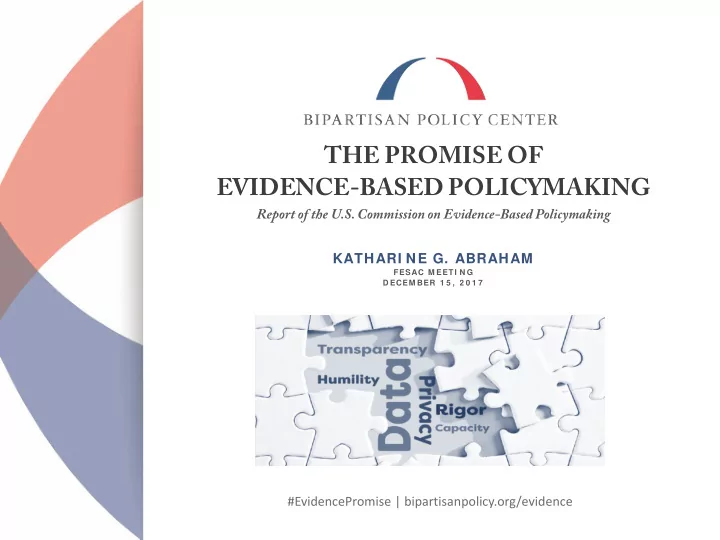
THE PROMISE OF EVIDENCE-BASED POLICYMAKING Report of the U.S. Commission on Evidence-Based Policymaking KATHARI NE G. ABRAHAM FESAC M EETI N G D ECEM BER 1 5 , 2 0 1 7 #EvidencePromise | bipartisanpolicy.org/evidence Commission on


slide-1
SLIDE 1

KATHARI NE G. ABRAHAM

FESAC M EETI N G D ECEM BER 1 5 , 2 0 1 7

THE PROMISE OF EVIDENCE-BASED POLICYMAKING

Report of the U.S. Commission on Evidence-Based Policymaking #EvidencePromise | bipartisanpolicy.org/evidence
slide-2
SLIDE 2
  • Commission was the result of bipartisan

agreement between Congress and the Obama administration that, with more and better evidence, the federal government could make better decisions on the budget and in authorizing and reforming programs

  • Created by legislation co-sponsored by Speaker Paul Ryan and

Senator Patty Murray, enacted March 30, 2016 (P .L. 114-140)

  • Members appointed by the President, Speaker of the House, House

Minority Leader, and Senate Majority and Minority Leaders –

  • 1/3 with expertise in privacy and confidentiality
  • 2/3 experts on program administration, data, or research
  • Final Commission report sent to the President and the Congress on

September 7, 2017

Commission on Evidence-Based Policymaking

2

slide-3
SLIDE 3
  • Commission spent 8 months gathering input:
  • 7 Public Meetings with 49 invited witnesses
  • 3 Public Hearings in DC, Chicago, and San Francisco with 37

witnesses

  • Request for Comments in the Federal Register with more than

350 submitted comments

  • CEP Survey of 209 Federal offices
  • More than 40 meetings with other groups
  • Following its fact-finding, Commission met in closed

session to consider all of the input received

  • Areas of agreement distilled into 22 recommendations
  • All endorsed unanimously by all 15 Commissioners

Commission’s Process

3

slide-4
SLIDE 4

“ Th The Com m ission … envisions a fut ure in w hich rigorous ev eviden ence ce is cr crea eat ed ed ef effici cien ent ly, as a rout ine e part of gove vernm ent t operat i t ions, and used t o t o const r t ruct t effect i t ive ve public policy.”

The Promise of Evidence-Based Policymaking: Report of the Commission on Evidence-Based Policymaking, September 2017

Commission’s Vision

4

slide-5
SLIDE 5
  • I m prove

ved Access t o t o Dat a t a – improve access to data for program administrators and researchers, facilitate linking of data sets

  • St ro

ronger r Priv rivacy P Pro rot ect io ions – strengthen privacy protections by making them more uniform across government and more dynamic in the face of changing risks associated with the use of data

  • Great er C

Capacit y – fill the existing gaps in capacity across actors inside and outside government, establish a single entity to better support data access and privacy protection

Major Themes in Final Report

5

slide-6
SLIDE 6
  • Establish a Nat ional Secure

re Dat a Serv rvice (NSDS) to facilitate access to data for evidence building while ensuring privacy and transparency in how the data are used.

  • Extend legal framework currently applicable to federal statistical

agencies to pr prohibi bit use of da dat a assem bl bled d by by t he NSDS for non

  • n-st

st at ist st ica cal purpose ses.

  • Review and re

revise law s aut hori rizing Federa ral dat a collect ion and nd us use to allow secure access to administrative and survey data for approved statistical projects.

  • Tak

ake st eps t o m ak ake dat at a a collect ed by st at at es av avai ailab able for evidence building purposes when program receives substantial Federal support.

  • Develop a single st re

ream am lined pro rocess for r ext ern rnal rese searchers to apply and qualify for secure access to confidential government data.

Recommendations to Improve Access to Data for Evidence-Building Purposes

6

slide-7
SLIDE 7
  • Require co

com prehensi sive risk sk asse ssessm sm ent s on de-ident ified confident ial dat a intended for public release to improve how data are protected and risk is managed.

  • Ado

dopt pt m ode dern pr privacy-enha nhanc ncing ng t echno hnologies for confident ial dat a used for evidence building to ensure the government’s capabilities to keep data secure and protect confidentiality are constantly improving.

  • Assign a senior

r official for r dat a policy in each government department to be responsible for stewarding that department’s data.

  • Codify

fy exist ing policies for r m aint aining int egri rit y and

  • bj ect ivit y in Federal statistics to promote continued trust in the

accuracy of this information.

Recommendations to Modernize Privacy Protections for Evidence Building

7

slide-8
SLIDE 8
  • I dent ify or

r est ablish a Chief Evaluat ion Officer in each department to coordinate evaluation and policy research.

  • Develop learning agendas

s in Federal dep epart m ent s to support the generation and use of evidence to address the full range of policymakers’ questions.

  • I m prov
  • ve coor
  • ordinat ion
  • n of
  • f gov
  • vernm ent -w ide evidence

ce building under OMB’s leadership.

  • Align adm inist ra

rat ive pro rocesses with evidence-building activities, including processes related to the approval of information collections and the procurement of services for evidence building.

  • Ensure

re t hat sufficient re resourc rces are re available to support evidence-building activities, including resources to support implementation of the Commission’s recommendations.

Recommendations to Strengthen Federal Capacity for Evidence Building

8

slide-9
SLIDE 9
  • Would be a separat e ent it y in the Department of Commerce built
  • n existing capacity at the Census Bureau and elsewhere.
  • Would not re

replace exist ing arra rrangem ent s for r accessing confident ial dat a that Federal agencies have already put in place.

  • Would play a leadership role in the de

developm pm ent and d appl pplicat ion

  • f st a

t at e t e-of

  • f-t h

t he-art rt pri rivacy pro rot ect ing t echnologies.

  • Would have capacit y t o pro

rovide t echnical and analyt ical al se service ces s on a fee-for-service basis for states and other jurisdictions

  • Would maintain a searc

rchable invent ory ry of appro roved pro roj ect s.

  • Would be guided by a st eering com m it t ee with broad

representation from the public, Federal agencies, states and academia.

9

Building the National Secure Data Service

slide-10
SLIDE 10
  • House Oversight and Government Reform Committee held a hearing

about the report and recommendations on Sept. 26, 2017

  • Bipartisan Policy Center agreed to continue the work of the Commission

after it sunset on Sept. 30, 2017. BPC will advocate for implementation

  • f the recommendations and further develop ideas contained in report

Next Steps

10

slide-11
SLIDE 11
  • Speaker Ryan and Sen. Murray co-filed the

“Fou

  • undat ion
  • ns for
  • r Evidence-Base

sed Pol

  • licym aking A

Act ” in the House and Senate.

  • Bill addresses 10 of the Commission’s

recommendations.

  • The bill was vot
  • t ed ou
  • ut of
  • f t he Hou
  • use

Com

  • m m it t ee on
  • n Oversight and

Gover ernm ent Ref eform o

  • n Nov. 2

. 2 and vot

  • t ed ou
  • ut of
  • f t he Hou
  • use on
  • n Nov
  • v. 15.
  • Additional legislation to be developed over

the next year.

  • Implementation also will require additional

guidance from OMB

Next Steps (continued)

11

slide-12
SLIDE 12
  • Sele

lect ed provis isio ions cont ain ained in in H.R. 4174

  • Establishes an advisory council charged to develop an implementation plan for

the NSDS

  • Clarifies that, unless otherwise prohibited by law, data maintained by federal

agencies shall, to the extent practicable, be available for evidence-building purposes

  • Directs departments to develop inventories of the data they collect
  • Requires comprehensive risk assessments of certain data releases,

strengthening efforts to protect confidentiality

  • Establishes Chief Evaluation Officer positions in government agencies
  • Directs government agencies to develop learning agendas
  • I ssues for fut ure le

legis islat lat io ion

  • Creation of the NSDS
  • Review and revision of laws that restrict federal agencies’ compilation and use
  • f confidential data for evidence-building purposes
  • Provision of resources to support expansion of evidence-building activities
  • To join BPC’s Evidence Initiative distribution list for periodic updates, email

nhart@bipartisanpolicy.org

Next Steps (continued)

12

slide-13
SLIDE 13

bipartisanpolicy.org/evidence

#EvidencePromise

13