The presenters have no conflicts of interest to Cultural Competence - - PDF document

the presenters have no conflicts of interest to
SMART_READER_LITE
LIVE PREVIEW

The presenters have no conflicts of interest to Cultural Competence - - PDF document

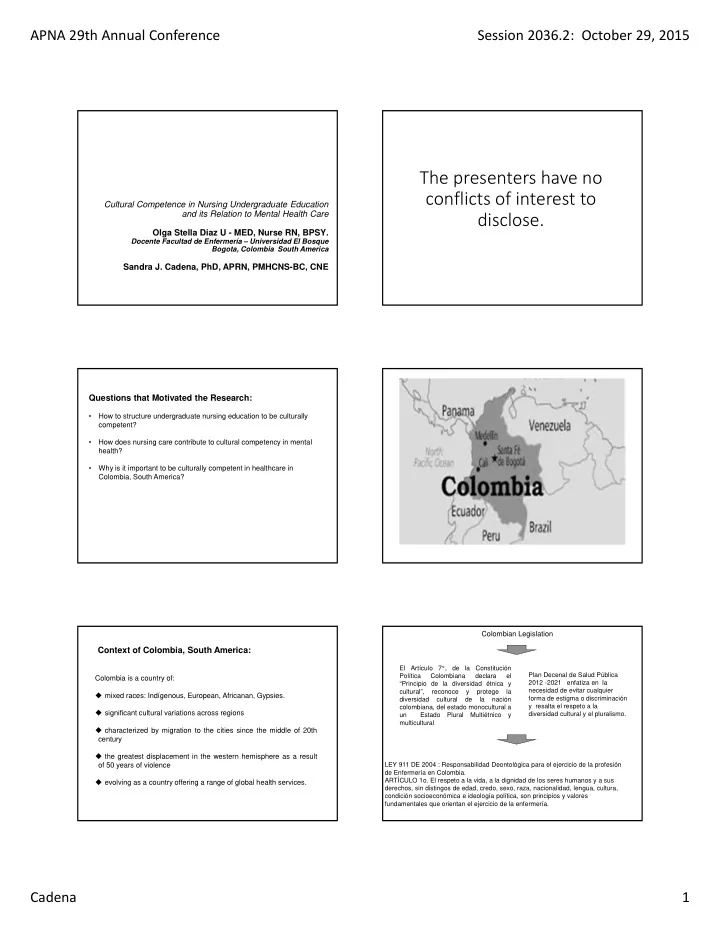
APNA 29th Annual Conference Session 2036.2: October 29, 2015 The presenters have no conflicts of interest to Cultural Competence in Nursing Undergraduate Education and its Relation to Mental Health Care disclose. Olga Stella Diaz U - MED, Nurse


slide-1
SLIDE 1

APNA 29th Annual Conference Session 2036.2: October 29, 2015 Cadena 1

Cultural Competence in Nursing Undergraduate Education and its Relation to Mental Health Care Olga Stella Diaz U - MED, Nurse RN, BPSY.

Docente Facultad de Enfermería – Universidad El Bosque Bogota, Colombia South America

Sandra J. Cadena, PhD, APRN, PMHCNS-BC, CNE

The presenters have no conflicts of interest to disclose.

Questions that Motivated the Research:

  • How to structure undergraduate nursing education to be culturally

competent?

  • How does nursing care contribute to cultural competency in mental

health?

  • Why is it important to be culturally competent in healthcare in

Colombia, South America?

Context of Colombia, South America:

Colombia is a country of:  mixed races: Indígenous, European, Africanan, Gypsies.  significant cultural variations across regions  characterized by migration to the cities since the middle of 20th century  the greatest displacement in the western hemisphere as a result

  • f 50 years of violence

 evolving as a country offering a range of global health services. Colombian Legislation

El Artículo 7°, de la Constitución Política Colombiana declara el “Principio de la diversidad étnica y cultural”, reconoce y protege la diversidad cultural de la nación colombiana, del estado monocultural a un Estado Plural Multiétnico y multicultural Plan Decenal de Salud Pública 2012 -2021 enfatiza en la necesidad de evitar cualquier forma de estigma o discriminación y resalta el respeto a la diversidad cultural y el pluralismo. LEY 911 DE 2004 : Responsabilidad Deontológica para el ejercicio de la profesión de Enfermería en Colombia. ARTÍCULO 1o. El respeto a la vida, a la dignidad de los seres humanos y a sus derechos, sin distingos de edad, credo, sexo, raza, nacionalidad, lengua, cultura, condición socioeconómica e ideología política, son principios y valores fundamentales que orientan el ejercicio de la enfermería.

slide-2
SLIDE 2

APNA 29th Annual Conference Session 2036.2: October 29, 2015 Cadena 2

CULTURAL COMPETENCIES

Capacity, interests and behaviors that promote inclusión, tolerance and diálogs about knowledge. Process to develop skills that are pertinent & care-based for the recognition of differences and similarities between cultures. (Campinha-Bacote, J. - http://transculturalcare.net/)

Basic requirements for the development of cultural skills Cultural Awareness Cultural Knowledge Cultural Competencies Cultural Desires Cultural Sensitivities Cultural Encounters

  • To take care of “the other” as elemental of mankind because of the fact of

“being human.”

  • To learn to recognize all cultures as legitimate including one’s own
  • Develop skills that allow for understanding of a ‘cosmic vision’ of those who

provide and/or receive care- basic in relationships of nursing (1).

  • Holístic care in nursing requires the capacity to understand culture as a major

component of health care delivery and encourage the willingness to identify experiences of patients & caregivers (2).

  • Nursing must recognize cultural symbols across individual and group levels
  • Develop capacity to accept the particular qualities expressed in need of care

and personal vision that determines each culture (3).

Background

Evidence-Based Literature

 Education in cultural competence improves knowledge, attitudes and skills of students (4,5).  Cultural competencies influence the quality of care,well being and mental health of patients (2).  Interest and commitment of administrative and academic staff of the schools of nursing in the education of cultural competency.  Inclusión in the undergraduate nursing curriculum.  Instruments and strategies for the exploration and measurement of cultural competencies in the basic curriculum should focus on culturally competent health care delivery.

  • Systematic experiences in the formatión of cultural competency is

difficult to identify and monitor in curriculum development.

  • Research studies reviewed associated and different perceptions of the

process of formation of cultural competency in both instructors and students.

  • Inadequate criteria for the evaluation of the development of cultural

competencies.

  • Standardized instruments need to be established in the process of

developing cultural competencies.

Evidence-Based Literature

Colombia in the World

GENERAL OBJECTIVES

Analyze guidelines and interviews for the development of cultural competence in undergraduate nursing students as a dimension of care that contributes to mental health.

SPECIFIC OBJECTIVES

  • Identify elements that facilitate and hinder the development of

cultural competence in nursing undergraduates.

  • Recognize proposed strategies implemented for the development
  • f cultural competence the nursing school at the Universidad El

Bosque (UEB)

  • Acknowledge contributions of cultural competency in mental

health care.

slide-3
SLIDE 3

APNA 29th Annual Conference Session 2036.2: October 29, 2015 Cadena 3

METHODOLOGY

Study: Qualitative descriptive Participants: Directors and instructors of the UEB undergraduate program Data Collection: Semi‐structured interviews with all directors and 6 instructors who had either taught theory and/or clinical courses in the undergraduate program. Length of data collection: Over two years in the program. Analysis: Based on the Grounded Theory approach. Analysis: The information was coded and categorized based on identified topics of the interview. Reaching saturation was verified by the constant comparison method. Dimensions were identified with integral components.

Findings

Dimension 1

Cult Cultural co compe mpetence ence in in th the cont context of

  • f nu

nursing car care

① Development of cultural competency ② Bidirectional ③ Susceptible to organizational definitions ④ Responsive to precipitants of care ⑤ Model for instructors ⑥ Aspects of self-reflection and culture

Dimension 2

El Elements that impede pede and and facilit cilitate the the developme velopment of

  • f

cul cultural al co comp mpeten etence ce in in nu nursin ing Impeding Elements:

① There is lack of clarity regarding the cultural dimension and any differences in other dimensions (social, spiritual) ② Lack of knowledge of their own culture among both faculty and students ① Need to consolidate the culture of “to be” in nursing program ② Lack of knowledge or interest in cultural expressions integral in health-illness process ⑤ Lack of instruments to evaluate a cultural dimension in education

Elements that Impede

“To know and understand that there are things in my culture that I may be trying to improve in care from my cultural perspective might be valid. I also have to analyze my culture; what is my background and how that plays into what I do; how I understand and experience care”. [A4CE5] “There is no dialogue of what is known; we have to be dogmatic. I have the knowledge and you simply follow {what I say}; there is no compromise.” [A1CE3].

slide-4
SLIDE 4

APNA 29th Annual Conference Session 2036.2: October 29, 2015 Cadena 4

Elements that Facilitate:

① Institutional Education Project ② Explicit interest in the program syllabus and learning objective ① Practice opportunities that enhance contact with peoples of different cultures ② Openings for specific students that come from diverse cultures ③ Required sociohumanistic courses ④ Acknowledgement of health conditions in the context of social determinants of health ⑤ “Normalizing” cultural aspects in nursing and health care.

Elements that Facilitate

“The institutional mission for a “culture of life, its quality and meaning” is an element of cohesion, not only in nursing. It is an institutional {UEB} imprint in favor of life and well being”. [A5CC4] “The curriculum, in its anthropological aspects, looks at ancestors to study and the regions including one’s origins. We emphasize that everyone brings a cultural inheritance, but we also teach to look at the patient and his/her environment “ [A3DCC2].

Dimension 3 Implemental strategies fo

for the the de develo lopment of

  • f cul

cultural al co comp mpeten etence ce in in nu nursin ing

  • Strengthening of the tools for the complete [total] measurement of the

recipient of care.

  • Development of practices in each semester in the community and the

educational settings.

  • Strengthening of the understanding of health in the context of public

health.

  • Research directed towards the recognition of cultural aspects associated

with situations of health and health care.

Di Dimens nsio ion 3 Str Strategies es

  • Guidelines for the development of insight (developed by students) that

will identify cultural aspects related to mental health and emotional well being.

  • Meetings with international faculty that bring both faculty and students

closer to an understanding of diverse cultural realities.

  • Strengthening institutional interest for widening options for exchanges

associated with the internationalization process.

  • Acknowledgement and exposure of the student’s cultural background;

participation in cultural events oriented to enhancing knowledge in the discipline

Dimension 4 Contributions to mental health by cultural competent care

  • Mutual acknowledgement of cultural diversity
  • Preserve cultural identity and maintain traditional and ancestral care

practices.

  • Enhance participation of patient & acknowledgement of autonomy in

health-related decisions.

“ If I acknowledge, in an integral fashion the person and do not ignore his/her history, I do not damage his identity that is the basis for one’s mental health….I am able to make him recognized and acccepted as a different person [from me] that cannot be disregarded”

[A4CE4]

Dimension 4

  • Stimulates the thinking about the myths and prejudices present in health

care.

  • Strengthens communication in the framework of the relationship
  • Enhances opportunities for empathetic communication
  • Raises questions about the relation of power that can limit self-

expression

  • Enhances the humane aspect of care within the patient-nurse

relationship. “To know the other person in his ‘singularity’ and in what he does differently, to interact with him, establish empathy and to have tools that will allow

  • interventions. To know my own prejudicies and facilitate the expression of
  • thers, brings us closer…”[ A6CC2].
slide-5
SLIDE 5

APNA 29th Annual Conference Session 2036.2: October 29, 2015 Cadena 5

Dimension 4

  • Integrate the human dimension into nursing care
  • Favor the care of the person over the disease
  • Humanize the care and project it in time and within the context of the

individual

  • Favor the respect of one’s individualized process of “being human.”

“It’s like…the capacity to get close to the other, to communicate, to have in mind that world that covers him… to listen to him…respects the

  • ther…” [A2DCC2]

“It is the respect for another....it is the capacity to incorporate the human dimension at the moment of planning and executing nursing care” . [A4CE3-4]

Emergent Dimension - Tensions

 Size of the groups and acknowledgement of the individuality of the students “With some students, when the group is small, or because they have particular characteristics, one is able to get to know the students…when it is a large group-more than 30- it is almost impossible. I believe when it’s a small group of students they are able to interact with the culture of faculty and the student’s cultures; when they are in large groups they are almost isolated from what we can call our culture; they walk on the side and you achieve little…” [A6RC1]  Development of cultural competency in instructors “I believe all the instructors should be culturally competent, not just those in the communities…” [A4DCC8]

Tensions

 Tools to evaluate culutral competency “It is not clear how or which one of the tools of the program and the actions of faculty can offer the student an understanding of each other and how this understanding is incorporated into the process of nursing care ” [A5DCC3].  Type of relationship that students and faculty develop “The knowledge of my culture as either a Director or instructor influences the establishment of a good or bad relationship with a student. In the encounter with one another (Director, faculty, classmate or patient) the cultures must be coherent with what is requested for the student as being competent {in one’s culture}” [A2RC1].

Conclusions

Recommended strategies for the development of cultural competency: ① Respond to the institutional interests for the recognition and respect for tolerance. ① Include ongoing activities in continuing education for cultural competencies formation for instructors and Directors. ② Incorporate cultutral competency horizontally (across all curriculum, administration) within the institution. ③ Include multidisciplinary cultural activities that facilitate the acknowledgement of diversity. ④ Research support to explore and develop tools, instruments and alternatives processes for evaluation. ⑤ Develop competencies within small groups and through collaborative efforts.

In Conclusion

To develop cultural competence means to  Understand each other  Show interest in an overarching fashion  Respect individuality  Remember that nursing care has the person as the object and not the disease. These understandings will strengthen the well being and mental health of each person. The development of cultural competency is the basis for all care of the human being taken from the perspective of the human being who cares. “It is basic to have interest to get to know [a person] and to put yourself at the same level of the other, as a human being that is equal to me, as a person with the same rights, that has a vision of himself and actively participates in his own care”.[ED2-2]

slide-6
SLIDE 6

APNA 29th Annual Conference Session 2036.2: October 29, 2015 Cadena 6

I thank you for your attention and interest in this research and my country of Colombia. Thank you to the APNA for opening the door for our exchange of knowledge. And thank you to Dra Sandra Cadena, for her permanent support of research initiatives and for her work as the co-investigator.

Acknowledgements

All comments are greatly appreciated. diazolga@unbosque.edu.co Scadenac@unbosque.edu.co

(1) Lillo Crespo, M. Enfermería Transcultural Aplicada al Proyecto Plan de Choque Intereuropeo‐ Holandés en Alicante. Biblioteca Las casas, 2006; 2 (2). Disponible en http://www.index‐f.com/lascasas/documentos/lc0119.php (2) Gallagher. Ruth. Características del nivel actual de la capacidad cultural en estudiantes del oficio de enfermera. 2009. University of South Florida College of Nursing. Doctorate of Nuring Practice Project, unpublished. (3) Salas Iglesias Pedro M. La ciencia de los cuidados, marco investigativo para alcanzar el éxito de la calidad de vida en el envejecimiento. 2006. Rev cultura de cuidado; año x, n° 19: 73‐ 78 (4) Beach MC, Price EG, Gary TL, et al. Cultural competence: a systematic review of health care provider educational interventions. Medical care 2005;43:356–73. (5) Price EG, Beach MC, Gary TL, et al. A systematic review of the methodological rigor of studies evaluating cultural competence training of health professionals. Academic Medicine 2005;80:578–86.

Re Refere rences Bi Bibliogr bliography

Lipson JG. Cultura y Cuidados de Enfermería. Index de Enfermería [Index Enferm] (edición digital) 2000; 28‐29. Disponible en: http://www.index‐f.com/index‐enfermeria/28‐29revista/28‐29_articulo_19‐25.php> Consultado el 5 de junio de 2009. Purnell L, Paulanka B. Diversity and Health Care. In: Purnell L, Paulanka B. Guide to Culturally Competent Health Care. Philadelphia: F.A. Davis Company, 2005;1‐ 5 Osorio‐Merchán May Bibiana, López Díaz Alba Lucero. Competencia cultural en salud: necesidad emergente en un mundo globalizado. Index Enferm [revista en la Internet]. 2008 Dic [citado 2009 Sep 17] ; 17(4): 266‐270. Disponible en: http://scielo.isciii.es/scielo.php?script=sci_arttext&pid=S1132‐12962008000400010&lng=es Beach MC, Price EG, Gary TL, et al. Cultural competence: a systematic review of health care provider educational interventions. Medical care 2005;43:356–73. Price EG, Beach MC, Gary TL, et al. A systematic review of the methodological rigor of studies evaluating cultural competence training of health professionals. Academic Medicine 2005;80:578–86. Strauss, A, Corbin, J. Bases de la investigación cualitativa. Técnicas y procedimientos para desarrollar la teoría fundamentada. Colombia: Universidad de Antioquia 2002

Gracias!