Conflicts of Interest: Dealing with the Inevitable! Conflicts of - - PDF document

conflicts of interest dealing with the inevitable
SMART_READER_LITE
LIVE PREVIEW

Conflicts of Interest: Dealing with the Inevitable! Conflicts of - - PDF document

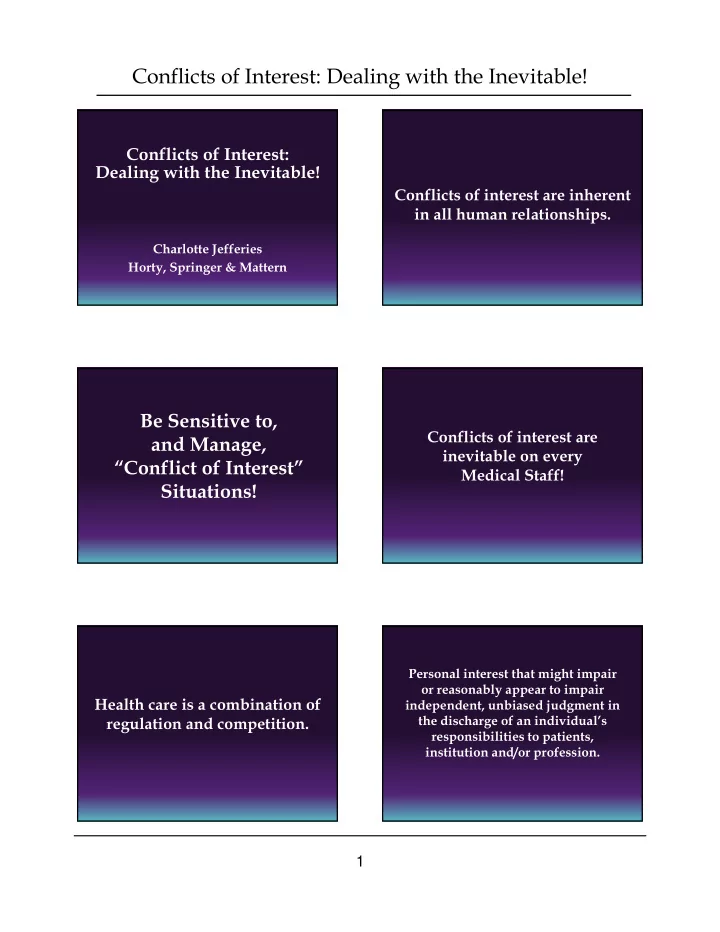
Conflicts of Interest: Dealing with the Inevitable! Conflicts of Interest: Dealing with the Inevitable! Conflicts of interest are inherent in all human relationships. Charlotte Jefferies Horty, Springer & Mattern Be Sensitive to,


slide-1
SLIDE 1

Conflicts of Interest: Dealing with the Inevitable!

1

Conflicts of Interest: Dealing with the Inevitable!

Charlotte Jefferies Horty, Springer & Mattern

Be Sensitive to, and Manage, “Conflict of Interest” Situations!

Health care is a combination of regulation and competition. Conflicts of interest are inherent in all human relationships. Conflicts of interest are inevitable on every Medical Staff!

Personal interest that might impair

  • r reasonably appear to impair

independent, unbiased judgment in the discharge of an individual’s responsibilities to patients, institution and/or profession.

slide-2
SLIDE 2

Conflicts of Interest: Dealing with the Inevitable!

2

COI can be real or perceived.

In medicine, decision-making is

  • ften made in best interest of:
  • physician
  • hospital
  • third-party payor
  • government

Conflicts Are Inevitable

  • Family member
  • Partner
  • Direct or indirect financial relationship
  • Competitor
  • History of conflict

Conflicts Are Inevitable

  • Close friends
  • Personally involved in care of patient
  • Reviewed case at prior level
  • Raised the concern
  • Employment relationship/contract

with hospital? COI in dual role – professional and businessperson:

  • Physician payment arrangements
  • Self-referrals
  • Physician ownerships
  • Promotional activities
  • Participation in industry-sponsored

clinical trials

  • Exclusive contracts
  • Situational COI
  • Pervasive – disqualifying COI

Types of COI

slide-3
SLIDE 3

Conflicts of Interest: Dealing with the Inevitable!

3

Basic Rules

First: DISCLOSURE Second: RECUSAL

Managing conflicts of interest is essential to:

  • Be fair to the physician under review
  • Protect integrity of the process
  • Protect person with COI

Assess the Situation:

  • What’s at root of conflict?
  • What are barriers preventing

resolution?

  • What are the best interests?
  • What are guiding principles?

Adopt Conflict of Interest Policy

Policy Should

  • Require disclosure
  • Authorize Chair (or committee) to resolve

dispute over conflict.

  • Allow individual with a COI to

provide information.

Whenever possible COI should be raised and resolved before meeting.

slide-4
SLIDE 4

Conflicts of Interest: Dealing with the Inevitable!

4

 Committee Chair always has discretion

to recuse member in particular situation if the Chair determines that the conflicted member’s presence would:

 Inhibit the full and fair discussion of

the issue

 Skew the recommendation or

determination of the committee, or

 Otherwise be unfair to the practitioner

under review

Safeguards

Minutes should reflect the individual with the COI left the meeting before discussion and did not vote.

Additional Practical Tips

No staff member has a RIGHT to demand recusal – within the discretion

  • f leadership

Additional Practical Tips

Choosing to refrain from participation is not a finding of actual conflict!

Routine disclosure of potential COI should be a basic inherent ethical responsibility.