Conflicts of Interest Dr. Ehret has no actual or potential conflicts - - PDF document

conflicts of interest
SMART_READER_LITE
LIVE PREVIEW

Conflicts of Interest Dr. Ehret has no actual or potential conflicts - - PDF document

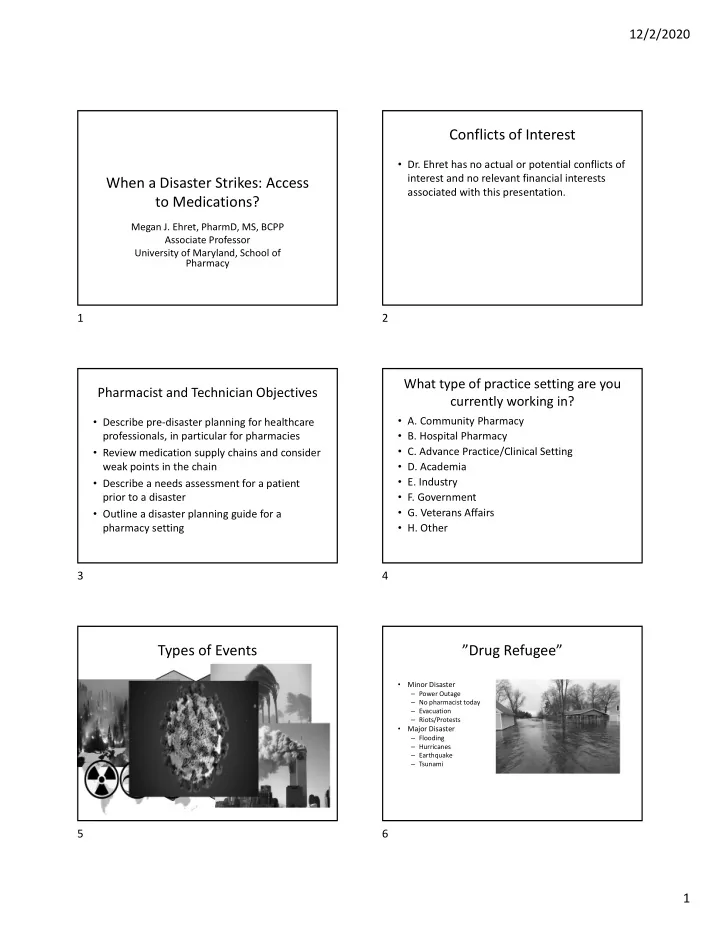
12/2/2020 Conflicts of Interest Dr. Ehret has no actual or potential conflicts of interest and no relevant financial interests When a Disaster Strikes: Access associated with this presentation. to Medications? Megan J. Ehret, PharmD, MS, BCPP


slide-1
SLIDE 1

12/2/2020 1

When a Disaster Strikes: Access to Medications?

Megan J. Ehret, PharmD, MS, BCPP Associate Professor University of Maryland, School of Pharmacy

Conflicts of Interest

  • Dr. Ehret has no actual or potential conflicts of

interest and no relevant financial interests associated with this presentation.

Pharmacist and Technician Objectives

  • Describe pre‐disaster planning for healthcare

professionals, in particular for pharmacies

  • Review medication supply chains and consider

weak points in the chain

  • Describe a needs assessment for a patient

prior to a disaster

  • Outline a disaster planning guide for a

pharmacy setting

What type of practice setting are you currently working in?

  • A. Community Pharmacy
  • B. Hospital Pharmacy
  • C. Advance Practice/Clinical Setting
  • D. Academia
  • E. Industry
  • F. Government
  • G. Veterans Affairs
  • H. Other

Types of Events

Natural Disaster Man‐ made Disaster Terrorist Event Complex Humanitarian Emergency War Occupation CBRNE Events

”Drug Refugee”

  • Minor Disaster

– Power Outage – No pharmacist today – Evacuation – Riots/Protests

  • Major Disaster

– Flooding – Hurricanes – Earthquake – Tsunami

1 2 3 4 5 6

slide-2
SLIDE 2

12/2/2020 2

Minor Disaster Question

  • Thunderstorm with major wind damage in a local
  • town. Power is out at one of the major hubs and

the independent pharmacy that everyone in town uses is closed. A major retail chain in the next town over has power.

  • Patient presents to the major retail chain with a

bottle for warfarin from the independent and states, “I am out of medication and my pharmacy is closed.”

  • What do you do?

Minor Disaster Question

  • A. Turn the patient away‐ you can’t call for a

transfer due to the independent being closed

  • B. Provide the patient with 3 days worth free
  • f charge
  • C. Provide the patient with an entire refill‐

worry about the transfer when the independent reopens

  • D. Call the provider to obtain a new script for

the medication to fill

Minor Disasters

  • Pharmacies might not be open

– Can I fill my prescription at any pharmacy that is open in town? – I don’t have my insurance card – I lost my prescription in the process – My pharmacy filled it, I didn’t pick it up yet, now they are not open – My medications were left out of the fridge, can I get new

  • nes?

– I am due for an injection, but my provider is not open or

  • nly doing telehealth

Major Disasters

  • No medications available

– Pharmacies are closed – Specialty medications‐ mail is slowed or stopped – Medications are expired‐ no fridge services available – No medications coming into area – Disruption in supply chains

  • Back order of medications

– Medication is unable to be made‐ example IV fluids/sterile water Hurricane Maria – Concerns over raw ingredients and drug supply manufacturing locations

  • No providers to prescribe medications

– Provider may not know medication history – Provider may be uncomfortable with certain medications (e.g. could a psychiatrist prescribe oncology medications?)

Supply Chains Supply Chains

  • Social and technical system by which demand

is identified, targeted, and fulfilled

  • Process of deciding what, when, and how

much is to be moved where

Ritchie EC et al. Current Psychiatry 2019

7 8 9 10 11 12

slide-3
SLIDE 3

12/2/2020 3

Commercial Supply Chain

Transportation

Fuel

Food/Water

Financial Electrical Power

Telecoms Medical Ritchie EC et al. Current Psychiatry 2019

Disaster Occurs Questions to Consider

  • Do I have a clear understanding of what

medications would be available through relief efforts? What is expected timetable would be for their restoration?

  • What basic formulary should I anticipate?
  • In case of an interruption in medication

supply, which of my patients are likely to have the most severe discontinuation syndromes?

  • What are my ethical and professional duties?

Ritchie EC et al. Current Psychiatry 2019

Questions to Consider

  • Should I be considering maintaining a supply
  • f certain medications? How do decision?
  • If I opt to maintain a small supply of certain

medications, do I know what I need to know to execute that plan? (e.g., securing of pharmaceuticals, expiration, temperature)

  • For long‐term stability‐maintenance patients,

what is a reasonable degree of disaster planning education/discussion?

Ritchie EC et al. Current Psychiatry 2019

Questions to Consider

  • What could be the short‐term and mid‐term

impacts of not having access to the electronic medical record be in may particular practice?

  • How have other providers dealt with these

questions in previous disasters?

Ritchie EC et al. Current Psychiatry 2019

Assessment of Where You Stand

Disaster Response Recovery Mitigation Preparation

13 14 15 16 17 18

slide-4
SLIDE 4

12/2/2020 4

Reasons to do an Assessment

  • Develop a strategic plan
  • Reports to command, families, media
  • Apportion resources
  • Target interventions

2017‐2022 HealthCare Preparedness and Response Capabilities; Dept. of HHS

Needs Assessment

  • Individual
  • Group
  • Population

– Consider vulnerable populations

  • Chronically mentally ill
  • Physically ill
  • Disabled

2017‐2022 HealthCare Preparedness and Response Capabilities; Dept. of HHS

Basic First Assessment of Physical Needs

  • Number affected
  • Shelter
  • Food
  • Wounds/Illnesses
  • Infectious Disease
  • Medications available
  • Fuel

– Heating – Cooking

  • Continued violence
  • Mass fatalities

2017‐2022 HealthCare Preparedness and Response Capabilities; Dept. of HHS

Assessment of Health Needs

  • Vulnerable populations

– Mentally ill – Children – Prisoners – Wounded – Bereaved

  • Medications
  • Hospital Beds

– General – ICU – Medical surge – Psychiatry

2017‐2022 HealthCare Preparedness and Response Capabilities; Dept. of HHS

Assessment of Health Needs

  • Try to gain as much information as possible

before departure to affected site

  • On the ground assessment usually necessary
  • Persons to talk to

– Schools – Hospitals – Clergy – Community leaders – Shelters

2017‐2022 HealthCare Preparedness and Response Capabilities; Dept. of HHS

Assessment Needs to be On‐Going

  • “Honeymoon” period common following

disasters

  • Attention and media leave:

– Physical and psychological needs surface – Feeling of bitterness, abandonment, anger

  • Clean‐up period

– Tedious, may still be dangerous

19 20 21 22 23 24

slide-5
SLIDE 5

12/2/2020 5

Assessment Question

  • In your current place of employment, have

you ever had training in disaster planning?

  • A. Yes
  • B. No
  • C. I might have, but I can’t recall

Completing the Assessment Disaster Assessment

  • Identify your team
  • Identify risks and needs (SWOT)

– Access to regional healthcare resources – Prioritize resource gaps and mitigation strategies – Consider vulnerable populations – Regulatory compliance

2017‐2022 HealthCare Preparedness and Response Capabilities; Dept. of HHS

Disaster Assessment

  • Develop Preparedness Plan

– Healthcare and medical response coordination – Emergency operations plan – Communications – Essential functions

  • Different for each setting
  • Supply chains
  • Finance functions
  • Sheltering in place
  • Protecting healthcare information systems and networks
  • Protecting responders’ safety and health

– Healthcare evacuation and relocation

Medical Surge Alternative Care Systems‐ Telemedicine/Virtual 2017‐2022 HealthCare Preparedness and Response Capabilities; Dept. of HHS

Disaster Assessment

  • Recovery Plan
  • Train and prepare the healthcare medical

workforce

  • Ensure preparedness is sustainable

2017‐2022 HealthCare Preparedness and Response Capabilities; Dept. of HHS

Examples/Thoughts for Discussion

25 26 27 28 29 30

slide-6
SLIDE 6

12/2/2020 6

Psychiatric Issues‐Acute

  • Stress as a reaction
  • Additional fear of unknown with CBRNE
  • Changes in mental status secondary to any

agents

  • Medical triage
  • Quarantine, reverse isolation
  • Loss, grief
  • Under‐reactions

Ritchie EC et al. Current Psychiatry 2019

“Drug Refugees”

  • Limited to no medications
  • Withdrawal symptoms
  • Symptoms return
  • Self inflicted harm
  • Psychosis
  • Cravings

Ritchie EC et al. Current Psychiatry 2019

Opioid Withdrawal

Early

  • Watery eyes
  • Runny nose
  • Sweating
  • Anxiety/Irritability
  • Poor sleep
  • Muscle pain

Later

  • Cramping
  • Diarrhea
  • Vomiting
  • Increased heart rate and

blood pressure

  • Restlessness
  • Shakiness
  • Chills
  • Sweating
  • Goose bumps
  • Dilated pupils

Ritchie EC et al. Current Psychiatry 2019

Katrina Behavioral Health Needs

  • Chronically mentally ill off medications

– Note: psychiatric medications not in stockpile

  • Displaced psychiatrists and populations

– Volunteers needed – Issues of housing, transportation

  • Louisiana National Guard

– All flooded to the “crash site”

  • Importance of pets
  • Long term issues of “diaspora”

Ritchie EC et al. Current Psychiatry 2019

Solutions

Patient

  • Refills prior to disaster

(personal stockpile)

  • Emergency kit prepared to

grab if you need to go quickly

  • Stock medications in multiple

places‐ office, home, family members house

  • Carry medication list with

current and past medications, allergies, and provider contact information

Provider

  • Develop emergency

plans for injections, blood draws, and other time sensitive monitoring

  • Provide patients with

medication lists

  • Discussions with

patients to be prepared

Ritchie EC et al. Current Psychiatry 2019

Resources

31 32 33 34 35 36

slide-7
SLIDE 7

12/2/2020 7

37