
SLIDE 1
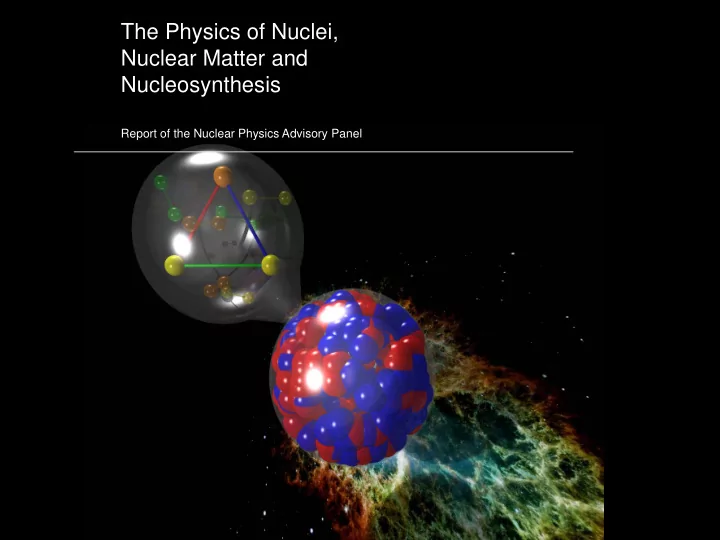
The Physics of Nuclei, Nuclear Matter and Nucleosynthesis
Report of the Nuclear Physics Advisory Panel
The Physics of Nuclei, Nuclear Matter and Nucleosynthesis Report - - PowerPoint PPT Presentation
The Physics of Nuclei, Nuclear Matter and Nucleosynthesis Report of the Nuclear Physics Advisory Panel Advice to PPAN via the Nuclear Physics Advisory Panel Science Priorities Funding Facilities Projects What are the Origins of the Elements?
Report of the Nuclear Physics Advisory Panel
What are the Origins of the Elements? How, and where, were the heavy elements synthesised? What are the key reaction processes that drive explosive astrophysical events such as supernovae, and X-ray bursts? What is the equation-of-state of compact matter in neutron stars? What are the nuclear processes, and main astrophysical sites, that produce the γ-ray emitting radionuclides
How do nuclear reactions influence the evolution of massive stars, and how do they contribute to observed elemental abundances? What is the Nature of Nuclear Matter? What are the limits of nuclear existence? How do simple patterns emerge in complex nuclei? Can nuclei be described in terms of our understanding of the underlying fundamental interactions? What is the equation-of-state of nuclear matter? How does the ordering of quantum states change in extremely unstable nuclei? Are there new forms of structure and symmetry at the limits of nuclear existence? How do the properties of hadrons and the quark- gluon plasma emerge from fundamental interactions? What is the mechanism for confining quarks and gluons in strongly interacting particles (hadrons)? What is the structure of the proton and neutron and how do hadrons get their mass and spin? Can we understand the excitation spectra of hadrons from the quark-quark interaction? Do exotic hadrons (multiquark states, hybrid mesons and glueballs) exist? What are the phases of strongly interacting matter and what is the nature of the quark-gluon plasma? How do nuclear forces arise from QCD?
1000 2000 3000 4000 5000 6000 7000 8000 9000 2006 2008 2010 2012 2014 2016 2018 2020 2022
Year Funding (k£)
Full Funding Current Projects
Based on potential scientific impact, balance of programme, leadership, strategic importance……… Original: £35M
New: £23.5M
reduction to 65%
1000 2000 3000 4000 5000 6000 7000 8000 9000 2006 2008 2010 2012 2014 2016 2018 2020 2022
Year Funding (k£)
Full Funding Current Projects Prioritised Funding
NuSTAR-programme
experiments on the storage ring EXL, ILIMA
ISOL-UK
measurements with ISOL beams – nuclear astrophysics, transfer studies, collective properties.
AGATA
PANDA Disc DIRC
feasibility study – if successful then invited to submit full proposal
exotic particles (mesons), heavy glueballs……
JLAB-upgrade
ELENA
1) Nothing? 2) Something? One suggestion: Fund, from the grants stream AFs/PDRFs in theory in 2010 and 2012 Could apply to work in any group Vetted by NPGP If no candidates make quality cut – no award Need to find funds.
Report of the Nuclear Physics Advisory Panel