
SLIDE 1
THE NORTH AMERICAN PETROLEUM RENAISSANCE (Reshaping World LNG - - PowerPoint PPT Presentation
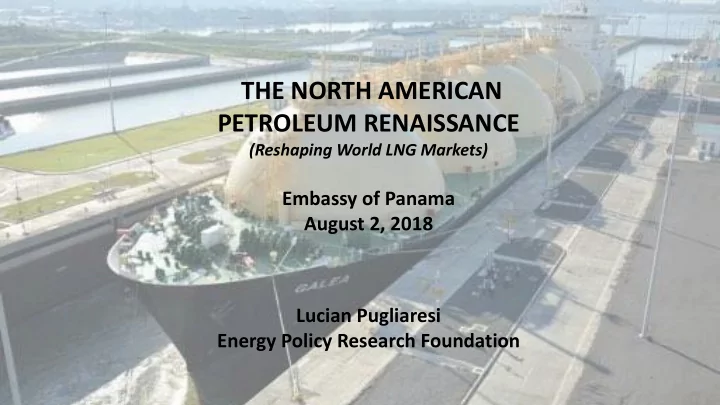
THE NORTH AMERICAN PETROLEUM RENAISSANCE (Reshaping World LNG Markets) Embassy of Panama August 2, 2018 Lucian Pugliaresi Energy Policy Research Foundation About EPRINC Founded 1944 Not-for-profit organization Studies intersection
economics and public policy
analyses for distribution to the public
e.g. Quadrennial Energy Review, DoD strategic outlook
ASIAN LNG
2
3
4
Stanley, Steven M. (1999). Earth System History. New York: W.H. Freeman and Company.
Power of Source Rock + Private Property Source: EIA
Source: HPDI Sept 2014, Past 90 Days
Williston Basin Powder River Basin Uinta Basin DJ Basin (Niobrara Reservoir) Anadarko Basin
(Mississippian, Granite Wash, Mississippi Lime and other stacked plays)
Permian Basin Eagle Ford Reservoir Utica
6
Well Site in the Barnett Shale Play, North Dakota
Source: Completion Design Changes on Well Productivity, Curtis & Montalbano, Forthcoming EPRINC paper, (November 2017). Note: Well productivity indexed to a base curve, which equals 1.
2 3 4 5 6 Reserves developed (billion barrels) Years Oshore shallow water Oshore deepwater Convennal onshore Extra-heavy oil and bitumen Tight oil
Iran Saudi Arabia Qatar Nigeria Venezuela Canada Russia Algeria Norway China Brazil Iraq United States
10 20 30 40 50 60 70 80
between FID and first production is a fraction of that for conventional fields (few months) and much lower capital intensity (few millions dollars)
Average lead times between final investment decision and first production for different oil resource types
US Rig Count
But the response is also fast when prices recover; Reflected in the sharp rise in the rig count and reverse in the declines
US Crude Production, y/y change, kb/d
US shale and been fastest to respond to decline in
200 400 600 800 1,000 1,200 1,400 1,600 1,800
(1,000) (500)
1,000 1,500 2,000
Jan-14 Apr-14 Jul-14 Oct-14 Jan-15 Apr-15 Jul-15 Oct-15 Jan-16 Apr-16 Jul-16 Oct-16 Jan-17 Apr-17 Jul-17 Oct-17
Source: Baker Hughes, Barclays
2017 Net Imports: 3.7 mbd
2017 Net Imports: 1.3 mbd
FACTORS DRIVING LOW NATURAL GAS COSTS
(2,500 lbs/ft)
Haynesville S
Bcf in 2025.
efficiencies counters increases in service costs
costs to $2.60/Mcf compared to $2.50/Mcf in 2017.
2017 vs 2025 (projected) – CASE STUDY OF THE Haynesville Play
Source: Vello Kuuskra, Advanced Resources International. Presentation at EPRINC Natural Gas Workshop, Washington, DC. April 19, 2018.
(Current Environment Advances Technology and Lowers Cost) 1. Resource base is vast, distributed among many players, subject to constant cost reductions and technology improvements, rapid infrastructure build-out (except in NY), government oversight is largely (but not always) efficient. 2. The separation of pipeline transportation services from gas sales 3. Third-party access to pipelines, storage, and LNG terminals 4. Transparency in the reporting of gas pipeline capacity utilization, tariffs, and prices at market hubs.
1. Increased “execution certainty” 2. More midstream (distribution) optionality
4.35 Bcf/d 32.6 MMt/yr
Sources: HPDI (drilling info), EIA, Raymond James
World Natural Gas Demand is Growing – IFIs are supporting natural gas regas and power infrastructure World LNG supply potential is growing -- US led shale gas leading the way, but new supplies also coming from Egypt, East Med, Africa Natural gas demand is expanding driven driven by energy security and environmental benefits LNG offers greater market flexibility, lower political risk, & lower cost for longer distance markets than pipelines US is cooperating with Asian and European Allies to expand natural gas infrastructure and regas Capacity Where does Cyprus fit in?
Source: Platts
Source: Poten & Partners
8 Bcf/d
Source: EIA, Platts
Production Distribution Liquefaction Shipping Falling break-even costs, technological advances, surge in associated gas Increasing midstream
uncertainty Efficient buildout of export capacity for rising demand Sustaining access to Panama Canal, lowering risk for vessel construction Underlying regulatory reform relevant to all 4 sectors
Transport capacity to Gulf Coast liquefaction plants will increase by 7.7 Bcf/day by 2020 Increased optionality will further cut already declining export prices
Cost of Production and Distribution Continue to Decline
Planned Expansion of Midstream Infrastructure: Delivered Cost to Liquefaction Facility Falling
EPRINC
Governments of Japan and U.S.
Presented in Tokyo (Oct 2017) -- Accepted by both Governments
Study for 7th Annual LNG Producer Consumer Meeting in Nagoya (October 2018) – Now Underway
Restrictions on Scheduling and Delays Increasing Costs for US Exports -- $45,000/day The Panama Canal Authority is working with LNG shippers towards doubling the capacity set aside for LNG vessels by next October 2018 Ship movements by the Panama Canal Authority (ACP) are outside the jurisdiction on the United States and Japan. However, in recent years, ACP has been active with U.S. and many foreign port authorities concluding agreements on joint marketing plans. Policy Recommendation Direct Engagement with ACP: METI and DOE should directly engage the ACP to develop formal data exchanges and research sharing on the future of LNG trade and strategies to support long-term and cost effective movement of LNG vessels to and from Asia to North America
THE FUTURE OF ASIAN LNG IEEJ – EPRINC JOINT RESEARCH PROJECT
US COMMITMENT TO GROWING THE WORLD LNG MARKET IS JUST BEGINNING