The Renaissance Why did the Renaissance begin in Italy? Italy had - - PDF document

the renaissance
SMART_READER_LITE
LIVE PREVIEW

The Renaissance Why did the Renaissance begin in Italy? Italy had - - PDF document

The Renaissance Why did the Renaissance begin in Italy? Italy had become a crossroads for travel more cities than other nations in Europe ruled by aristocrats had merchant princes arts supported by the wealthy


slide-1
SLIDE 1

The Renaissance

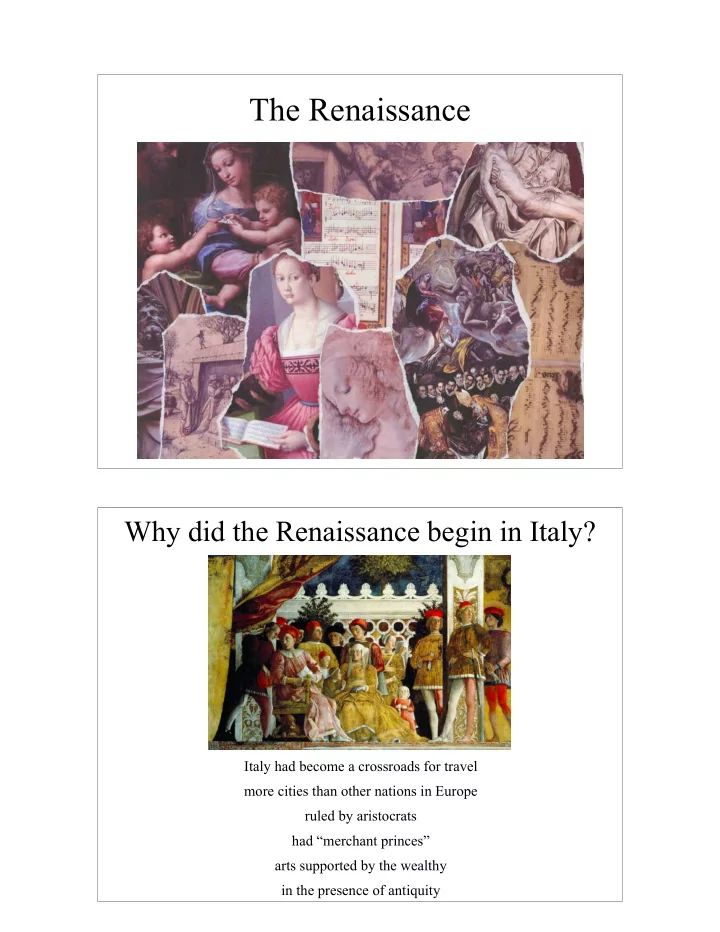
Why did the Renaissance begin in Italy?

Italy had become a crossroads for travel

  • more cities than other nations in Europe
  • ruled by aristocrats
  • had “merchant princes”
  • arts supported by the wealthy
  • in the presence of antiquity
slide-2
SLIDE 2

stratification now based on wealth as well as title

  • Baldassare Castiglione:

The Book of the Courtier

  • profit-makers indulged in

philanthropy

  • wealthy wanted to use their wealth

to enjoy the pleasures of life

  • very patriarchal society
  • marriages were arranged

Renaissance Society Renaissance Italy Politics

5 major Italian states:

Rome Venice Milan Florence the Kingdom of Naples

  • many Italian cities were

trade centers

  • signoria: city-state government
  • wealthy business people became

these cities’ leading citizens

  • lived in beautiful homes

employed great artists to decorate them

slide-3
SLIDE 3

Florentine gold coin (the florin) was the standard coinage throughout Europe

  • the city guild members planned and voted on city issues

Renaissance Florence

the center of the Italian Renaissance guild members included textile workers, bankers, masons, builders, sculptors, lawyers

  • members of the guilds were wealthy and held

positions in government

  • the Palazzo Vecchio [left], constructed in 1299,

the home of the Florentine guilds contributed to the construction of grand cathedrals

  • a competition developed between the rich merchants to see who could commission

the grandest buildings

Florentine Wool Trade

artist guilds regulating trades were the basis of Florence’s commercial success much of Florence’s wealth was dependent on the manufacture or trade of wool Florentine textile workers cleaned, carded, spun, dyed, and wove the wool into cloth of excellent quality the most powerful guilds were those that represented textile workers

slide-4
SLIDE 4

In 1397, Giovanni de Medici, banker to the Papal Court, established headquarters in Florence.

  • Giovanni held almost every political office in Florence

at some point in his life.

  • Giovanni died in 1429, leaving behind a legacy of

patronage for the arts and a son, Cosimo de Medici.

The Medici Family

leaders of Florence Cosimo took over the family banking business and built up his father's fortune, establishing business connections all over Europe. The Medici family controlled Florence throughout much of the Renaissance.

Giovanni de Medici Cosimo de Medici

Cosimo's grandson, Lorenzo de Medici, was known as ‘Il Magnifico.’

  • Lorenzo lived more elegantly than had Cosimo.

Lorenzo the Magnificent

During Lorenzo’s rule, from 1469 to 1492, Florence became the most important city-state in Italy and the most beautiful city in all of Europe. Under Lorenzo’s control, the Florentine economy expanded significantly

slide-5
SLIDE 5

The Medici family was ousted by an uprising spawned by a fanatical priest, Girolamo Savonarola.

  • Savonarola began preaching against the

immorality of the Renaissance.

  • After the Medici were ousted in 1494,

Savonarola assumed power and drafted a new draconian constitution.

  • He burned any books he considered immoral.

Girolamo Savonarola

In 1495, Savonarola went too far when he challenged the authority of Pope Alexander VI.

  • Savanarola lost his support, was declared a heretic, and was burned at the stake.

In 1502 Niccolò Machiavelli was appointed as political adviser and protégé to Piero Soderini, elected chief magistrate for life of Florence. Soderini’s soon surrendered to the attacking Medici, however, signaling the end of Machiavelli’s dreams of political greatness.

  • Machiavelli then asked for a job with Giovanni de Medici’s

new regime, but instead, the Medici sent him into solitary exile.

Niccolò Machiavelli

“Since love and fear can hardly exist together, if we must choose between them, it is far safer to be feared than loved…”

  • “I see that one is obliged to look to the results of an action, and not to the means by which it was achieved…”
  • “The fortunate man is he who fits his plan of action to the times.”

While in exile Machiavelli composed The Prince, a manifesto which came to symbolize a new breed of politics that was shrewd but without morality. He remained in exile for the rest

  • f his life. His legacy was his name and his manifesto.
slide-6
SLIDE 6

The Renaissance Papacy

They used the papal military to enforce and expand upon the longstanding territorial and property claims of the papacy. With ambitious expenditures on war and construction projects, popes turned to new sources of revenue from the sale

  • f indulgences and bureaucratic and ecclesiastical offices.
  • The popes became absolute monarchs but unlike their European peers, they were

not hereditary, so they could only promote their family interests through nepotism.

  • (The word nepotism originally referred specifically to the practice of creating cardinal-nephews;

it appeared in the English language about 1669.)

The Renaissance popes were known for their sponsorship of the arts and their political machinations, but not for their theology, morality, or spirituality.

  • These popes became both religious and secular

rulers, signing treaties with other sovereigns and fighting wars.

Alexander VI (1492-1503) had four acknowledged children.

Renaissance Popes

Good and, well...

Nicholas V (1447-1455) was best-known for the rebuilding of St. Peter's Basilica, which began during his reign. Julius II (1503-1513) commissioned Michelangelo to decorate the Sistine Chapel. He also become known as “the Warrior Pope” for his use of bloodshed to increase the territory and property of the papacy. Leo X (1513-21) was said to have remarked: “Let us enjoy the papacy, since God has given it to us.” The diplomatic and military campaigns of Pope Clement VII (1523-1534) resulted in the Sack of Rome in 1527.