
SLIDE 1
Why did the Renaissance begin in Italy?
Italy had become a crossroads for travel more cities than other nations in Europe ruled by aristocratic “merchant princes” arts supported by the wealthy in the presence of antiquity
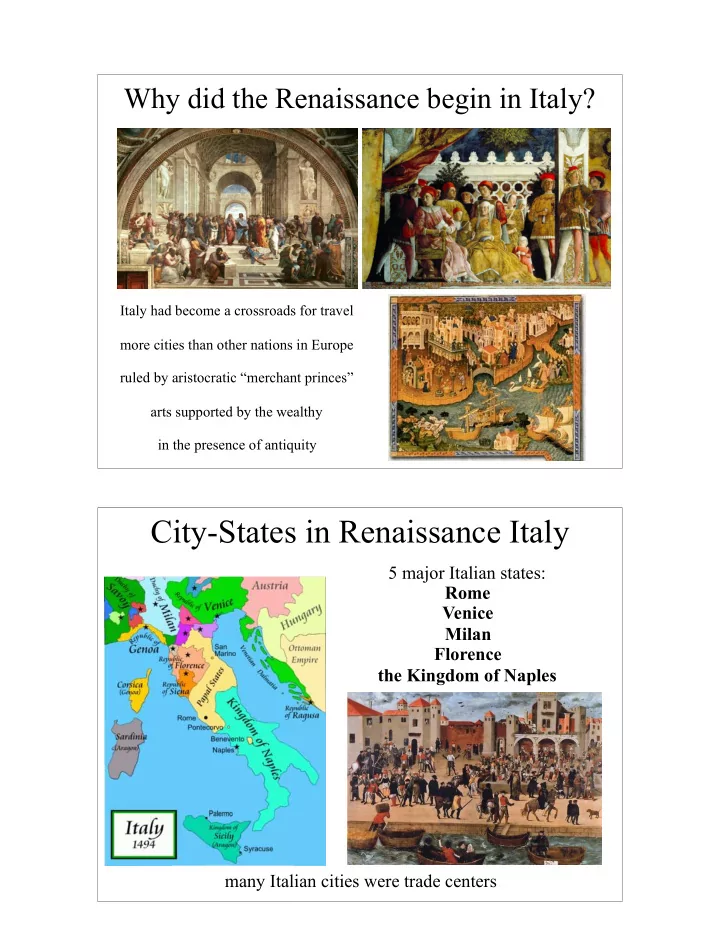
City-States in Renaissance Italy 5 major Italian states: Rome - - PDF document
Why did the Renaissance begin in Italy? Italy had become a crossroads for travel more cities than other nations in Europe ruled by aristocratic merchant princes arts supported by the wealthy in the presence of antiquity City-States in
Italy had become a crossroads for travel more cities than other nations in Europe ruled by aristocratic “merchant princes” arts supported by the wealthy in the presence of antiquity
Florentine gold coin (the florin) was the standard coinage throughout Europe the city guild members planned and voted on city issues
Florence: the center of the Italian Renaissance
(remember: guild members included textile workers, bankers, masons, builders, sculptors, lawyers)
members of the guilds were wealthy and held positions in government the Ponte Vecchio [left], constructed in 1299, the home of the Florentine guilds contributed to the construction of grand cathedrals a competition developed between the rich merchants to see who could commission the grandest buildings
profit-makers indulged in philanthropy
Middle Ages: art and learning centered on the church/religion by the 14th century: people became more interested in thinking about themselves and what they were capable of doing this was to be accomplished through the study of the studia humanitatis, today known as the humanities: grammar, rhetoric, history, poetry, and moral philosophy this became known as humanism
Humanist educators sought to create an educated citizenry who could: speak and write with eloquence and clarity engage in the civic life of their communities persuade others to virtuous and prudent actions
Petrarch (1304-1374) known as the “Father of Humanism” Italian poet who studied the works of Roman writers and modeled some of his own writings on their works
his best know work is a collection of love sonnets to Laura, a married woman with whom he’d become infatuated
in art of the Middle Ages, saints in paintings wore halos and were larger in scale than ordinary or less important figures
The central figures of the Madonna and child in this Middle Ages painting are larger than
that they are the most important figures in the painting. “Breeze, blowing that blonde curling hair, stirring it, and being softly stirred in turn, scattering that sweet gold about, then gathering it, in a lovely knot of curls again…” The holy family of Mary, Joseph and baby Jesus are joined here by shepherds and an angel in the center playing a lute. The landscape around them is earthly rather than heavenly.
Renaissance art incorporated humanist ideals
saints began to look more like ordinary people