The Need for Distributed Intelligence Automation Implemented through - - PowerPoint PPT Presentation

the need for distributed intelligence automation
SMART_READER_LITE
LIVE PREVIEW

The Need for Distributed Intelligence Automation Implemented through - - PowerPoint PPT Presentation

The Need for Distributed Intelligence Automation Implemented through Four Overlapping Approaches ! Intelligence Automation Software, Standardization for Interoperability, Network-Centric System of Systems Infrastructure (with Advanced Cloud


slide-1
SLIDE 1

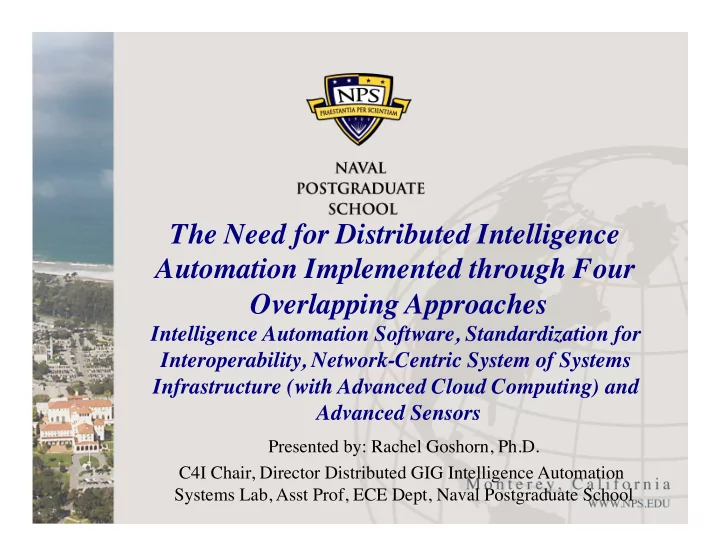
The Need for Distributed Intelligence Automation Implemented through Four Overlapping Approaches!

Intelligence Automation Software, Standardization for Interoperability, Network-Centric System of Systems Infrastructure (with Advanced Cloud Computing) and Advanced Sensors "

Presented by: Rachel Goshorn, Ph.D. ! C4I Chair, Director Distributed GIG Intelligence Automation Systems Lab, Asst Prof, ECE Dept, Naval Postgraduate School !

slide-2
SLIDE 2

Four Goshorn Authors - Paper is the Result

  • f 10+ Years of Goshorn Collaboration

!

  • Dr. Lawrence

Goshorn

  • Dr. Rachel

Goshorn (me!)

  • Dr. Joshua Goshorn

(Ph.D, 2011)

  • Dr. Deborah

Goshorn

* Invited Book Chapter: Reference: Rachel E. Goshorn, Deborah E. Goshorn, Joshua L. Goshorn, and Lawrence A. Goshorn “Behavior Modeling for Detection, Identification, Prediction, and Reaction (DIPR) in AI Systems Solutions” Handbook of Ambient Intelligence and Smart Environments, Springer Handbook (http://www.springerlink.com/content/n812r0064785g764/ ) * 10+ Years of Collaboration in Intelligence Automation for Distributed Systems (+growing up w/ advanced technologies) * Invited Book on Tutorial Material Underway (majority of book material completed)

slide-3
SLIDE 3

AI History of Events to Now … !

3

  • 11-12 yrs ago: started intelligence automation!
  • 10 yrs ago: intelligence automation (looking for “bad

behaviors” of people in the lab, cars on the freeway)!

  • 4-6 yrs ago: finding bad behaviors/jamming signals in

the blue-comms spectrum and removing them!

  • 3-6 yrs ago: finding IED initiators (bad behaviors) - and

selective jamming of IED initiators!

  • 1.5-3 yrs ago: AI Network-Centric Systems Engineering

Lab with fixed sensors. Detect, Identify, Predict, React (DIPR)!

  • Now-1.5 yrs ago: mobile ground/airborne vehicles!
  • Now-1.5 yrs ago: NetCentric Operations/Warfare with

automated unmanned vehicles!

  • Now-1 year ago: Concept Level - Intelligence

Automation for Cyber Security/Warfare!

slide-4
SLIDE 4

Need for Intelligence Automation and Specialized Sensors at Multiple Levels of the GIG

Need for Automation !

4

Need for Automation!

  • 1. Predict & Prevent

Terror/Crime ! (DoD, DHS, Everyday)!

  • 2. Current Economic

Crisis ! (Crime/Terror + $ )!

  • 1. Need for

Intelligence Automation!

  • 2. Need for

Standardization for Interoperability!

  • 3. Need for

Network-Centric System of Systems!

  • 4. Need for New

Sensors!

drives drives

slide-5
SLIDE 5

Need for Automation !

5

  • 1. Need for

Intelligence Automation!

  • 2. Need for

Standardization for Interoperability!

  • 3. Need for

Network-Centric System of Systems!

  • 4. Need for New

Sensors!

Need for Automation!

Predict & Prevent Terror/Crime ! (DoD, DHS, Everyday)! Current Economic Crisis ! (Crime/Terror + $ )!

  • 1. Detection!
  • 2. Identification!
  • 3. Prediction!
  • 4. Reaction!

+ advanced fusion! + advanced learning

  • 2a. Standard!

Interfaces

  • 1. Intel !

Automation

  • 2. Comms!
  • 3. Security!
  • 2b. Standard!

GIG Nodes

  • 1. Dumb (pass !

raw data)

  • 2. Intelligent (some!

automation)!

  • 3. Stand Alone (with !

rules of engagement)!

  • 1. Top-Down System !

(Enterprise/Collaboration/Cloud)!

  • 2. Bottom-Up System!

(Origination of Data: sensors, unmanned systems, etc)!

  • 3. Middle-Ware System!

(Smart push/smart pull)!

  • 4. Side-View System!

(Disadvantaged Users)!

+ NC Core (integrates SoS)! (networks, comms, distributed !

processecing, real-time processing,! cyber,…)!

+ Where is the data?! (back-ups)! New threats ! require new ! sensors (comply ! with standards !

  • f #2)!

drives drives

Need for Intelligence Automation and Specialized Sensors at Multiple Levels of the GIG

slide-6
SLIDE 6

The Need!

Driver 1: Predict/Prevent Terror/Crime! Driver 2: Current Economic Crisis!

6

slide-7
SLIDE 7

Current/Future Warfare !

  • Terror threats are national,

worldwide, and across the maritime domain (brown, green blue waters), and are the defining forces of the GWOT and Homeland Security.!

  • To mitigate these threats, we

must automate detection, identification, prediction and reaction to nationally and globally distributed potential terror threats. !

7

  • The Global Information Grid (GIG), whether global or national, is

the building block to bring information together. !

  • From information, comes intelligence.!
slide-8
SLIDE 8

Current/Future Warfare (Cont.) !

  • GWOT and Homeland protection is made

up of two elements: intelligence to determine a threat and the force to stop it. !

  • Intelligence is currently made up of

mostly human intelligence, inputted manually into the GIG, and intelligence

  • fficers/analysts analyzing and predicting.

!

  • With sensor numbers, and sensor types

growing, there will never be enough: humans, intelligent centers, or bandwidth. !

8

  • Once GIG nodes are mobile, there will

never be enough: bandwidth, power, or

  • weight. !
  • The unmanned world has to be automated

through intelligence automation. !

slide-9
SLIDE 9

Network-Centric Warfare/Operations Implementation !

  • Mission!
  • Rules of Engagement !
  • GIG Technologies!
  • Situational Awareness!
  • Behavior Modeling!
  • Behavior Prediction– object and behavior tracking

through the GIG!

  • Extraction of Key Features from Sensor Data!
  • Sensors to Collect Necessary Data!
  • Platforms for sensors!

9

slide-10
SLIDE 10

Sensors: Collection of Information !

  • Sensors – Fixed!
  • Sensors – Mobile!
  • Unmanned Ground Vehicle (UGV)!
  • Unmanned Aerial Vehicle (UAV)!
  • Unmanned Surface Vehicle (USV)!
  • Unmanned Underwater Vehicle

(UUV)!

slide-11
SLIDE 11

The Global Information Grid (GIG) !

  • Big picture GIG!

– Inside and outside of the DoD! – All information sources for C4ISR!

11

slide-12
SLIDE 12

Internet – everything is going to IP!!

  • What does this mean for the GIG?!
  • 4G (mobile comms) – all IP!
  • Multi-media, virtual networks, VOIP, …!
  • Taking over from GSM …!
  • Once in IP world – never go through telephone switching!
  • GIG will be - Parallel virtual networks!
  • Collaboration, service oriented architectures (SOA),

enterprises, clouds, etc …!

  • Everything will be connected!!!
  • NSA and the GIG:http://www.nsa.gov/ia/programs/

global_industry_grid/index.shtml !

12

Where is the GIG Going?

slide-13
SLIDE 13

Sensors = Too Much Data! !

http://www.nytimes.com/2010/01/11/business/11drone.html?pagewanted=1

slide-14
SLIDE 14

Example! Bandwidth Required "

  • 100 million keyboards, typing 10 characters a second, this is 1

billion bytes per second, all the keyboards in the world!

  • If you have a 20 megapixel camera, each pixel being 3 bytes, is

60 megabytes; if you’re transmitting that at 30 frames/sec, that’s 1.8 billion bytes per second !

  • Twice as many bytes as 100 million keyboards from one camera!
  • Therefore, there is a paradigm shift in network bandwidth

required for all of these surveillance cameras!

  • With millions of these distributed, you will never have the

humans, facilities, or bandwidth !

  • Intelligence Automation (e.g. DIPR) is the ultimate bandwidth

compression algorithm, facilities, and human savings!

slide-15
SLIDE 15

Example "

Mobile/Satellite Bandwidth, Power, Weight

!

  • For every transmission, it takes a fixed amount of energy per bit –

(energy per bit)!

  • If you transmit 102 bytes/sec versus 107 bytes/sec, you save 105 bytes/

sec that don’t have to be transmitted, and save 104 – 105 in power, thereby saving weight!

  • If 100 watts transmitting over 108 bits (one watt per million bits). If,
  • nly transmitting 103 bits, it’s one miliwatt of power total for the same

energy per bit!

  • Paradigm shift in bandwidth, power and weight requirements for

mobile systems. Therefore, future will be the same for nano-satellites!

  • Therefore, if bandwidth goes down, power goes down, weight goes

down in mobile systems and future nano-satellites!

  • Intelligence Automation (e.g. DIPR) is the ultimate bandwidth,

power and weight compression algorithm!

slide-16
SLIDE 16

Network-Centric Warfare/Operations Implementation !

  • Mission!
  • Rules of Engagement !
  • GIG Technologies!
  • Situational Awareness!
  • Behavior Modeling!
  • Behavior Prediction– object and

behavior tracking through the GIG!

  • Extraction of Key Features from

Sensor Data!

  • Sensors to Collect Necessary Data!
  • Platforms for sensors!

16

Automation

  • 1. Need for

Intelligence Automation!

  • 2. Need for

Standardization for Interoperability!

  • 3. Need for

Network-Centric System of Systems!

  • 4. Need for New

Sensors!

Planning

slide-17
SLIDE 17

Need for Intelligence Automation and Specialized Sensors at Multiple Levels of the GIG

17

Need for Automation!

  • 1. Predict & Prevent

Terror/Crime ! (DoD, DHS, Everyday)!

  • 2. Current Economic

Crisis ! (Crime/Terror + $ )!

  • 1. Need for

Intelligence Automation!

  • 2. Need for

Standardization for Interoperability!

  • 3. Need for

Network-Centric System of Systems!

  • 4. Need for New

Sensors!

drives drives

Driver 2. Current Economic Crisis !

slide-18
SLIDE 18

The Need!

Driver 1: Predict/Prevent Terror/Crime! Driver 2: Current Economic Crisis!

18

slide-19
SLIDE 19

Telephone Switching !

  • 1920’s – my Grandma

worked as a telephone

  • perator.!
  • 1920’s - people

projected a huge growth in the number

  • f telephones.!
  • Based on the need –

concluded they would need to hire every high school girl graduate as a telephone operator.!

19

Telephone Operators Technology created – switching circuits " (automated telephone operators)

slide-20
SLIDE 20

Current Economic Crisis !

20

Terror/Crime Rates Are Going Up (Global, National, Local) Budgets are Being Cut (DoD, HLS, Federal, State, Local)

Requires increase in number of people Requires decrease in number of people Forced to Automate

slide-21
SLIDE 21

Example - Police !

  • Crime rate and terror threats require

constant surveillance (24 hours a day, 7 days a week)!

21

slide-22
SLIDE 22

Example - City !

2 2 2 2 10 cameras for one intersection (2 cameras looking down each street (day, night) + 2 extra) Intersection – city block every 10th mile 10 square miles = 10,000 cameras 1 mile 1 mile 10 intersections 10 intersections 10,000 Displays Good security system

slide-23
SLIDE 23

Human Factors !

  • Visual inspection and ability to perform

roles dramatically reduces within a few hours!

  • Assume one human can look on average 50

cameras (100 at night, 50 during the day)!

  • 10,000 cameras requires 200 policeman

(10,000 = 200 x 50 cameras) constantly (24/7) to monitor ten square miles (and these are police not on the streets). Takes more police than patrolling by foot – went in wrong direction!!

23

10 square mile = 10,000 Displays

  • Continue with automation on each camera – alerting abnormal
  • behavior. Assume 1% of the time a camera may pick up abnormal
  • behavior. Now, only need 2 policeman (24/7) per 10 square miles (1%
  • f 200 policeman), moderate activity (100 to 1 reduction in police)!
slide-24
SLIDE 24

Cost is the Driving Factor! !

  • Today’s world, turn-key system installed is $20K per camera

(without automation)!

  • When in mass production, with automation, project in future, $4K

per camera. 10,000 cameras x $4K = $40M!

  • Amortize over life of 20 years = $2M/year!
  • Assume cost of one full-time policeman is $330K/year (include
  • verhead, department, etc)!
  • One police on 24/7 = 168 hours!
  • Assume one human puts in 28 effective hours per week (sick,

vacation, holiday, admin, etc)!

  • 168/28 = 6 x $330K = $1.98M!
  • Amortize value of 10 square miles of a fully automated system

cost is equivalent to one 24/7 policeman fulltime!

24

slide-25
SLIDE 25

Cost is the Driving Factor !

  • Therefore – benefits of having a system

automated with full security + cost of one full time policeman!

– Could incorporate traffic and DMV violation automation (system would pay for itself)!

  • Scale this example to other applications !
  • For example: Soldiers – around $1M/soldier in

Iraq (include support per soldier) !

– Need for automation!

25

slide-26
SLIDE 26

Need for Intelligence Automation and Specialized Sensors at Multiple Levels of the GIG

Need for Intelligence Automation !

26

Need for Automation!

  • 1. Predict & Prevent

Terror/Crime ! (DoD, DHS, Everyday)!

  • 2. Current Economic

Crisis ! (Crime/Terror + $ )!

  • 1. Need for

Intelligence Automation!

  • 2. Need for

Standardization for Interoperability!

  • 3. Need for

Network-Centric System of Systems!

  • 4. Need for New

Sensors!

drives drives

slide-27
SLIDE 27

Network-Centric Warfare/Operations Implementation !

  • Mission!
  • Rules of Engagement !
  • GIG Technologies!
  • Situational Awareness!
  • Behavior Modeling!
  • Behavior Prediction– object and behavior tracking

through the GIG!

  • Extraction of Key Features from Sensor Data!
  • Sensors to Collect Necessary Data!
  • Platforms for sensors!

27

slide-28
SLIDE 28

Intelligence Automation = Automating Intelligence Analysts !

slide-29
SLIDE 29

System of Systems – AI Software using Detect, Identify, Predict, and React (DIPR)"

  • AI Software SoS is divided into different systems of technologies !
  • Detection System – objects or events in sensor data (e.g. extract features)!
  • Identification System – fusion of multiple features to form an intelligent

entity !

  • Prediction System – entity tracking, behavior classification and prediction of

events!

  • Reaction System – action outputs or rules of engagement!
  • DIPR can be distributed across a network, or loaded into one node of the
  • network. Every sensor network system has two sides: the infrastructure

(networks, comms, software) and the intelligence automation (e.g. DIPR) !

slide-30
SLIDE 30

DIPR System !

Reference: Rachel E. Goshorn, Deborah E. Goshorn, Joshua L. Goshorn, and Lawrence A. Goshorn “Behavior Modeling for Detection, Identification, Prediction, and Reaction (DIPR) in AI Systems Solutions” Handbook of Ambient Intelligence and Smart Environments, Springer Handbook (http:// www.springerlink.com/content/n812r0064785g764/ )

slide-31
SLIDE 31

Detect Subsystem !

31

slide-32
SLIDE 32

Output of Detection System !

Space Features Time

One Slice in Time"

Binary Detection Outputs" Analog Detection Outputs" Space !" " Features"

  • Low-level classifiers - Output a

certain feature, at a certain time, in a certain space!

  • Either analog or binary!
  • Used for fusion in Identification

System!

slide-33
SLIDE 33

Identification System!

slide-34
SLIDE 34

Prediction System!

slide-35
SLIDE 35

35

Sequential-Syntactical Behavior Classifier

Sequence s Behavior B

. . .

M’1

B1= L(M1)

M’2

B2= L(M2)

M’N

BN= L(MN)

MSC

d(s,B1) d(s,B2) d(s,BN)

Maximum similarity classification

slide-36
SLIDE 36

DIPR and Reaction System !

Reference: Rachel E. Goshorn, Deborah E. Goshorn, Joshua L. Goshorn, and Lawrence A. Goshorn “Behavior Modeling for Detection, Identification, Prediction, and Reaction (DIPR) in AI Systems Solutions” Handbook of Ambient Intelligence and Smart Environments, Springer Handbook (http:// www.springerlink.com/content/n812r0064785g764/ )

slide-37
SLIDE 37

Network-Centric Warfare/Operations Implementation !

  • Mission!
  • Rules of Engagement !
  • GIG Technologies!
  • Situational Awareness!
  • Behavior Modeling!
  • Behavior Prediction– object and behavior tracking

through the GIG!

  • Extraction of Key Features from Sensor Data!
  • Sensors to Collect Necessary Data!
  • Platforms for sensors!

37

slide-38
SLIDE 38

A Generic Network-Centric SoS for Distributing Intelligence for Fixed and Mobile Nodes!

  • System of Systems (SoS) Hardware and Software Net-Centric Solution

– (each level is a system of the entire Net-Centric Systems Solution) !

  • System solution for ground is functionally the same as space!
slide-39
SLIDE 39

Need for Intelligence Automation and Specialized Sensors at Multiple Levels of the GIG

Need for Standardization for Interoperability !

39

Need for Automation!

  • 1. Predict & Prevent

Terror/Crime ! (DoD, DHS, Everyday)!

  • 2. Current Economic

Crisis ! (Crime/Terror + $ )!

  • 1. Need for

Intelligence Automation!

  • 2. Need for

Standardization for Interoperability!

  • 3. Need for

Network-Centric System of Systems!

  • 4. Need for New

Sensors!

drives drives

slide-40
SLIDE 40

Interoperability Standards are Required for Automation !

  • Interoperability must be standardized! "
  • Interoperability is broken into two areas:!

– Standard Interfaces! – Standard GIG Nodes (Intelligence Automation)!

40

slide-41
SLIDE 41

Interoperability Standardization of Interfaces !

41

New Peripheral! Download Driver So It Can Interface

What is the “driver” for a node, or system (GIG Node), so it can interface with another?

GIG Node!

System or ! GIG Node!

1. 2. 3.

Standard Interfaces

  • 1. Define the Intelligence Automation Standards (like outputs of DIPR)
  • 2. Define What Communications Are Allowed
  • 3. Define Allowed Security (Open, NIPRNET, SECRET, TOP-SECRET, etc)
slide-42
SLIDE 42

Intelligence Automation Interface Requirements !

  • Any interface must define the intelligence automation

requirements!

  • Raw sensor data formats!
  • Detection Output: standard features (i.e. agreed

vocabulary of features), standard temporal parameters, standard spatial parameters!

  • Identification Output (fused features): symbols (known

text symbols)!

  • Prediction Output: known behavior predictions (library)!
  • Reaction Output: agreed upon rules of engagement

(library)!

  • Could be in format: text files, XML, binary, etc … !

42

slide-43
SLIDE 43

Communications and Security Interface Requirements !

  • Agreed upon communication types allowed in the

system (802.11, specific SATCOM, etc)!

  • Agreed upon security types allowed in the system

(unclassified, secret, top-secret, etc …)!

  • A GIG node can be plugged into the network

anywhere, with standard data (DIPR outputs), standard comms, standard security. If the GIG node does not comply to the agreed standards, it will not be able to interface into the network. !

43

slide-44
SLIDE 44

Interoperability Standardization of Interfaces !

44

GIG Node! 1. 2. 3.

System or ! GIG Node! System or ! GIG Node!

1.

  • 2. 3.

System or ! GIG Node!

1. 2. 3.

Standard Interfaces

  • 1. Define the Intelligence Automation Standards (like outputs of DIPR)
  • 2. Define What Communications Are Allowed
  • 3. Define Allowed Security (Open, NIPRNET, SECRET, TOP-SECRET, etc)

Can plug and play GIG nodes anywhere in the network with standard interfaces defined

slide-45
SLIDE 45

Interoperability Standardization of Building Blocks – GIG Nodes !

45

GIG Node! GIG Node! GIG Node!

Class 1: Dumb (pass raw data) Class 2: Intelligent (some form of automation of DIPR) Class 3: Stand Alone (with rules of engagement)

GIG Node! 1.

GIG Node Defined by Standard Interface:

  • 1. Define the Intelligence Automation Standards (outputs of DIPR)

raw data some D,I,P

  • utput

D,I,P,R

  • utput
slide-46
SLIDE 46

Interoperability Standards are Required for Automation !

  • Interoperability must be standardized! "
  • Interoperability is broken into two areas:!

– Standard Interfaces!

  • 1. Intelligence Automation!
  • 2. Communications Requirements!
  • 3. Security!

– Standard GIG Nodes!

  • 1. Dumb (pass raw data)!
  • 2. Intelligent (some form of automation)!
  • 3. Stand Alone (with rules of engagement)!

46

slide-47
SLIDE 47

Need for Intelligence Automation and Specialized Sensors at Multiple Levels of the GIG

Need for Network-Centric System of Systems Infrastructure !

47

Need for Automation!

  • 1. Predict & Prevent

Terror/Crime ! (DoD, DHS, Everyday)!

  • 2. Current Economic

Crisis ! (Crime/Terror + $ )!

  • 1. Need for

Intelligence Automation!

  • 2. Need for

Standardization for Interoperability!

  • 3. Need for

Network-Centric System of Systems!

  • 4. Need for New

Sensors!

drives drives

slide-48
SLIDE 48

Network-Centric Warfare/Operations Implementation !

  • Mission!
  • Rules of Engagement !
  • GIG Technologies!
  • Situational Awareness!
  • Behavior Modeling!
  • Behavior Prediction– object and behavior tracking

through the GIG!

  • Extraction of Key Features from Sensor Data!
  • Sensors to Collect Necessary Data!
  • Platforms for sensors!

48

slide-49
SLIDE 49

Network-Centric Systems Engineering Generic Model!

NCSE Core

Networks, Comms, Distributed Computing, Real-Time Processing, Cyber,Data Backup, etc. Stove-pipes, Different Terminology & Approaches

Disadvantaged Users System Middle

Smart Push/Smart Pull (Publish/Subscribe)

Stove-pipes, Different Terminology & Approaches

49 Model is Result of 2 years (50+ iterative meetings wit DoD/DHS)

slide-50
SLIDE 50

Network-Centric Systems Engineering!

50

slide-51
SLIDE 51

Network-Centric System’s Approach Required (Sharing Sensor Data) !

  • Bottom-Up System: origination of data!
  • All information needs to be shared (through a “smart

push”) from a “bottom-up” approach (from sensors, humans, nodes, GIG Nodes, etc), to a top-down approach of collaboration (through a service oriented architecture with “smart push/smart pull”).!

  • Once sensors are selected, and formed into a GIG

node, GIG nodes should categorized into standard formats: dumb (passing information), intelligent (automation of some form), and stand alone with rules

  • f engagement to take action.!
  • Interfaces need to be standardized – intelligence

automation (DIPR)!

51

slide-52
SLIDE 52

Network-Centric Systems Engineering Generic Model!

NCSE Core

Networks, Comms, Distributed Computing, Real-Time Processing, Cyber,Data Backup, etc. Stove-pipes, Different Terminology & Approaches

Disadvantaged Users System Middle

Smart Push/Smart Pull (Publish/Subscribe)

Stove-pipes, Different Terminology & Approaches

52 Model is Result of 2 years (50+ iterative meetings wit DoD/DHS)

slide-53
SLIDE 53

Network-Centric System’s Approach Required (Operator Interface to Intelligence) !

  • This enterprise and collaboration level must automate

the information into the highest level of intelligence for the mission and user. !

  • The infrastructure of information sharing for threat

predictions and preventions, must ride on a SOA/ Cloud infrastructure, where the analyst has control

  • ver the necessary intelligence (e.g. request behaviors,

reactions, features, sensors from a “smart pull” and automate the “smart push” from the sensors, nodes, etc.), and must allow for potential “disadvantaged users” to “plug and play”. !

53

slide-54
SLIDE 54

Network-Centric Systems Engineering Generic Model!

NCSE Core

Networks, Comms, Distributed Computing, Real-Time Processing, Cyber,Data Backup, etc. Stove-pipes, Different Terminology & Approaches

Disadvantaged Users System Middle

Smart Push/Smart Pull (Publish/Subscribe)

Stove-pipes, Different Terminology & Approaches

54 Model is Result of 2 years (50+ meetings wit DoD/DHS)

slide-55
SLIDE 55

Information from the “Tactical Edge” !

  • Additionally, in the GIG infrastructure, GIG nodes

may be a “disadvantaged user”, a node with critical information to share, but a “disadvantaged” communications pipe (i.e. limited bandwidth/ communications, limited security, stealth requirements, etc). !

  • Ensuring this information is pushed to the person/

center of interest, is critical for GWOT and HLS threat prevention. !

  • Various communications architectures could be

designed for “plug and play” for standardizing disadvantaged user interfaces. !

55

slide-56
SLIDE 56

Potential Disadvantaged User Solution !

56

GIG! Gateway! IP Security … … …

10 DoD" Radios 10 DHS" Radios 8 Industry + 2 New Radios

Put gateways in area of operations to handle most disadvantaged users. Gateway transfer signals to/from IP and to/from security requirements.

slide-57
SLIDE 57

Network-Centric Systems Engineering Generic Model!

NCSE Core

Networks, Comms, Distributed Computing, Real-Time Processing, Cyber,Data Backup, etc. Stove-pipes, Different Terminology & Approaches

Disadvantaged Users System Middle

Smart Push/Smart Pull (Publish/Subscribe)

Stove-pipes, Different Terminology & Approaches

57 Model is Result of 2 years (50+ meetings wit DoD/DHS)

slide-58
SLIDE 58

NCSE Core !

  • NCSE CORE Integrates Four Systems (Top-

Down, Middle, Bottom-Up, Disadvantaged Users) !

– Networks! – Communications! – Distributed Computing! – Real-Time Processing! – Cyber Security! – Data Backup – Where is the data stored?? !

  • Need back-ups!

– etc.!

58

slide-59
SLIDE 59

Network-Centric Systems Engineering Generic Model!

NCSE Core

Networks, Comms, Distributed Computing, Real-Time Processing, Cyber,Data Backup, etc. Stove-pipes, Different Terminology & Approaches

Disadvantaged Users System Middle

Smart Push/Smart Pull (Publish/Subscribe)

Stove-pipes, Different Terminology & Approaches

59 Model is Result of 2 years (50+ meetings wit DoD/DHS)

slide-60
SLIDE 60

Superimpose automated cyber security onto network-centric systems (e.g. using DIPR mindset – it has to be automated and go through the behavior prediction and reaction stages!)"

Sensor networks, network-centric systems, existing networks (power grid), etc …! Cyber Security - Growing Threats!!

60

slide-61
SLIDE 61

Cyber Overview !

  • Intelligence automation framework to automate

“cybersecurity experts” to maintain a secure SoS and prevent potential cyber attacks.!

  • This intelligence automation framework can be

used for securing a smart sensor network SoS, through automating feature extractions, fusions, classifying and predicting behaviors, and recommending and automating reactions.!

  • In addition, the same intelligence automation

framework can be used to automate “cyber warfare experts” to infiltrate and take-down an enemy network SoS.!

slide-62
SLIDE 62

The Future of Cybersecurity and Cyber Warfare is Intelligence Automation, Automating Cyber Analysts, within network-centric smart sensor system of systems. !

!"#$%&'()*+,-./*&(&0,1#1*2(+0"3.1*#4.*&"#$%&'$(*$5*0.&/(2()*(.6*.(.%,*#&+'+17* #.+4(28".17*&(3*9/$+.3"/.1*:;;<1=> *

slide-63
SLIDE 63
slide-64
SLIDE 64

New Graphical User Interfaces (GUI’s) Required at the Enterprise Level (Top-Down System)!

64

slide-65
SLIDE 65

New Graphical User Interfaces (GUI’s) Required!

65

User Inputs & Generates DIPR Automation Algorithms

slide-66
SLIDE 66

Human Intel Operator Interface !

  • Information and the GIG are merging!
  • Intelligence automation also needs to be implementable through

user friendly GUI’s at various GIG nodes/servers, where analysts can input scenarios, high level rules of intelligence detection, prediction, reaction of interest; then, automation algorithms would be generated automatically and pushed down onto the appropriate nodes (i.e., in order to automate intelligence extraction at those nodes and pushing this intelligence, defined through the GUI, back to the analyst). !

  • These GUI’s need to be simple and quick as new intelligence (i.e.

potential threats) is discovered and needs to be implemented

  • instantly. Automation will be discussed through four sciences of

detection, identification, prediction, and reaction, with various applications (e.g. Land, Maritime, Border, etc.). !

66

slide-67
SLIDE 67

67

GUI Human Interface Superimposed On DIPR" (Operators Input Rules of Engagement, Behaviors, Features, Select Sensors, etc .. Automation Algorithms are Generated)

slide-68
SLIDE 68

Need for Intelligence Automation and Specialized Sensors at Multiple Levels of the GIG

Need for New Sensors !

68

Need for Automation!

  • 1. Predict & Prevent

Terror/Crime ! (DoD, DHS, Everyday)!

  • 2. Current Economic

Crisis ! (Crime/Terror + $ )!

  • 1. Need for

Intelligence Automation!

  • 2. Need for

Standardization for Interoperability!

  • 3. Need for

Network-Centric System of Systems!

  • 4. Need for New

Sensors!

drives drives

slide-69
SLIDE 69

Sensors !

  • What is a sensor?!

69

sensor!

Automate Analysis! A/D!

Digital signal

signals Can’t analyze signals if the sensor does not exist to collect the signals of interest

slide-70
SLIDE 70

Sensors!

  • Where are sensors going? And sensor

networks?!

  • “eyes”, “ears”, “nose” – mimic human sensors!
  • Other – IR, magnetic, sonar, etc …!
  • Cost, size, etc …!

70

slide-71
SLIDE 71

Sensors!

  • Where are sensors going?!
  • “eyes”, “ears”, “nose” – mimic human sensors!
  • Other – IR, magnetic, sonar, infrasonic, etc …!
  • New sensors – can you detect fear? Can you

detect/predict evil? A new world of sensor developments will occur in order to collect information we need for intelligence to predict terror threats."

71

slide-72
SLIDE 72

The Need for New Sensors !

  • Intelligence automation can be generalized,

and then customized per application. !

72

  • If threats could be in boats, planes, trains, autos,

etc., then there must be sensors developed to detect what those vehicles are carrying. !

  • If it’s human traffic and borders where the threat

is, you must have sensors for detection of human and border barrier penetration!

  • If Maritime Domain Awareness (MDA) is

an issue for blue, green, brown waters, the necessary sensors must be developed for threats that you can conceive and plan for in that environment. !

slide-73
SLIDE 73

Overwhelming Amount of Sensor Data !

  • Intelligence is currently made up of

mostly human intelligence, inputted manually into the GIG, and intelligence officers/analysts analyzing and predicting. !

73

  • Once the sensors are there, it will become an
  • verwhelming bottleneck of data, and require

intelligence automation. !

  • Overall, the problem has to be broken into:!

– Sensors or Applications (or a matrix of those two). ! – Development can happen in those areas, and distribution around the GIG. !

slide-74
SLIDE 74

Need for Automation !

74

  • 1. Need for

Intelligence Automation!

  • 2. Need for

Standardization for Interoperability!

  • 3. Need for

Network-Centric System of Systems!

  • 4. Need for New

Sensors!

Need for Automation!

Predict & Prevent Terror/Crime ! (DoD, DHS, Everyday)! Current Economic Crisis ! (Crime/Terror + $ )!

  • 1. Detection!
  • 2. Identification!
  • 3. Prediction!
  • 4. Reaction!

+ advanced fusion! + advanced learning

  • 2a. Standard!

Interfaces

  • 1. Intel !

Automation

  • 2. Comms!
  • 3. Security!
  • 2b. Standard!

GIG Nodes

  • 1. Dumb (pass !

raw data)

  • 2. Intelligent (some!

automation)!

  • 3. Stand Alone (with !

rules of engagement)!

  • 1. Top-Down System !

(Enterprise/Collaboration/Cloud)!

  • 2. Bottom-Up System!

(Origination of Data: sensors, unmanned systems, etc)!

  • 3. Middle-Ware System!

(Smart push/smart pull)!

  • 4. Side-View System!

(Disadvantaged Users)!

+ NC Core (integrates SoS)! (networks, comms, distributed !

processecing, real-time processing,! cyber,…)!

+ Where is the data?! (back-ups)! New threats ! require new ! sensors (comply ! with standards !

  • f #2)!

drives drives

Need for Intelligence Automation and Specialized Sensors at Multiple Levels of the GIG

slide-75
SLIDE 75

Examples of Now - Future Applications - NetCentric Operations/Warfare with Unmanned Vehicles and Automated Intelligence!

75

slide-76
SLIDE 76

Applications

Launch an unmanned vehicle first for surveillance and reactions (automated intelligence and automated rules of engagement). E.g. react if the vehicle “sees” someone with an AKA-47.

slide-77
SLIDE 77

Mobile Airborne Surveillance and Warfare … !

  • Automate airborne human

ISR and Rules of Engagement

slide-78
SLIDE 78

Automate Search and Destroy of IED’s !

slide-79
SLIDE 79

Automate Search and Destroy of IED’s" (Movie “The Hurtlocker”) !

79

  • Automate part of an Explosive Ordinance Disposal (EOD)’s job!
  • Automated unmanned ruggedized robots to search for IED’s and

automate rules of engagement (e.g. low-cost robots could be expendable and therefore destroy IED’s)

slide-80
SLIDE 80

Sentry Duty !

80

Automate human intelligence – “sentry duty”

slide-81
SLIDE 81

Network-Centric Warfare/Operations Implementation !

  • Mission!
  • Rules of Engagement !
  • GIG Technologies!
  • Situational Awareness!
  • Behavior Modeling!
  • Behavior Prediction– object and behavior tracking

through the GIG!

  • Extraction of Key Features from Sensor Data!
  • Sensors to Collect Necessary Data!
  • Platforms for sensors!

81

slide-82
SLIDE 82

Need for Automation !

82

  • 1. Need for

Intelligence Automation!

  • 2. Need for

Standardization for Interoperability!

  • 3. Need for

Network-Centric System of Systems!

  • 4. Need for New

Sensors!

Need for Automation!

Predict & Prevent Terror/Crime ! (DoD, DHS, Everyday)! Current Economic Crisis ! (Crime/Terror + $ )!

  • 1. Detection!
  • 2. Identification!
  • 3. Prediction!
  • 4. Reaction!

+ advanced fusion! + advanced learning

  • 2a. Standard!

Interfaces

  • 1. Intel !

Automation

  • 2. Comms!
  • 3. Security!
  • 2b. Standard!

GIG Nodes

  • 1. Dumb (pass !

raw data)

  • 2. Intelligent (some!

automation)!

  • 3. Stand Alone (with !

rules of engagement)!

  • 1. Top-Down System !

(Enterprise/Collaboration/Cloud)!

  • 2. Bottom-Up System!

(Origination of Data: sensors, unmanned systems, etc)!

  • 3. Middle-Ware System!

(Smart push/smart pull)!

  • 4. Side-View System!

(Disadvantaged Users)!

+ NC Core (integrates SoS)! (networks, comms, distributed !

processecing, real-time processing,! cyber,…)!

+ Where is the data?! (back-ups)! New threats ! require new ! sensors (comply ! with standards !

  • f #2)!

drives drives

Need for Intelligence Automation and Specialized Sensors at Multiple Levels of the GIG