SLIDE 1
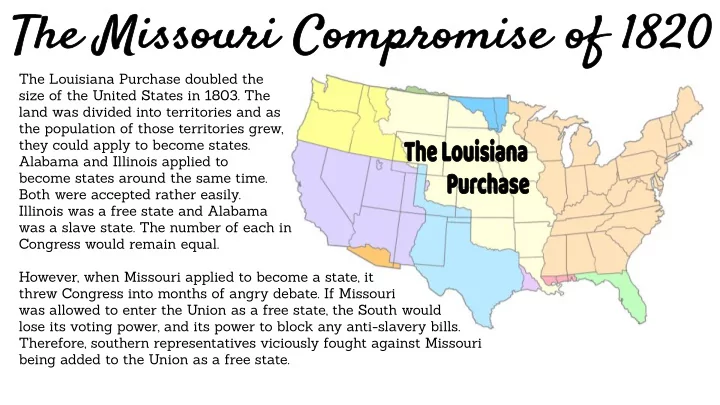
The Louisiana Purchase doubled the size of the United States in 1803. The land was divided into territories and as the population of those territories grew, they could apply to become states. Alabama and Illinois applied to become states around the same time. Both were accepted rather easily. Illinois was a free state and Alabama was a slave state. The number of each in Congress would remain equal. However, when Missouri applied to become a state, it threw Congress into months of angry debate. If Missouri was allowed to enter the Union as a free state, the South would lose its voting power, and its power to block any anti-slavery bills. Therefore, southern representatives viciously fought against Missouri being added to the Union as a free state.
SLIDE 2 The Northern Point of View The Southern Point of View
- Most of Missouri is in the
northern part of the country, where slavery is already banned.
Missouri, won’t it be able to expand to all of the Louisiana Purchase?
Amendment - Missouri can enter the Union, but only as a free state.
prevent slaveholders from keeping slaves (property) within a state.
- Northerners are trying to
end slavery altogether.
Missouri, might it be stopped in all of the Louisiana Purchase?
SLIDE 3 Henry Clay, a representative from Kentucky, eventually came up with the compromise.
- 1. Missouri would be added to the Union as
a slave state. However, Maine (which has previously been part of Massachusetts) would now become a free state.
- 2. A line would be drawn across the
Louisiana Purchase, below the Missouri territory, at the 36°30’ latitude line. New states below the line would allow slavery while new states above the line would not.
“If the Union must be dissolved,
slavery is precisely the question on which it ought to break. For the present, however, the contest is laid asleep.”
Will this compromise last? Can you see any problems with this compromise?
Young Henry Clay
SLIDE 4
Slave States Free States Missouri Maine Missouri Compromise Line Slave Territory Free Territory Spanish Territory Oregon Territory
SLIDE 5
While the Missouri Compromise stopped the debate in Congress for a while, the nation was still in turmoil over the issue of slavery. Abolitionists sent thousands of anti-slavery petitions to Washington D.C. Congress decided to avoid addressing those petitions in 1836. In 1831, Nat Turner staged a slave rebellion and more than 50 white people were killed. Fears of further uprisings led to stricter slave laws. Meanwhile, slaves continued to assert their right to freedom by running away. Some sympathetic Northerners began helping those slaves to freedom. Then in 1846, war with Mexico broke out, and the U.S. ultimately won the war. Congress now had to decide whether to allow slavery in the new land.
SLIDE 6 The Northern Point of View The Southern Point of View
Cession should be free territory.
should be decided by popular sovereignty. This means that the voters of the states would decide if the territory was slave or free.
Cession should be open to slavery.
Compromise line should be extended all the way to the Pacific Coast.
right to take their property into the territories.
SLIDE 7 For the North... For the South... California would be added to the Union as a free state. The Fugitive Slave Act was passed - This act made it easier for slaveholders to find and take back their slaves. The slave trade in Washington D.C. ended (slavery didn’t). The Mexican Cession was divided into two territories - New Mexico and Utah - both would decide the issue of slavery by popular sovereignty. Finally, a border dispute between Texas and New Mexico was decided in favor of New Mexico. Will this compromise survive? Will I?
Old Henry Clay
SLIDE 8 Slave States Free States Mexican Cession - now
sovereignty Indian Territory Free Territory
Label the Following:
❏ Utah Territory ❏ New Mexico Territory ❏ California ❏ Unorganized Territory ❏ Oregon Territory ❏ Minnesota Territory
SLIDE 9 The Northern territory in the Louisiana Purchase had been classified as
- fficial Indian Territory since the territory became part of the U.S.
However, in 1854, Senator Stephen Douglas proposed dividing the land into two areas - Kansas and Nebraska. Both would decide the issue of slavery through popular sovereignty. Douglass wanted to open up the land so that the transcontinental railroad could pass through. While the act made it through Congress, it only encouraged more
- controversy. Soon, Kansas became a breeding ground for political
- violence. Settlers, both pro and anti-slavery, poured over the border of
Kansas to support or oppose slavery. Two governments were set up, one supported slavery and the other was against it. Violence broke out between pro and anti-slavery settlers, and Kansas become known as “bleeding Kansas.”
SLIDE 10 Lawrence, Kansas - On May 21, 1856, over 700 pro-slavery “border ruffians” attacked the anti-slavery town of Lawrence. They burned down the hotel, looted homes, and destroyed the printing presses. Pottawattamie, Kansas - On May 23, 1856, John Brown, enraged by the attack on Lawrence, invaded the nearby pro-slavery town of Pottawattamie. In the dark of night, he and four of his sons dragged 5 pro-slavery men from their beds and hacked them apart with swords.
John Brown
Caution, Sir! I am eternally tired of hearing that word
- caution. It is nothing but
the word of cowardice!
SLIDE 11 Washington D.C. - The halls of Congress also saw an outbreak of violence. When Charles Sumner, an abolitionist Senator from Massachusetts, gave a speech titled “The Crime against Kansas,” he was assaulted by a Representative, Preston Brooks. Brooks felt that Sumner has insulted Brooks’ uncle in the speech. Two days later, Brooks took his cane, and hit Sumner until his cane was broken. Sumner’s injuries would impact him for the rest of his life. The reactions to Brooks’ assault reflect how divided the nation has become. Supporters actually sent Brooks new canes to replace the
- ne he had broken. One was engraved with
the words “hit him again.”
SLIDE 12 Slave States Free States
Territory open to slavery through the Compromise of 1850
Free Territory
Label the Following:
❏ Utah Territory ❏ New Mexico Territory ❏ Nebraska Territory ❏ Kansas Territory ❏ Oregon Territory ❏ Minnesota Territory
New Territory open to slavery through the Kansas-Nebraska Act
Indian Territory The Gadsden Purchase