SLIDE 1
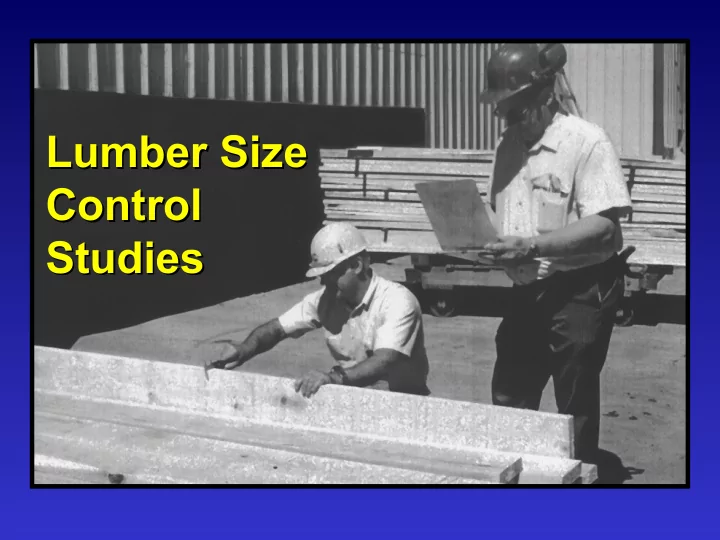
Lumber Size Lumber Size Control Control Studies Studies
SLIDE 2
Lumber Size Control Lumber Size Control
Troubleshoot machine center performance
– Locate & identify problems – Stabilize & improve sawing accuracy – Reduce oversizing
Objective is to improve
– Lumber recovery – Sawmill efficiency – Productivity
SLIDE 3 Lumber Size Control
Purpose
Lumber Size Control
Purpose
Stabilize & improve sawing accuracy—reduce lumber size variation (thick & thin lumber) Troubleshooting—locate & identify problems in sawing machine centers Properly adjusting lumber target sizes—control
- versizing/undersizing to improve lumber
recovery and grade yield
SLIDE 4
Thick & Thin Lumber
SLIDE 5
Study Procedures
Sampling
Study Procedures
Sampling
Requires 50-100 study boards per machine center (or saw to saw pocket on gang saws) Sample 25-50 subgroups of 2 consecutively produced boards (3 successive sawlines or two consecutive pieces on gang saws) Maintain order of production (i.e., order in which subgroups are manufactured)
SLIDE 6 Study Procedures
Measuring & Recording Procedures
Study Procedures
Measuring & Recording Procedures
Use a calipers to take 4-5 measurements
- n both edges on each board (8-10 total
measurements per board) Record measurement data (0.001 in.), time & comments Note what is going on in the mill during sampling (saw snaking, hit metal,
SLIDE 7
Study Procedures
Study Sampling & Measurement Positions
Study Procedures
Study Sampling & Measurement Positions
SLIDE 8
Study Procedures
Subgroups of 2 Consecutive Boards
Study Procedures
Subgroups of 2 Consecutive Boards
SLIDE 9
Measuring Lumber Thickness Measuring Lumber Thickness
Take 8 measurements per board & record to the nearest 0.001 inch Take 8 measurements per board & record to the nearest 0.001 inch
SLIDE 10
Study Procedures
Measurement Location on Study Boards
Study Procedures
Measurement Location on Study Boards
Top Edge -First End into Saw Trailing End Bottom Edge
SLIDE 11
Lumber Size Analysis Lumber Size Analysis
Components of lumber size variation
– Average measured size – Within-, between-, and total-sawing variation
SPC-LSA computer routine—demonstration Interpretation & troubleshooting—causes of lumber size variation
SLIDE 12
Components of Lumber Size Variation Components of Lumber Size Variation
Average Measured Size ( ) Components of Lumber Size Variation
– Total variation (st) – Within-board variation (sw) – Between-board variation (sb)
Calculated with SPC-LSA program
X
SLIDE 13
Interpretation of Lumber Size Variation Interpretation of Lumber Size Variation
Between-board variation—setworks system Within–board variation—sawing system Patterns of lumber size variation
– End-to-end taper – Edge-to-edge wedging – Thick or thin ends – Snake
SLIDE 14
SPC-LSA Computer Routine SPC-LSA Computer Routine
Compiled MS-DOS based PC software Calculates the components of lumber size variation & oversize/undersize Graphical analysis reports (histogram, variation range graph, specification chart) Lumber size control charts (average, within- & between-board variation)
SLIDE 15
Class Exercise - Statistics Class Exercise - Statistics
Described a set of numbers
– Calculate average – Measures of variation – Shape of its distribution
Statistics uses simple arithmetic The hardest thing about “Statistics” is its pronunciation
SLIDE 16