SLIDE 1
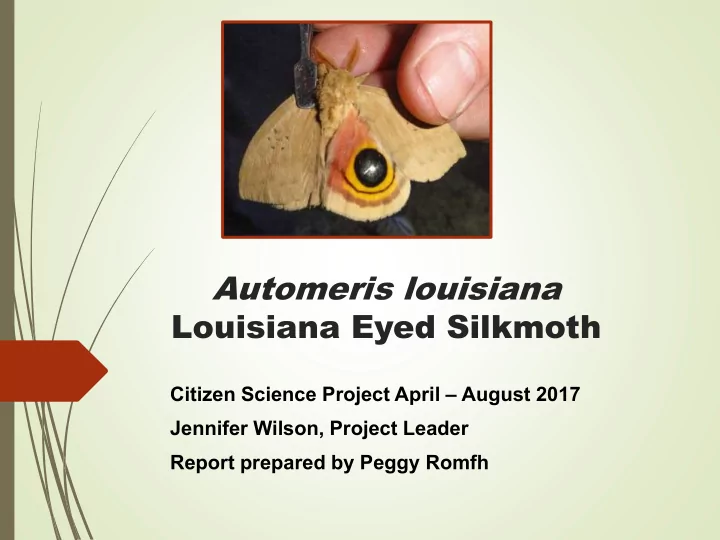
Automeris louisiana Louisiana Eyed Silkmoth
Citizen Science Project April – August 2017 Jennifer Wilson, Project Leader Report prepared by Peggy Romfh
SLIDE 2 Louisiana Eyed Silkmoth (LAESM)
Disco Discover ered ed in in 19 1981 81 alon along LA g LA co coast ast Similar to IO Moth but more brownish and less spotted Wing ing Span Span: : 2 1/2 - 3 1/2 inches
LAESM photos courtesy of John Savell, FWS
SLIDE 3 Life Cycle
- Eggs laid on host plant.
- Cocoons spun around several leaf blades of
Cordgrass about 6-12 inches above the ground.
YUM!!
SLIDE 4 Species of Concern
Limited geographic range – extreme SE Texas to extreme SW Mississippi along coast Limited habitat – coastal saltmarsh Smooth Cordgrass (Spartina alterniflora) Sturdy Bulrush (Bolboschoenus robustus)
Coastal wetland loss Hurricane devastation Massive mosquito spraying
BAMONA: Populations should be monitored to determine impacts
Unable to assign rank due to lack of available information.
SLIDE 5
Stor Storm m De Devasta vastation tion and and Wetland etland Loss Losses es
Since 2000, 33 significant storms hit LA 2001 Allison 2005 Katrina 2005 Rita 2008 Ike 2008 Gustav 2017 Harvey
Wetland Losses: Texas: 5,700 acres/year LA: 18,000 acres/year
SLIDE 6
Hypothesis (Question):
Does the LAESM still exist in its historic range and has it expanded its range along the central Gulf Coast where Smooth Cordgrass (larval host) is found? Project search areas:
4 parishes in LA 4 counties in TX 2 counties in MS 1 county in AL
Overall Project Leader: John Savell, LA FWS
SLIDE 7 Project – Search for LAESM in Texas Mid-Coast Refuges
Mid-Coast Project Leader: Jennifer Wilson, FWS TMN-COT Citizen Scientists Oron Atkins Her Herb b My Myer ers Jo My
ers Lar Larry y Peter eterson son Peggy y Romfh
Pete ete Romfh
George Valadez
400 volunteer hours
SLIDE 8
Materials: Moth Trap
5 gal. pail with suspended UV light, reflective winged frame, and funnel into bucket trap Powered by battery + solar backup Dark: UV light ON Daylight: UV light OFF
SLIDE 9
Method: Set trap at new moon.
Set trap for 2 nights. Check trap in early a.m. each day Document date, habitat, species seen, life cycle stage, numbers.
New Moons 2017 April 26 May 25 June 23 July 23 August 21
SLIDE 10
Trap Locations Texas Mid-Coast
BNWR Crosstrails Pond Weir Dam Road Alligator Marsh SBNWR Cowtrap Levee Sargent Unit Sargent Unit
SLIDE 11
Project Results
BNWR, SBNWR, Alabama sites Texas: Jefferson County, [Chambers County (Anahuac)] Louisiana: Cameron, Terrebone, Lafourche, and Orleans Parishes
SLIDE 12 Map of Sites Seen
Map courtesy John Savell, FWS
Anahuac
SUCCESSFUL
UNSUCCESSFUL
SLIDE 13 Project Results by Date
Month All Project Traps Set TMN-COT Traps Set Moths Trapped February 1 effort X March April X X X May X X X June X X X July X X X August X X X September X Hurricane X
Fli ligh ght: t: Three to four broods from February to early November.
SLIDE 14 Project Conclusions
Presence of A. louisiana: Cited threats (hurricanes, limited range, chemical control of insect populations, coastal land loss, and habitat fragmentation) do not appear to be limiting factors at this time. [Savell] Habitat range: No habitat expansion beyond historic range (LA and extreme SE Texas and SW MS) was
- bserved. During this four month
study at seven sites in BNWR and SBNWR, Automeris louisiana was not seen.
SLIDE 15
Project Post-notes
No plans to repeat the study Center for Biological Diversity has re- petitioned FWS to remove LAESM from species of concern (along with 22 other species) to focus on about 30 other species of greater concern. Master naturalists role is critical to success. Results for Texas Mid-Coast pointed to biodiversity of species on the refuges and possibly local studies in the future of some of the non-target species seen.
June 8, 2018
SLIDE 16 Non-target Species
Giant Water Bug
Lethocerus americanus
Moth trap bucket
4/27/18 Rogers Pond
SLIDE 17
Non-target Species: Tiger Beetles
Other Citizen Science Projects: BugGuide i-Naturalist
SLIDE 18
Non-target Species: Lady Beetles
Other Citizen Science Projects: Lost Ladybug i-Naturalist
SLIDE 19
Non-target Species: Doryodes sp. Moths
Doryodes – DNA testing IP to ID species
SLIDE 20
Non-target Species: Other Moths
Meske’s Pero Moth (Pero meskaria) – usually only found in drier areas of SW
SLIDE 21 Non-target Species: Sphinx Moths
Carolina Sphinx Manduca sexta
[Jennifer Wilson]
Five-spotted Hawkmoth Manduca quinquemaculata
[Larry Peterson]
SLIDE 22
Non-target Species: Water Boatman
SLIDE 23 Citiz Citizen Science Pr en Science Project:
LA Ey LA Eyed Silkmoth ed Silkmoth
USFWS
BugGuide Lost Ladybug i-Naturalist Master Naturalists