The keyword list thus far: Creating Correct Programs Creating - - PowerPoint PPT Presentation

the keyword list thus far
SMART_READER_LITE
LIVE PREVIEW

The keyword list thus far: Creating Correct Programs Creating - - PowerPoint PPT Presentation

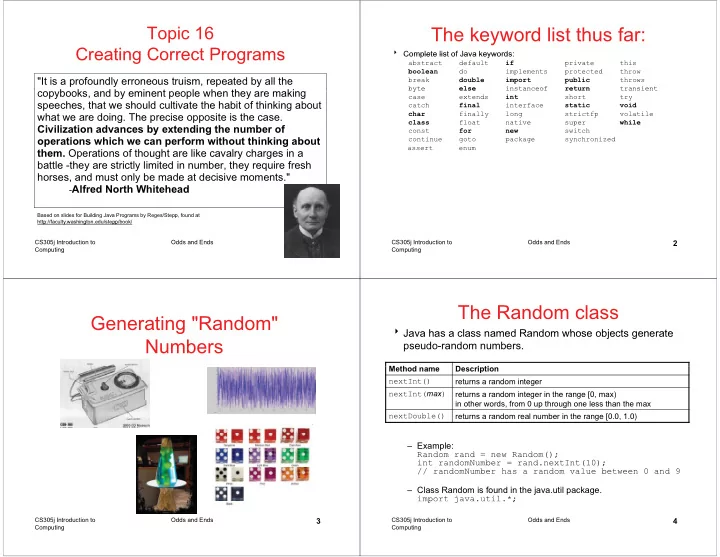
Topic 16 The keyword list thus far: Creating Correct Programs Creating Correct Programs Complete list of Java keywords: Complete list of Java keywords: abstract default if private this boolean do implements protected


slide-1
SLIDE 1

Topic 16 Creating Correct Programs Creating Correct Programs

"It is a profoundly erroneous truism, repeated by all the copybooks, and by eminent people when they are making speeches, that we should cultivate the habit of thinking about what we are doing. The precise opposite is the case. g p pp Civilization advances by extending the number of

  • perations which we can perform without thinking about
  • them. Operations of thought are like cavalry charges in a
  • them. Operations of thought are like cavalry charges in a

battle -they are strictly limited in number, they require fresh horses, and must only be made at decisive moments." Alfred North Whitehead

  • Alfred North Whitehead

Based on slides for Building Java Programs by Reges/Stepp, found at http://faculty.washington.edu/stepp/book/

CS305j Introduction to Computing Odds and Ends

1

p y g pp

The keyword list thus far:

Complete list of Java keywords: Complete list of Java keywords:

abstract default if private this boolean do implements protected throw break double import public throws byte else instanceof return transient byte else instanceof return transient case extends int short try catch final interface static void char finally long strictfp volatile class float native super while class float native super while const for new switch continue goto package synchronized assert enum

CS305j Introduction to Computing Odds and Ends

2

Generating "Random" g Numbers

CS305j Introduction to Computing Odds and Ends

3

The Random class

Java has a class named Random whose objects generate Java has a class named Random whose objects generate pseudo-random numbers.

M th d D i ti Method name Description nextInt() returns a random integer nextInt(max) returns a random integer in the range [0, max) in other words, from 0 up through one less than the max nextDouble() returns a random real number in the range [0.0, 1.0)

– Example: Random rand = new Random(); int randomNumber = rand.nextInt(10); // randomNumber has a random value between 0 and 9 – Class Random is found in the java.util package. import java.util.*;

CS305j Introduction to Computing Odds and Ends

4

p j ;

slide-2
SLIDE 2

Pseudo Random Numbers

What does "pseudo random" numbers mean? What does "pseudo random" numbers mean? Computers don't do things ambiguously

– despite what people think desp te at peop e t

They have a limited number of commands

– "Pick a random number" isn't one of them

  • d

d b t d pseudo random numbers are generated algorithmically via mathematical operations They start with an initial number of see number They start with an initial number of see number If you know the seed and the algorithm you can completely predict the sequence of numbers p y p q

CS305j Introduction to Computing Odds and Ends

5

Pseudo Random Numbers

T thi Try this:

for(int i = 0; i < 10; i++){ Random r = new Random(1127); ( ); for(int j = 0; j < 20; j++){ System.out.print( r.nextInt() ); } System.out.println(); }

Try with out the initial seed. A whole area of computer science devoted to trying to generate seemingly random numbers

CS305j Introduction to Computing Odds and Ends

6

Random examples

Random rand = new Random(); Random rand new Random();

A random number between 0 and 19 inclusive: A random number between 1 and 10 inclusive: A random number between 4 and 17 inclusive: A random even number between 0 and 10 inclusive: A random even number between 0 and 10 inclusive: A random multiple of 10 between 100 and 200 inclusive:

CS305j Introduction to Computing Odds and Ends

7

Random examples (answers)

Random rand = new Random(); Random rand new Random();

A random number between 0 and 19 inclusive:

int random1 = rand.nextInt(20);

A random number between 1 and 10 inclusive:

int random1 = rand.nextInt(10) + 1;

A random number between 4 and 17 inclusive:

int random1 = rand.nextInt(14) + 4;

A random even number between 0 and 10 inclusive: A random even number between 0 and 10 inclusive:

int random1 = rand.nextInt(6) * 2;

A random multiple of 10 between 100 and 200 inclusive:

int random1 = rand.nextInt(11) * 10 + 100;

CS305j Introduction to Computing Odds and Ends

8

slide-3
SLIDE 3

Random practice problem

Write a multiplication tutor program Example dialogue: Write a multiplication tutor program. Example dialogue:

This program helps you learn multiplication by Asking you 5 random multiplication questions and counts how many you get right. #1 of 5: 10 * 25 = 250 Correct! #2 of 5: 72 * 12 = 864 #2 of 5: 72 12 864 Correct! #3 of 5: 87 * 21 = 1741

  • Incorrect. The correct answer was 1827

#4 of 5: 8 * 84 = 692

  • Incorrect. The correct answer was 672

#5 of 5: 25 * 36 = 900 Correct! You got 3 out of 5

CS305j Introduction to Computing Odds and Ends

9

The do/while Loop The do/while Loop

CS305j Introduction to Computing Odds and Ends

10

The do/while loop

Java has another kind of loop named the do/while loop Java has another kind of loop named the do/while loop.

– It is almost identical to the while loop, except that its body statement(s) will always execute the first time, regardless of whether the condition is true.

The do/while loop, general syntax:

do { <statement(s)> ; <statement(s)> ; } while (<condition>); – Example: p // roll until we get a number other than 3 Random rand = new Random(); int dice; do { dice = rand.nextInt(); } while (dice == 3);

CS305j Introduction to Computing Odds and Ends

11

Creating Correct Programs and Reasoning About Programs

CS305j Introduction to Computing Odds and Ends

12

slide-4
SLIDE 4

Assertions

B t Bonus quote:

– "As soon as we started programming, we found

  • ut to our surprise that it wasn't as easy to get
  • ut to our surprise that it wasn t as easy to get

programs right as we had thought. Debugging had to be discovered. I can remember the exact instant when I realized that a large part of my life from then on was going to be spent in finding mistakes in my own programs." – Maurice V Wilkes

CS305j Introduction to Computing Odds and Ends

13

Assertions

Assertion: A declarative sentence that is Assertion: A declarative sentence that is either true or false Examples: Examples:

2 + 2 equals 4

The Yankees did not play in the world series in 2006.

> 45 x > 45 It is raining. UT beat OU last year in football. y UT volleyball will make the NCAA tourney this year.

Not assertions Not assertions

How old are you? Take me to H.E.B.

CS305j Introduction to Computing Odds and Ends

14

Take me to H.E.B.

Assertions

S ti t f l d di Some assertions are true or false depending

  • n context. Which of these depend on the

t t? context?

2 + 2 equals 4

The Yankees did not play in the world series in 2006 The Yankees did not play in the world series in 2006.

x > 45 It is raining. UT will beat OU next year. UT volleyball will make the NCAA tourney thi this year.

CS305j Introduction to Computing Odds and Ends

15

Assertions

Assertions that depend on context can be Assertions that depend on context can be evaluated if the context is provided.

when x is 13, x > 45 when x is 13, x > 45 It was raining in Round Rock, at 8 am on, October 10, 2006.

M kill i d t b Many skills required to be a programmer or computer scientists Just a few we have seen so far Just a few we have seen so far

– ability to generalize – create structured solutions – trace code – manage lots of details

CS305j Introduction to Computing Odds and Ends

16

slide-5
SLIDE 5

Assertions

A th i t t kill i i d Another important skill in programming and computer science is the ability "to make ti b t d t assertions about your programs and to understand the contexts in which those ti ill b t " assertions will be true."

i Scanner console = new Scanner(System.in); System.out.print("Enter Y or N: "); String result = console.next(); String result console.next(); // is result equal to "Y" or "N" here?

CS305j Introduction to Computing Odds and Ends

17

Checking Input

Scanner console = new Scanner(System.in); System.out.print("Enter Y or N: "); String result = console.nextLine(); while( !result.equals("Y") && !result.equals("N")){ System out print("That wasn't a Y or N "); System.out.print( That wasn t a Y or N. ); System.out.print("Enter Y or N: "); result = console.nextLine(); } // is result equal to "Y" or "N" here?

CS305j Introduction to Computing Odds and Ends

18

Assertions

P bl A ti A ti th t Provable Assertion: An assertion that can be proven to be true at a particular point in ti program execution. Program Verification: A field of computer i th t i l i b t th science that involves reasoning about the formal properties of programs to prove the correctness of a program correctness of a program.

– Instead of testing. – A number of UTCS faculty are involved in – A number of UTCS faculty are involved in verification research: Hunt, Lam, Shmatikov, Young, Emerson, Moore,

CS305j Introduction to Computing Odds and Ends

19

g, , ,

Examples

if(<t t>){ if(<test>){ // test is always true here } if(<test>){ // test is always true here } else { // test is never true here } if(<test>){ // test is always true here // test is always true here // other statements // can we assert test is true here? }

CS305j Introduction to Computing Odds and Ends

20

}

slide-6
SLIDE 6

Examples

if(<t t>){ if(<test>){ // test is always true here // more statements } // can we assert anything about test here? while( <test> ){ //test is always true here //test is always true here // more statements } // test is never true here (unless we break ) // test is never true here (unless we break...)

CS305j Introduction to Computing Odds and Ends

21

Examples

if( < 0 ){ if( x < 0 ){ // x < 0 is always true here x = -x; } // what about x < 0 here? "Programmers use assertions naturally when writing

  • programs. Program verification researchers try to figure
  • ut how to do this kind of reasoning in a formal,
  • ut how to do this kind of reasoning in a formal,

verifiable, and hopefully automated way."

CS305j Introduction to Computing Odds and Ends

22

Example

if(<t t>){ if(<test>){ // test is always true here } if(<test>){ // test is always true here } else { // test is never true here } if(<test>){ // test is always true here // test is always true here // other statements // can we assert test is true here? }

CS305j Introduction to Computing Odds and Ends

23

}

Detailed Example

public static void printCommonPrefix(int x int y){ public static void printCommonPrefix(int x, int y){ int z = 0; // Point A while( x != y ){ // Point B // Point B z++; // Point C if( x > y ){ // Point D // Point D x = x / 10; } else { // Point E y y / 10; y = y / 10; } // Point F } // P i t G // Point G System.out.println("common prefix = " + x); System.out.println("Number of digits discarded = " + z); }

CS305j Introduction to Computing Odds and Ends

24

slide-7
SLIDE 7

Detailed Example

I t t d i ti Interested in assertions:

x > y x == y x == y z == 0

Are these assertions always true, never true, Are these assertions always true, never true,

  • r sometimes true at the various labeled

points in the method points in the method

CS305j Introduction to Computing Odds and Ends

25

Assertion example 1

public static int mystery(Scanner console) { public static int mystery(Scanner console) { int prev = 0; int count = 0; int next = console.nextInt(); // Point A // Point A while (next != 0) { // Point B if (next == prev) { // Point C // Point C count++; } prev = next; next = console nextInt(); next console.nextInt(); // Point D } // Point E return count;

Which of the following assertions are true at which point(s) in the code? Choose ALWAYS, NEVER, or SOMETIMES.

return count; }

Choose ALWAYS, NEVER, or SOMETIMES.

next == 0 prev == 0 next == prev

CS305j Introduction to Computing Odds and Ends

26

Assertion example 2

public static void mystery(int x int y) { public static void mystery(int x, int y) { int z = 0; // Point A while (x >= y) { // Point B x -= y;

Which of the following assertions are true at which point(s) in the code? Choose ALWAYS, NEVER, or

// Point C z++;

SOMETIMES.

x < y x == y

// Point D } // P i t E

z == 0

// Point E System.out.println(z + " " + x); }

CS305j Introduction to Computing Odds and Ends

27

}

Assertion example 3

// Assumes y >= 0, and returns x to the y power // y , y p public static int pow(int x, int y) { int prod = 1; // Point A while (y > 0) { // P i t B // Point B if (y % 2 == 0) { // Point C x *= x; y /= 2; y / 2; // Point D } else { // Point E d * prod *= x; y--; // Point F } // Point G Which of the following assertions are true at which point(s) in the code? Choose ALWAYS, NEVER, or SOMETIMES // Point G } // Point H return prod; } SOMETIMES.

y == 0 y % 2 == 0

CS305j Introduction to Computing Odds and Ends

28

slide-8
SLIDE 8

Java assert statement

J i l d th bilit t t ti i Java includes the ability to put assertions in the code as executable statements t <b l i > assert <boolean expression>;

CS305j Introduction to Computing Odds and Ends

29