SLIDE 1 1 1
The Instrument for Stability
A special Focus on the Long-Term Component in South-East Asia
March 2014
Robert FRANK,
Regional Cooperation Officer for South-East Asia, Instrument for Stability (DEVCO component), Delegation of the European Union to the Philippines
2
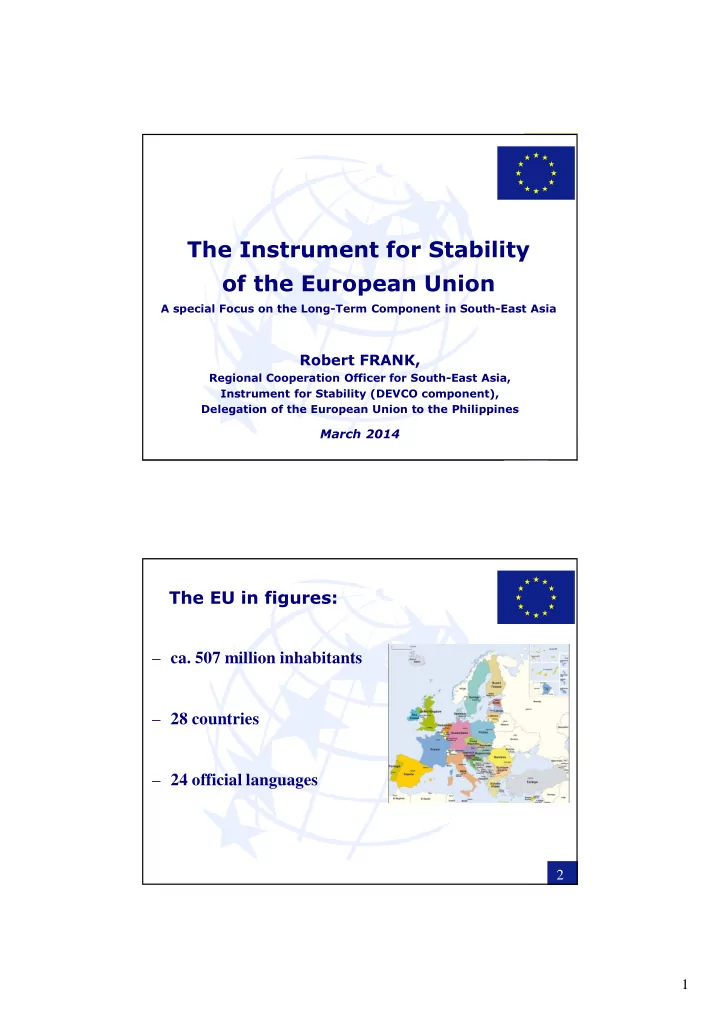
The EU in figures: – ca. 507 million inhabitants – 28 countries – 24 official languages
SLIDE 2 2 3
The EU in figures: – largest investor in the Philippines (€ 7.9 billion FDI stock in 2010, that is
- ca. 40% of total Philippine FDI stock)
– largest investor in ASEAN countries (ca. € 9.1 billion annually) – EU = ASEAN’s 2nd largest trading partner (11 % of ASEAN trade), ASEAN = EU's 3rd largest trading partner (> € 206 billion in goods and services in 2011)
4
Key aims of the EU’s external policy: – support stability, – promote human rights and democracy, – seek to spread prosperity, and – support the enforcement of the rule of law and good governance.
SLIDE 3
3 5
Instruments for External Actions
Pre-Accession Instrument European Instrument for Democracy and Human Rights Instrument for Nuclear Safety Instrument for Stability Development Cooperation Instrument European Neighbourhood Instrument etc. 6
The EU’s Instrument for Stability: – was launched in 2007 as Instrument for Stability, – had a financial envelope of more than € 2 billion for 2007 – 2013, – is expected to have more resources in the financial envelope 2014 – 2020.
SLIDE 4
4 7
“Peace, security and stability as well as human rights, democracy and good governance are essential elements for sustainable economic growth and poverty eradication.”
IfS Regulation 2006
8
The Instrument for Stability has two components:
Component for a context of stable conditions ("long-term") Component for situations of crisis or emerging crisis ("short-term")
SLIDE 5
5 9
The EU’s Instrument for Stability aims to help,
in a situation of crisis or emerging crisis, preserve, establish or re-establish stability;
Example: International Monitoring Team in Mindanao, Philippines
10
The EU’s Instrument for Stability aims to help,
in the context of stable conditions, build capacity.
SLIDE 6
6 11
The Instrument for Stability in the context of stable conditions
preparedness for pre- and post-crisis situations CBRN risk mitigation addressing global and transnational threats helps build capacity in the fields of 12
The EU’s Instrument for Stability aims to help,
in the context of stable conditions, build capacity to ensure preparedness to address pre- and post-crisis situations;
Example: Training in facilitation and mediation, Maldives
SLIDE 7
7 13
The EU’s Instrument for Stability aims to help,
in the context of stable conditions, build capacity to address specific global and transregional threats having a destabilising effect; 14
Examples of global and transregional threats:
– terrorism and organised crime, – illicit trafficking of people, drugs, firearms and explosive materials, – ineffective control of illegal trade and transit, – threats to international transport, energy operations and critical infrastructure, – threats to public health (e. g. epidemics, falsified medicines), – cybercrime.
SLIDE 8
8 15
EU capacity building actions to address global and transregional threats:
EU-UNODC Joint Initiative for Supporting Southeast Asian Countries to Counter Terrorism
− Cambodia, Laos, Indonesia, Philippines, Vietnam − € 2 million − 05/2012 - 04/2014 − supporting regional and national capacity to counter terrorism while fully respecting human rights and undertake related regional cooperation
16
Capacity Building on Hazardous and Noxious Substances Preparedness and Response in the Straits of Malacca and Singapore
− Contribution to the International Maritime Organization Malacca and Singapore Straits Trust Fund − € 500.000,-- − 11/2010 – 11/2012
EU capacity building actions to address global and transregional threats:
SLIDE 9
9 17
Critical Maritime Routes Programme Monitoring, Support and Evaluation Mechanism (CRIMSON)
− in South East Asia: Indonesia, Malaysia, Singapore − € 1 million − 01/2013 – 01/2015 − strengthen the transregional coordination, coherence and complementarity effect among the various projects contained in the Critical Maritime Routes Programme
EU capacity building actions to address global and transregional threats:
18
Critical Maritime Routes Indian Ocean (CRIMARIO)
− Western Indian Ocean and South-East Asia − € 5.5 million − to be launched in 2014 − enhance information sharing between countries of the two regions and build capacity to increase transregional cooperation on maritime safety and countering piracy
EU capacity building actions to address global and transregional threats:
SLIDE 10 10 19
Global Action on Cybercrime (GLACY)
− in South-East Asia: Philippines (interested in implementing the Budapest Convention on Cybercrime) − € 3 million (EU contribution) − Nov. 2013 – Nov. 2016 − enable criminal justice authorities to engage in international cooperation on cybercrime and electronic evidence on the basis of the Budapest Convention on Cybercrime
EU capacity building actions to address global and transregional threats:
20
The EU’s Instrument for Stability aims to help,
in the context of stable conditions, build capacity to provide assistance to risk mitigation and preparedness relating to chemical, biological, radiological and nuclear (CBRN) materials
SLIDE 11
11 21 EU capacity building actions to provide assistance to risk mitigation and preparedness relating to CBRN materials or agents:
Assistance in Export Control of Dual Use Goods
− in South-East Asia: Malaysia, Philippines, Thailand, Vietnam − € 3,650,000.-- − 05/2013 - 12/2014 − Implemented by the German BAFA (Bundesamt für Wirtschaft und Ausfuhrkontrolle)
22
EU CBRN Centres of Excellence Risk Mitigation Initiative
EU capacity building actions to provide assistance to risk mitigation and preparedness relating to CBRN materials or agents:
SLIDE 12
12 23
Website: http://www.cbrn-coe.eu/
24
Regional Cooperation Officer for South-East Asia, Instrument for Stability (DEVCO): Robert FRANK Robert.Frank@eeas.europa.eu +63 2 859 5136
Delegation of the European Union to the Philippines 30/F Tower 2, RCBC Plaza 6819 Ayala Av., Makati City, 1200, Metro Manila
Contact:
SLIDE 13
13 25
Thanks for your attention!