European Union European union foundation West European nations - - PowerPoint PPT Presentation

european union european union foundation
SMART_READER_LITE
LIVE PREVIEW

European Union European union foundation West European nations - - PowerPoint PPT Presentation

European Union European union foundation West European nations created the Council of Europe in 1949. It was the first step towards cooperation between them, but six countries wanted to go further. As of 1950, the European Coal and Steel


slide-1
SLIDE 1

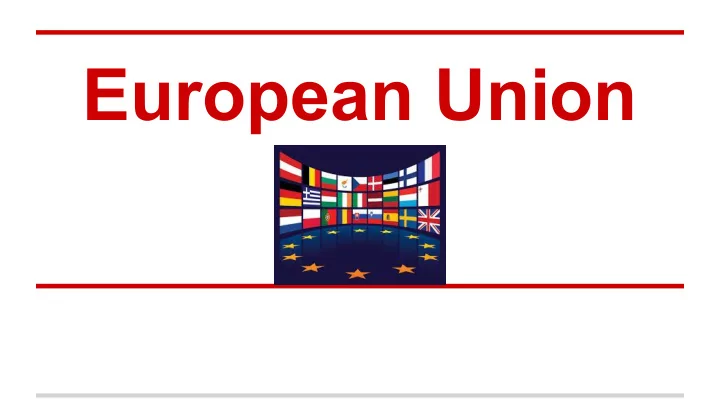
European Union

slide-2
SLIDE 2

European union foundation

  • West European nations created the Council of Europe in 1949. It was the first step

towards cooperation between them, but six countries wanted to go further.

  • As of 1950, the European Coal and Steel Community began to unite European

countries economically and politically in order to secure lasting peace.

  • Founding members were: The Netherlands, France,

Germany, Italy, Belgium and Luxembourg.

slide-3
SLIDE 3

Consecutive Joinings to EU

  • EU has 28 members and 6 candidate members.

1957: Germany (one of the founding members) 1986: Spain 1995: Finland 2004: Poland

slide-4
SLIDE 4

Consecutive Joinings to EU

slide-5
SLIDE 5

Main European Institutions

  • Council of the EU
  • Sets the EU's overall political

direction

  • Represents EU internationally
  • Develops EU’s foreign and

defence policies

  • Connects police forces across

the member countries

slide-6
SLIDE 6

Main European Institutions

  • European Parliament
  • Represents EU’s citizens
  • Debates and passes European laws with Council
  • f the EU
  • Supervises the budget and accepts budgets
  • Makes sure that everything is done democratically
slide-7
SLIDE 7

Main European Institutions

  • European Commission
  • Proposes laws to Parliament and the Council
  • Enforces EU laws
  • Manages the funds of budget
  • Is composed of 28 Commissioners, one from every EU country
slide-8
SLIDE 8

Main European Institutions

  • European Council
  • Sets the EU’s general political directions and priorities.
  • Deals with complex issues that cannot be resolved at lower

levels

  • It has meetings twice every 6 months
slide-9
SLIDE 9

Main Economic Policies in EU

Main usage of resources

  • Creating growth and jobs
  • Protection of environment

and society

slide-10
SLIDE 10

Typical stereotypes of European countries a with hint

  • f humour

Finland

Depressed and emotionless vodka drinkers

Rude, introverted and emotionless people who live in the woods and split their time between hitting themselves with birch branches in the sauna and hunting bears.

Germany

Car lovers and humourless hardworkers

Germans are regarded as hardworking who love their cars more than anything, efficient and disciplined, but also stiff and humourless.

Poland

Hard-drinking Catholic zealots

Poles are mostly regarded as convinced Catholics and they drink lots

  • f alcohol per citizen per year. This may be a consequence
  • f the rough and turbulent reputation of vodka.

Spain

Fiesta, siesta and macho men?

Spanish people are said to be loud and lazy with a passionate

  • character. There’s the siestas in the afternoon, and the partying at

night.

slide-11
SLIDE 11

Sources

http://hum.port.ac.uk/europeanstudieshub/learning/module-1-understanding-eu- institutions/introduction-to-study-of-the-european-union-institutions/the-institutional-triangle/ http://www.futurelabeurope.eu/blog/a-model-explaining-european-cultural-differences/ http://europa.eu/index_en.htm http://businessculture.org/northern-europe/ http://businessculture.org/eastern-europe/ http://europeisnotdead.com/video/images-of-europe/european-stereotypes/