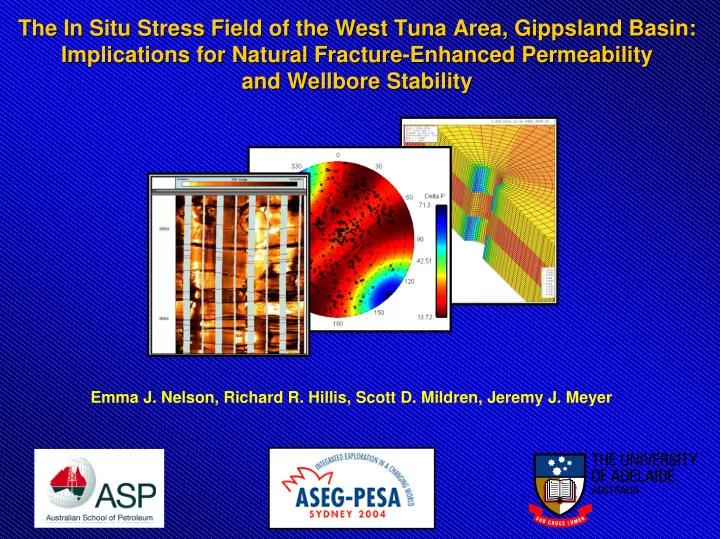
The In Situ Situ Stress Field of the West Tuna Area, Stress Field - - PowerPoint PPT Presentation

the in situ situ stress field of the west tuna area
SMART_READER_LITE
LIVE PREVIEW

The In Situ Situ Stress Field of the West Tuna Area, Stress Field - - PowerPoint PPT Presentation

The In Situ Situ Stress Field of the West Tuna Area, Stress Field of the West Tuna Area, Gippsland Gippsland Basin: Basin: The In Implications for Natural Fracture- -Enhanced Permeability Enhanced Permeability Implications for Natural


slide-1
SLIDE 1

The In The In Situ Situ Stress Field of the West Tuna Area, Stress Field of the West Tuna Area, Gippsland Gippsland Basin: Basin: Implications for Natural Fracture Implications for Natural Fracture-

  • Enhanced Permeability

Enhanced Permeability and and Wellbore Wellbore Stability Stability

Emma J. Nelson, Richard R. Hillis, Scott D. Mildren, Jeremy J. Meyer

slide-2
SLIDE 2

Gippsland Location Map Gippsland Location Map

slide-3
SLIDE 3

Objectives Objectives

The Problem: The Problem:

The R The R-

  • and S

and S-

  • reservoirs have low permeability.

reservoirs have low permeability. Drilling has been associated with stuck pipe and fluid loss Drilling has been associated with stuck pipe and fluid loss

Aims: Aims:

  • Determine the in situ stress tensor

Determine the in situ stress tensor

  • Determine the extent and nature of natural fracturing

Determine the extent and nature of natural fracturing

  • Probability of fracture enhanced permeability

Probability of fracture enhanced permeability

  • Finite element modelling to assess

Finite element modelling to assess wellbore wellbore stability stability

slide-4
SLIDE 4

Presentation Outline Presentation Outline

  • In Situ Stress in West Tuna

In Situ Stress in West Tuna

  • Fracture characterisation and fracture enhanced permeability

Fracture characterisation and fracture enhanced permeability

  • Wellbore

Wellbore stability and finite element modelling of near stability and finite element modelling of near wellbore wellbore stress stress

  • Conclusions

Conclusions

slide-5
SLIDE 5

Reservoir Stresses Reservoir Stresses

Shmin SHmax Sv

  • S

SHmax

Hmax Orientation

Orientation

  • S

SV

V Magnitude

Magnitude

  • S

Shmin

hmin Magnitude

Magnitude

  • S

SHmax

Hmax Magnitude

Magnitude

slide-6
SLIDE 6

S Sv

v Magnitude

Magnitude

Sv Sv = = ρ ρ(z)g (z)g dz dz

z

ρ ρav

av from checkshot

from checkshot velocity velocity

500 1000 1500 2000 2500 3000 3500 10 20 30 40 50 60 70 80 90 100

Pressure (MPa) Depth (m)

slide-7
SLIDE 7

S Shmin

hmin Magnitude

Magnitude

500 1000 1500 2000 2500 3000 3500 10 20 30 40 50 60 70 80 4000

Pressure (MPa) Depth (m)

Pressure Time LOP P

c

Leak Off Tests Leak Off Tests

slide-8
SLIDE 8

Stress at the Wellbore Wall Stress at the Stress at the Wellbore Wellbore Wall Wall

σH σH

Compression Tension

σθθ

= (σHmax + σhmin) – 2(σHmax - σhmin) cos2θ - ∆P

Kirsch Equations

slide-9
SLIDE 9

SHmax Orientation S SHmax

Hmax Orientation

Orientation

Azimuth with Respect to Maximum Horizontal Stress Circumferential Stress (MPa)

DITF Breakout Compressive rock strength Tensile rock strength

slide-10
SLIDE 10

SHmax Orientation S SHmax

Hmax Orientation

Orientation

Breakout Breakout

360 180 1 metre

DITF DITF

180 360 1 metre West Tuna 8

138 138º º N N

slide-11
SLIDE 11

S SHmax

Hmax Magnitude

Magnitude

S SHmax

Hmax Ori

Ori = 138° N = 138° N S Sv

v

= 21 MPa = 21 MPa P PP

P

= 9.8 MPa = 9.8 MPa S Shmin

hmin

= 21 MPa = 21 MPa S SHmax

Hmax

= 38 MPa = 38 MPa Depth Depth = 1000 m = 1000 m

SHmax > Shmin ~Sv

slide-12
SLIDE 12

Presentation Outline Presentation Outline

  • In Situ Stress in West Tuna

In Situ Stress in West Tuna

  • Fracture characterisation and fracture enhanced permeability

Fracture characterisation and fracture enhanced permeability

  • Wellbore

Wellbore stability and finite element modelling of near stability and finite element modelling of near wellbore wellbore stress stress

  • Conclusions

Conclusions

slide-13
SLIDE 13

Natural Fractures Natural Fractures Natural Fractures

Electrically conductive fractures in cemented sandstones

slide-14
SLIDE 14

Fracture Susceptibility Fracture Susceptibility Fracture Susceptibility

Conductive fractures Conductive fractures Mohr Circle Mohr Circle

Shear Stress (MPa) Normal Stress (MPa)

  • Conductive fractures are optimally oriented to be hydraulically

Conductive fractures are optimally oriented to be hydraulically conductive in the far conductive in the far-

  • field

field

  • Conductive fractures are restricted to cemented sandstones with

Conductive fractures are restricted to cemented sandstones with low matrix permeability low matrix permeability

  • Conductive fractures may be important to reservoir connectivity

Conductive fractures may be important to reservoir connectivity

slide-15
SLIDE 15

Presentation Outline Presentation Outline

  • In Situ Stress in West Tuna

In Situ Stress in West Tuna

  • Fracture characterisation and fracture enhanced permeability

Fracture characterisation and fracture enhanced permeability

  • Wellbore

Wellbore stability and finite element modelling of near stability and finite element modelling of near wellbore wellbore stress stress

  • Conclusions

Conclusions

slide-16
SLIDE 16

3D Homogenous Block Model Results 3D Homogenous Block Model Results 3D Homogenous Block Model Results

Azimuth with Respect to Maximum Horizontal Stress Circumferential Stress (MPa)

Verification using Kirsch equations

σθθ= (σHmax + σhmin) – 2(σHmax - σhmin) cos2θ - ∆P σ σθθ

θθmin min = 3

= 3σ σh

h -

  • σ

σH

H -

  • P

Pw

w -

  • P

Po

  • σ

σθθ

θθmax max = 3

= 3σ σH

H -

  • σ

σh

h -

  • P

Pw

w -

  • P

Po

  • = 100 MPa

= 20 MPa

slide-17
SLIDE 17

3D Layered Model 3D Layered Model 3D Layered Model

Material Properties

E= 40 GPa υ =0.25 E = 8.5 GPa υ =0.35 ‘Sandstone’ ‘Shale’ ‘Sandstone’

Circumferential Stress SHALE Azimuth with Respect to Maximum Horizontal Stress Circumferential Stress (MPa)

40.7 MPa 17.1 MPa

SANDSTONE Azimuth with Respect to Maximum Horizontal Stress Circumferential Stress (MPa)

21.1 MPa 133 MPa

Compressive strength Compressive strength

slide-18
SLIDE 18

Conclusions Conclusions Conclusions

  • 1. The in situ stress field in West Tuna is on the boundary of strike-

slip and compression. 2. Fractures are optimally oriented to be hydraulically conductive in the far-field. 3. Breakouts and DITFs only occur in cemented sandstones. This can be explained by stress partitioning.

  • 1. The in
  • 1. The in situ

situ stress field in West Tuna is on the boundary of strike stress field in West Tuna is on the boundary of strike-

  • slip and compression.

slip and compression. 2. 2. Fractures are optimally oriented to be hydraulically conductive Fractures are optimally oriented to be hydraulically conductive in in the far the far-

  • field.

field. 3. 3. Breakouts and Breakouts and DITFs DITFs only occur in cemented sandstones. This

  • nly occur in cemented sandstones. This

can be explained by stress partitioning. can be explained by stress partitioning.

slide-19
SLIDE 19

Acknowledgements Acknowledgements Acknowledgements

Glen Nash Glen Nash Mike Power Mike Power Wayne Wayne Mudge Mudge Adem Djakic

Thanks to: Thanks to: Thanks to:

Adem Djakic Andrew Marr Andrew Marr