The future of Bluefin Tuna Introducing the closed cycle, farm raised - - PowerPoint PPT Presentation

the future of bluefin tuna
SMART_READER_LITE
LIVE PREVIEW

The future of Bluefin Tuna Introducing the closed cycle, farm raised - - PowerPoint PPT Presentation

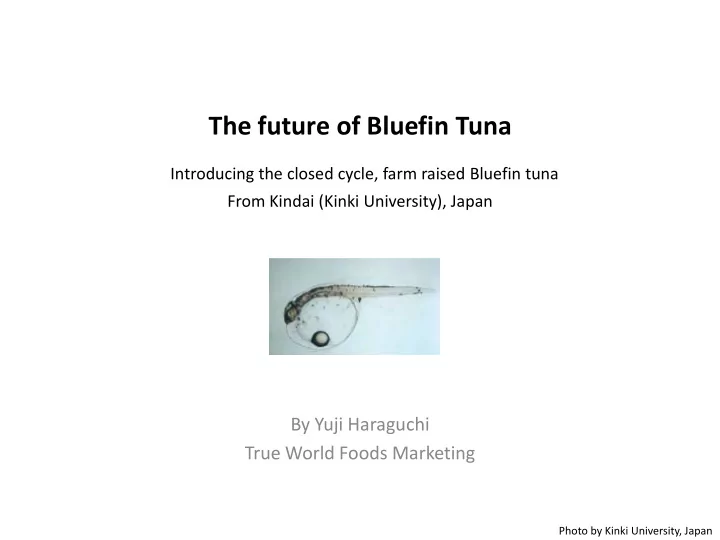
The future of Bluefin Tuna Introducing the closed cycle, farm raised Bluefin tuna From Kindai (Kinki University), Japan By Yuji Haraguchi True World Foods Marketing Photo by Kinki University, Japan Tuna Family Bluefin Tuna Yellowfin Tuna

slide-1
SLIDE 1

The future of Bluefin Tuna

Introducing the closed cycle, farm raised Bluefin tuna From Kindai (Kinki University), Japan

By Yuji Haraguchi True World Foods Marketing

Photo by Kinki University, Japan

slide-2
SLIDE 2

Tuna Family

Bluefin Tuna Southern Bluefin Tuna Bigeye Tuna Yellowfin Tuna Albacore Tuna

Picture-Japan Bonito and Tuna Fisheries Association

slide-3
SLIDE 3

Amount of Wild Caught Tuna Worldwide

(10,000 Ton)

Source - Ministry of Agriculture, Forestry, and Fisheries of Japan

Beginning of sushi boom in the U.S.

slide-4
SLIDE 4

Bluefin Tuna

“Black Diamond” from the ocean

  • The largest and most expensive kind of tuna.
  • It grows as big as 1000LB in 30 years.
  • Its fat is known as “Toro,” which becomes the most valuable piece of sushi.
  • One Bluefin tuna sold at the first tuna auction at the Tsukiji fish market

this year for 16 milion yen ($180,000)

Photos by Yuji Haraguchi 2008

slide-5
SLIDE 5

Saving the Bluefin Tuna

  • Tunas have been overfished due to the rapid growth of the global Sushi market

and as well as other markets.

  • Tuna fisheries worldwide generate billions of dollars annually, making them among

the most valuable fisheries on Earth. The growing demand for Bluefin tunas increasingly is a cause for concern throughout the global oceans.

  • The restrictions are becoming more strict every year, especially on Bluefin tuna.
  • The fishing has been strictly monitored by the Tuna Regional Fisheries

Management Organizations. Tuna Regional Fisheries Management Organization

ICCAT

  • The International Commission for the Conservation of Atlantic Tunas

IOTC

  • Indian Ocean Tuna Commission

IATTC - Inter-American Tropical Tuna Commission WCPFC - Western and Central Pacific Fisheries Commission CCSBT - Commission for the Conservation of Southern Bluefin Tuna (Monterey Bay Aquarium)

slide-6
SLIDE 6

The Conventionally “Farm-Raised” Bluefin Tuna

(Mostly done in Japan, Mexico, Mediterranean, and Australia)

Purse Seining Pen

Pictures by Monterey Bay Aquarium

Catch a school of young wild Bluefin tunas (20-30LB) and bring them to a pen. Feed the tunas with sardines and etc for about 3

  • years. Then, release them to the market.

It is “Farm raised,” but Not sustainable as it depends only on the wild tunas for resource.

slide-7
SLIDE 7

The Kindai Farm-Raised Bluefin Tuna

(A joint project with Japanese government since 1970) Born in

  • -- Kinki University (Kindai), Wakayama, Japan

Raised in

  • -- Amakusa, Kagoshima, Japan

Distributed by --- True World Foods

slide-8
SLIDE 8

Source – Kinki University, Japan

  • CLOSED CYCLE FARMING -
slide-9
SLIDE 9

Challenges of farming tuna

  • Closed cycle farming is a common practice for other kinds of fishes such as

salmon and stripped bass.

  • However, because tuna cannot stop swimming or they will die, the closed

cycle farming presents greater challenges.

  • In 2002, after 32 years of R&D and over $50 Million spent, Kinki University

has succeeded in spawning Bluefin tuna eggs and kept its cycle.

Photos by Burimy Japan

slide-10
SLIDE 10

Sustainable Feed

(All the fishes are sourced only in Japan)

O Nago (Sand Eel) Sardine Mackerel

Photos by Burimy Japan

slide-11
SLIDE 11

Farming environment

Amakusa City, Kagoshima, Japan

Photos by Burimy Japan

slide-12
SLIDE 12

Specification

  • Tunas are shipped when they become about 60-

80LB/Whole. (3 years of feeding)

  • 10-15LB per loin (Belly and Back)
  • Otoro and Chutoro from Belly loins
  • Chutoro and Red meat from Back loins
  • Head On (Usually, tunas are not shipped with heads on.)

Photos by Burimy Japan and Yuji Haraguchi