SLIDE 1
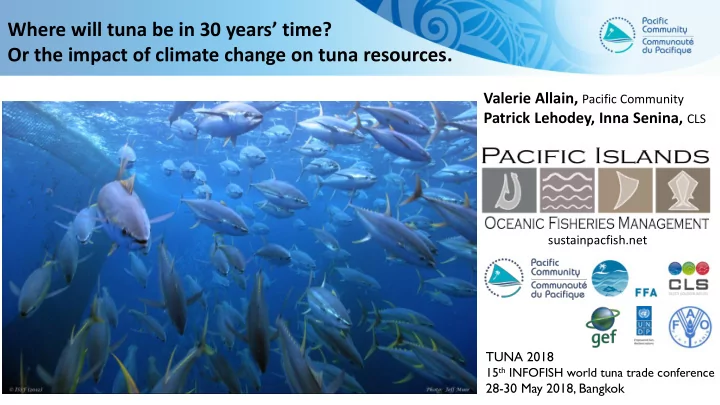
Where will tuna be in 30 years’ time? Or the impact of climate change on tuna resources.
Valerie Allain, Pacific Community Patrick Lehodey, Inna Senina, CLS
TUNA 2018
15th INFOFISH world tuna trade conference
28-30 May 2018, Bangkok sustainpacfish.net
SLIDE 2
1. Importance of tuna in the WCPO 2. Climate impact 3. Model and climate scenario used 4. Impact on tuna 5. Impact on Pacific Islands
References: Lehodey, P., Senina, I., Calmettes, B., Dessert, M., Nicol, S., Hampton, J., Smith, N., et al. 2017. Modelling the impact of climate change including ocean acidification on Pacific yellowfin tuna. 13th Meeting of the Scientific Committee of the Western and Central Pacific Fisheries Commission, WCPFC-SC13, Rarotonga, Cook Islands, 9-17 August 2017, WCPFC-SC13-2017/EB-WP-01: 1–26. https://www.wcpfc.int/system/files/EB-WP-01%20SEAPODYM.pdf Senina, I., Lehodey, P., Calmettes, B., Nicol, S., Caillot, S., Hampton, J., and Williams, P. G. 2016. Predicting skipjack tuna dynamics and effects of climate change using SEAPODYM with fishing and tagging data. 12th Meeting of the Scientific Committee of the Western and Central Pacific Fisheries Commission, WCPFC-SC12, Bali, Indonesia, 3-11 August 2016, WCPFC-SC12-2016/EB WP-01: 1–71. https://www.wcpfc.int/system/files/EB-WP-01%20SEAPODYM%20SKJ%20Fixed.pdf
OUTLINE
SLIDE 3
1. Importance of tuna in the Western and Central Pacific Ocean
2.7 million tonnes of tuna 56% of the global tuna catch 5.3 billion USD 2016
SLIDE 4
1. Importance of tuna in the Western and Central Pacific Ocean
Status of stocks
SLIDE 5
2. Climate impact
Purse seine effort Transition Water >28.5°C La Niña El Niño
SLIDE 6
Impact on the ocean
2. Climate impact
SLIDE 7
2. Climate impact
Impact on the fish and its optimal habitat:
temperature and oxygen surface 500 m 100 m
Skipjack
Low oxygen High oxygen
Yellowfin Bigeye Albacore
depth Warm Cold prey and predators
SLIDE 8 3. Model and climate scenario used
SEAPODYM Model Tuna population (larvae, immature, adult) 6 forage groups Primary production fisheries Environmental constraints: temperature, currents,
- xygen, euphotic depth,
- cean acidification
Resolution 1° x month
SLIDE 9
RCP 8.5 - Business as usual, CO2 emissions keep increasing until 2100 IPCC scenarios RCP 6.0 – decline of CO2 emissions after 2080 RCP 4.5 – decline of CO2 emissions after 2040 RCP 2.6 – decline of CO2 emissions after 2020
3. Model and climate scenario used
SLIDE 10
4. Impact on tuna
Hu et al. 2015
SLIDE 11 4. Impact on tuna
Skipjack Yellowfin
2005 2050 2100
SLIDE 12 4. Impact on tuna
Bigeye Albacore
2005 2050 2100
SLIDE 13
4. Impact on tuna
SLIDE 14 5. Impact on Pacific Islands
Kiribati
80%
Papua New Guinea
4%
Tuvalu
52%
- Fed. States of Micronesia
40%
12%
Solomon Islands
9%
Proportion of tuna revenue in government revenue
SLIDE 15
5. Impact on Pacific Islands
Projected % changes in biomass in Pacific Island countries EEZs
SLIDE 16 CONCLUSION
- Models predict
- a decrease in tropical tuna biomasses in the Pacific
- a shift of the biomasses of tropical tuna towards the east, and towards the south for albacore
- a strong impact at the national level
- The main driver of changes is the warming temperature, ocean acidification is predicted to have a limited
impact
- Improving models to improve the accuracy and confidence of the forecast for better management and
adaptation
- Better observation of fisheries
- Better observation and understanding of the pelagic ecosystem
- Models can be used to project the impact of fishing
that remains the major external driver of the tuna population dynamics. Different fishing scenarios can be tested.