The Honolulu Rail Transit Project Public-Private Partnership - - PowerPoint PPT Presentation

the honolulu rail transit project
SMART_READER_LITE
LIVE PREVIEW

The Honolulu Rail Transit Project Public-Private Partnership - - PowerPoint PPT Presentation

The Honolulu Rail Transit Project Public-Private Partnership Development Program Recommended Program Structure 1 July 19, 2016 Discussion Outline Project Status / Remaining Work Comprehensive Analysis: P3 Feasibility Purpose


slide-1
SLIDE 1

1

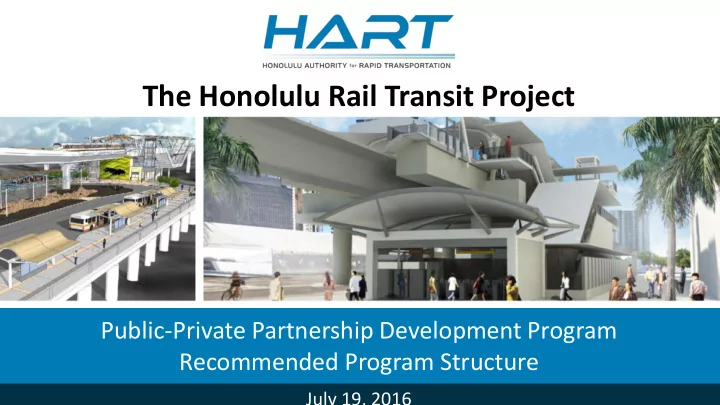
The Honolulu Rail Transit Project

Public-Private Partnership Development Program Recommended Program Structure

July 19, 2016

slide-2
SLIDE 2

2

Discussion Outline

  • Project Status / Remaining Work
  • Comprehensive Analysis: P3 Feasibility
  • Purpose and Objectives of the Analysis
  • Funding and Financing Overview
  • Recommended Project Delivery Method
  • Risk Allocation and Assessment: DB vs. DBF/OM
  • Summary
  • Next Steps
slide-3
SLIDE 3

3

Remaining Civil Works to be Procured

City Center Guideway and Stations and Pearl Highlands Garage and Transit Center

Pearl Highlands Garage & Transit Center City Center Guideway & Stations

slide-4
SLIDE 4

4

Comprehensive Analysis to Support Recommendation

  • Retained EY to conduct a P3 commercial feasibility assessment
  • Reviewed comparable projects and relevant case studies
  • Developed a P3 structure specific to the HRTP
  • Conducted a comprehensive risk assessment involving staff and outside

experts in risk mitigation

slide-5
SLIDE 5

5

Purpose and Objectives

To define a project delivery structure that…

Encourages robust global competition by bundling construction and O&M Promotes schedule certainty by financially based performance requirements Reduces the possibility of cost increases through enhanced fiscal discipline Improves risk management by optimally allocating risks and responsibilities Provides a “life-cycle” approach linking construction with operations Promotes incorporation of technical innovation and best practices Integrates the mutual goals of HART and the City for improved mobility and long-term sustainability

slide-6
SLIDE 6

6

Increases Fiscal Discipline and Reduces Cost Increases

  • DBF/OM reduces the potential for cost increase and/or change orders
  • DBF/OM places financial incentives and performance requirements on

the P3 partner to meet pre-established budget, scope and schedule

  • DBF/OM is projected to provide modest cost reductions when compared

conservatively to DB over the 30-year term, primarily due to more competitive pricing and increased efficiency

  • Projected City savings of over $310M in operating costs over the 30-year term,

primarily forecast for the years 2031-2050 subsequent to termination of existing CSC

  • Projected HART savings of $46M in construction costs for CCGS and PHGTC
slide-7
SLIDE 7

7

Promotes Schedule Certainty

  • DBF/OM confirms adherence to the schedule and provides substantial

contractual requirements and associated financial penalties to the developer if delays occur

  • The P3 development agreement will include fundamental schedule incentives

including private financing and robust performance metrics for O&M

  • DBF/OM is projected to result in a slightly earlier Revenue Service Date
  • Schedule acceleration is due to construction innovation and efficiency and parallel

testing and commissioning, enhanced by financial incentives for early completion

  • These schedule accelerators compensate for a longer procurement period for P3
slide-8
SLIDE 8

8

Provides a “Life-Cycle” Approach

  • DBF/OM recognizes that major infrastructure endeavors are long-term

community assets and should be constructed, operated, and maintained accordingly

  • DBF/OM combines construction and long-term operations and

maintenance into a joint procurement by HART and the City which creates a full life-cycle approach by linking design, construction,

  • perations and maintenance
slide-9
SLIDE 9

9

Optimizes Risk Management

  • DBF/OM allocates risk to the parties best equipped to accept the respective

risks and responsibilities

  • DBF/OM procurement increases likelihood of attracting bidders who have

world-class experience and the capabilities to accept allocation of risks

  • DBF/OM transfers key construction and O&M interface risks from HART and

the City to P3 partner

  • Reduces level of HART-required staffing for management & construction oversight
  • Eliminates the requirement for both HART and the City to serve as the integrator and

interface manager for numerous contracts and transfers that risk to the P3 partner

slide-10
SLIDE 10

10

Encourages Competition

  • DBF/OM encourages increased and robust competition from among US-

based and international contractors with positive performance records in developing and operating major transit and infrastructure projects, many

  • f whom are unlikely to propose for only a design-build program
slide-11
SLIDE 11

11

Promotes Technical Innovation

  • DBF/OM promotes incorporation by the developer of technical innovation

and best practices by optimizing the developer’s opportunities to connect design and construction with long-term operations and maintenance

slide-12
SLIDE 12

12

Integrates HART and City Goals

  • DBF/OM integrates the mutual goals of HART and the City to build,
  • perate, and maintain one of the most significant sustainable

infrastructure assets undertaken on behalf of the citizens and visitors to Hawaii

slide-13
SLIDE 13

13

Funding and Financing Overview

  • HART’s principal sources of capital funding are from GET, TAT and the federal FFGA
  • HART has received approximately $3.2B total from inception through June 30, 2018
  • Approximately $6.1B is anticipated in local and FFGA revenues from July 1, 2018 to

2030, which covers all remaining construction, contingency, and financing costs

  • About $1.9B is available for the capital components of the P3 agreement after

reserving for non-P3 project costs, debt service/financing charges, and required contingency . This number is referred to as the “affordability ceiling”

  • The City will fund O&M of systems and rolling stock and non-systems elements of

the project including facilities and stations

slide-14
SLIDE 14

14

DBF/OM Attributes

  • The P3 procurement will be a joint procurement between HART and the City
  • To assure maximum transparency, bidders will be required to provide

separate pricing for capital construction and financing funded by HART and O&M funded by the City

  • The concession term will be 30 years: 2020-2050
  • The P3 structure is based on a design-build-finance (DBF) model for the civil

works combined with a 30-year O&M agreement, linked through a single procurement designed to obtain strong global competition, favorable pricing, cost, and schedule certainty and optimal risk transfer

14

slide-15
SLIDE 15

15

Major Components of the Project Structure

Remaining under HART Key P3 Components

  • Ongoing and completed capital

construction, including guideway, stations and systems installation for West Side and Airport Guideway and Stations (AGS)

  • Civil and systems design and

construction for the City Center Guideway and Stations (CCGS) and Pearl Highlands Garage and Transit Center (PHGTC)

  • Rolling stock acquisition, testing and

commissioning

  • Full systems integration and long-term

O&M of all system elements

slide-16
SLIDE 16

16

Ongoing and Completed Construction Including Guideway, Stations and Systems

  • Completion of AGS, finalization of West Side contracts and related

systems installation, and rolling stock acquisition, testing and commissioning will not be included in the P3 partner contract

  • Funding and financing by HART will continue as at present
  • The current civil and systems contractors will continue accordingly
  • Under its current contract, the Core Systems Contractor is expected to

complete its installation of the systems for the AGS segment in mid-2022 and complete its testing and commissioning for this segment in 2023

slide-17
SLIDE 17

17

Civil and Systems Construction for City Center and Pearl Highlands Facilities

  • CCGS design, construction, and systems work will be the civil construction

element of the P3 partner’s contract

  • This work will be funded through GET, TAT, and FFGA
  • CCGS construction will occur between 2020 and 2025
  • Revenue Service Date (RSD) expected by December 2025 or earlier
slide-18
SLIDE 18

18

Civil and Systems Construction for City Center and Pearl Highlands Facilities

  • The P3 partner will:
  • Undertake design and construction of CCGS and PHGTC
  • Finance construction works privately
  • Receive milestone payments during construction between 2020-2025
  • Receive capital availability payments post-construction between 2026-2030
  • 2026-2030 is a five year “tail” where HART retains fiscal control to

assure satisfactory performance

  • CCGS systems installation being performed by Ansaldo Honolulu Joint

Venture (AHJV) will become part of the P3 partner’s scope

  • Transfers interface risk and likely accelerates completion
slide-19
SLIDE 19

19

Operations and Maintenance

  • Core Systems Contract (AHJV) scope includes interim and full operations
  • Since the project schedule has changed, the AHJV contract will need to be

renegotiated to reflect the current schedule

  • HART and the City will jointly negotiate a “term sheet” with AHJV
  • Will incorporate all relevant scope and contractual conditions
  • The new O&M aspects of the Core Systems Contract constituting the term

sheet will be transferred to the P3 partner

  • AHJV will perform its O&M responsibilities under the redefined contract

as a subcontractor to (or member of) the P3 partner’s consortium

slide-20
SLIDE 20

20

Operations and Maintenance

  • The City will provide availability payments to the P3 partner for the initial

O&M period (assumed to be 10 years) inclusive of AHJV’s participation

  • This approach will provide cost certainty to the City regarding its costs
  • ver the initial years of system operation under rigorous performance

requirements

  • When the interim O&M term undertaken by AHJV under the P3 partner

concludes, the P3 partner can:

  • Negotiate with AHJV to continue serving as the system operator for all or part
  • f the remainder of the development agreement term
  • Change its organization to facilitate increased O&M efficiency beyond 2030
slide-21
SLIDE 21

21

Responsibility/Risk Allocation

  • The DBF/OM structure will transfer certain

risks and responsibilities to the P3 partner from the City and HART

  • A comparison was made between

DBF/OM and Design-Build to examine:

  • How these responsibilities and risks would

be allocated

  • How this would affect cost and schedule
slide-22
SLIDE 22

22

Comparative Risk Assessment: DB and DBF/OM

  • A Risk Assessment Workshop was conducted June 19–21, 2018 with

representatives from HART, the City and financial and project delivery experts

  • Purposes of the workshop:
  • Define and quantify risks, with focus on risks that differed between the two delivery

methods

  • Assess which delivery method would provide greater cost and schedule certainty
  • “Base” costs were defined as starting point to reflect the longer procurement

period and additional advisory fees for DBF/OM:

  • DB Base Cost:

$1.61B

  • DBF/OM Base Cost:

$1.64B

slide-23
SLIDE 23

23

Key Risk Differentiators for DB and DBF/OM

  • Procurement
  • Right-of-Way
  • Design and construction
  • Administrative oversight
  • Market opportunity

Comparison of Risk Differentiators for Design-Build (DB) and Design-Build- Finance-Operate-Maintain, (DBF/OM or P3) Key Risk Differentiators Design-Build Procurement Design-Build-Finance-Operate- Maintain (DBF/OM or P3)

Project Element Threat / Opportunity Events Description Probability

  • f

Occurring Potential Schedule Impact Potential Cost Impact Probability

  • f

Occurring Potential Schedule Impact Potential Cost Impact Procurement Risk of joint procurement with City resulting in schedule delay to P3 procurement The base schedule for P3 incorporates the risk of delay owing to the requirement for concurrence between HART and the City regarding key decisions that affect procurement of both construction and

  • perations of the project. This risk considers

additional delay beyond the base schedule. Risk ID: P3 CTR 10.01 0% NA NA 25% 1-2 Month Delay NA Procurement Risk of delay in notice-to-proceed due to potential bid protest With DB and P3 delivery there is a risk of bid protest to unsuccessful bidder(s), but the likelihood of cost and schedule impacts is greater with a P3 delivery because there is much more at stake for the proposing firms. This risk is based on previous

  • experience. There is consideration of a schedule

impact for P3. There is no cost impact assumed other than a monetized schedule delay. Risk ID: DB CTR 10.02, and P3 CTR 10.02 12% total (Allocated) 1 month–5% to 14 months—2% NA 23% total (Allocated) 1 month– 10% to 14 months— 3% NA

Comparison of Risk Differentiators for Design-Build (DB) and Design-Build- Finance-Operate-Maintain, (DBF/OM or P3) Key Risk Differentiators Design-Build Procurement Design-Build-Finance-Operate- Maintain (DBF/OM or P3)

Project Element Threat / Opportunity Events Description Probability

  • f

Occurring Potential Schedule Impact Potential Cost Impact Probability

  • f

Occurring Potential Schedule Impact Potential Cost Impact ROW Risk of late delivery

  • f ROW necessary

for on time completion of CCGS Risk of not having necessary ROW acquisitions in time for sequencing of CCGS construction and systems

  • installation. During the CCGS procurement, it will be

necessary for a last addendum to the RFP, prior to contract-signing, to report on full resolution of remaining ROW acquisition necessary for the P3 or DB to rely on for CCGS project construction. The costs recorded represent a financing charge of $1.062M per month of delay. This cost represents the additional financing costs a P3 developer would experience above and beyond a design-build procured project. Risk ID: DB ROW 10.01, and P3 ROW 10.01 25% 1-6 Month Delay NA 25% 1-6 Month Delay $1.06 -$6.37 M Cost Increase CCGS Design & Construction Opportunity for P3 to present a cost and schedule reduction for construction of CCGS Opportunity risk that P3 delivery for CCGS would offer innovation and an economy in design and construction costs or schedule compared to DB

  • delivery. This savings would be realized in lower bid

prices due to increased competition for a much larger

  • contract. Consider a 95% probability of a 3% to 5%

capital cost savings, and a 4 to 6-month schedule reduction for a P3 compared to a DB. Risk ID: P3 CNS 10.01 0% NA NA 95% 4-6 Month Savings $30-50 M Cost Savings

slide-24
SLIDE 24

24

Key Risk Differentiators for DB and DBF/OM

  • Procurement
  • Risk of joint procurement with City resulting in schedule delay to P3 procurement
  • Risk of delay in notice-to-proceed due to potential bid protest
  • Right of Way
  • Risk of late delivery of ROW necessary for on-time completion of CCGS
  • Potential for a delay to incur higher financing costs under P3
  • Design and construction
  • Opportunity for P3 to present a cost and schedule reduction for construction of CCGS
  • Opportunity for P3 to present a cost and schedule reduction for construction of PHGTC
  • Opportunity for DB and P3 to present a schedule reduction during commissioning and

testing of the overall rail system

slide-25
SLIDE 25

25

Key Risk Differentiators for DB and DBF/OM

  • Administrative oversight
  • Opportunity to lower HART’s costs for design and construction oversight
  • Market opportunity
  • Marketplace opportunity to increase number of qualified competing contractors for

CCGS and PHGTC under DBF/OM

slide-26
SLIDE 26

26

Risk-Adjusted Capital Cost

$1,027.84 $998.54 $174.11 $169.15 $317.83 $308.77 $107.20 $104.14 $0.00 $200.00 $400.00 $600.00 $800.00 $1,000.00 $1,200.00 $1,400.00 $1,600.00

Capital Cost

CCGS and PHGTC Program Management Oversight PHGTC Design and Construction CCGS Systems Installation CCGS Design and Construction

$1,626.98 $1,580.60 Capital Costs

Design-Build DBF/OM Risk-Adjusted Capital Cost of DB and DBF/OM Implementation (YOE $ Millions)

  • Incorporating the risk

assessment and modeling, risk-adjusted capital costs

  • f DB and DBF/OM are:
  • DB:

$1.627B

  • DBF/OM:

$1.581B

  • $46M potential cost

saving with DBF/OM

slide-27
SLIDE 27

27

Risk-Adjusted Capital Cost

July 13, 2018

$1,027.84 $174.11 $317.83 $107.20 $998.54 $169.15 $308.77 $104.14

$0.00 $200.00 $400.00 $600.00 $800.00 $1,000.00 CCGS Design and Construction CCGS Systems Installation PHGTC Design and Construction CCGS and PHGTC Program Management Oversight Capital Cost

Design-Build DBF/OM

Source: HART Risk Assessment Workshop, June 2018

Risk-Adjusted Capital Cost of DB and DBF/OM Implementation (YOE $ Millions)

  • Risk-adjusted capital costs

reflect the potential to

  • ffset the higher base cost
  • f DBF/OM through:
  • Opportunity for modest cost

and schedule reduction for construction of CCGS and PHGTC

  • Opportunity to reduce total

cost to HART for program management oversight

slide-28
SLIDE 28

28

Risk Analysis Results: Capital Cost

  • These figures show the results of the risk

assessment for the risk-adjusted capital costs projected at various levels of probability

  • At 80% probability
  • DB Cost:

$1.627B

  • DBF/OM Cost: $1.581B
  • At 90% probability
  • DB Cost:

$1.641B

  • DBF/OM Cost: $1.601B

28

slide-29
SLIDE 29

29

O&M Cost of DB and DBF/OM Implementation

  • With DBF/OM, Systems-related O&M will be

under the P3 Partner, beginning 2020 and continuing to 2050

  • Anticipated cost savings with DBF/OM were

assumed to accrue for Systems–related O&M

  • ver the 2031-2050 period
  • O&M cost for DBF/OM is projected to be

$309.67M less than DB

slide-30
SLIDE 30

30

Risk Analysis Results: Revenue Service Date

  • These figures show the results of the risk

assessment for the risk-adjusted schedule for the start of revenue service projected at various levels of probability

  • At 65% probability (FTA’s standard: P65)
  • DB Completion: By Late December 2025
  • DBF/OM Completion: By Early December 2025
slide-31
SLIDE 31

31

Summary

  • DBF/OM will improve cost certainty and fiscal discipline as compared to DB, with cost

savings over the 30-year concession period conservatively to exceed $350 million.

  • DBF/OM will enhance schedule certainty, with Revenue Service Date projected to occur

earlier than under DB delivery.

  • DBF/OM will facilitate risk transfer from HART and the City to an experienced and

capable P3 partner who will manage the interfaces between design, construction, and

  • perations and maintenance over the life-cycle of the project.
  • DBF/OM will encourage robust global competition which in turn will promote

competitive pricing for both construction and operations and maintenance.

  • DBF/OM will utilize private financing for civil construction, reducing the need to issue

public debt and creating fiscal incentives for on-time and on-budget performance.

slide-32
SLIDE 32

32

Next Steps

  • Based on these findings, staff recommends that the HART Board:
  • Approve the Fiscal Year 2019 Capital Budget Reappropriation Request for P3

Consultants in support of HART, utilizing the Design-Build-Finance-Operate- Maintain (DBF/OM) project delivery method to complete construction of the remainder of completion of the Minimum Operable Segment of the Locally Preferred Alternative for Mass Transit Project jointly with the City and County

  • f Honolulu.
slide-33
SLIDE 33

33