
SLIDE 1
1
The Great Tennessee Eclipse 2017
MTSU Department of Physics & Astronomy
www.mtsu.edu/eclipse
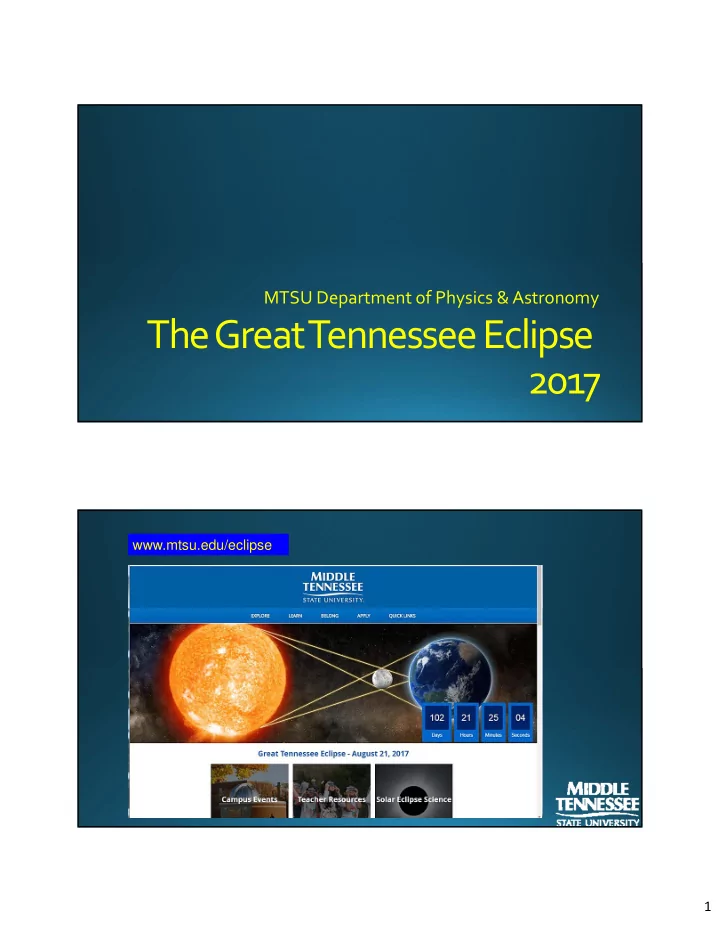
The Great Tennessee Eclipse 2017 www.mtsu.edu/eclipse 1 Goals for - - PDF document
MTSU Department of Physics & Astronomy The Great Tennessee Eclipse 2017 www.mtsu.edu/eclipse 1 Goals for today 1) We convey our excitement for the eclipse 2) You learn a little about how eclipses occur, and achieve a level of confidence for
1
MTSU Department of Physics & Astronomy
www.mtsu.edu/eclipse
2
3
4
Galileo spacecraft, 1992
65 million years ago 20,000 years ago 500 years ago 65 years ago
5
6
7
Sun Earth Moon
Unique geometry Lunar orbit
Earth
Shadows
8
Solar Eclipses 1996-2020 Saros Cycle 18.03 years
9
90 min of totality across the US shadow moves at average speed near 1500 mph (Mach 2)
10
Where will you be on August 21 at 1:28 pm?
Where will you be on August 21 at 1:28 pm?
11
August 21, 2017 Schedule at MTSU: 11:00 am: Campus festivities begin 11:59 am: First contact! The moon begins to pass in front of the sun. 1:29:08 pm- Totality! 1:30:17 pm: Darkness falls across campus 2:55 pm: Last contact 3:00 pm: Campus festivities end
We will have solar glasses … astronomers … telescopes …
Credit: Rick Fienberg
August 21, 2017 Changing daylight Twilight at 90% eclipse Diamond rings and beads Awesome Darkness! … and celestial crowns Temperature feel different Changes in nature
12
Mercury Sun Arcturus Jupiter Mars Venus Procyon Sirius Regulus
Ecliptic Plane
13
http://www.zam.fme.vutbr.cz/~druck/Eclipse/Ecl2008m/Tse2008_200_mo1/0‐info.htm
14
Credit Ken Offit, Rice University DiamondRingfirst2012_KOffit_Rice_Univ
Australia, 2012 (3:39) https://www.youtube.com/watch?v=KZ2npH7zZ4A 2017 Simulation from Hopkinsville, KY (1:31) https://www.youtube.com/watch?v=vzJqeyxye_E 2016 Solar Eclipse (3:42) http://space.rice.edu/eclipse/solar_eclipse_2016/reiff_video/totality_253_Masked.mp4 2012 Solar Eclipse (0:31) http://space.rice.edu/eclipse/solar_eclipse_2012/Ken_Offit/ 11 July 2010 Solar Eclipse (10:12, best part is 3:00 – 4:00) http://space.rice.edu/eclipse/solar_eclipse_2010/videos/
15
Solar Corona Lunar Orbit corrections General Relativity Testing new instruments
A solar eclipse taken in Svalbard on March 20, 2015. Credit: Miloslav Druckmuller, Peter Aniol and Shadia Habbal
16
www.mtsu.edu/eclipse http://www.visitmusiccity.com/eclipse https://eclipse2017.nasa.gov/
www.mtsu.edu/eclipse
17
Basketball = 9.55” diameter (Earth) Baseball = moon Basketball court = Sun Lunar distance = 24 ft Solar distance = 1.8 miles
18
19
Why is the guy standing the closest to the empty beer bottles looking the wrong way?