
SLIDE 1
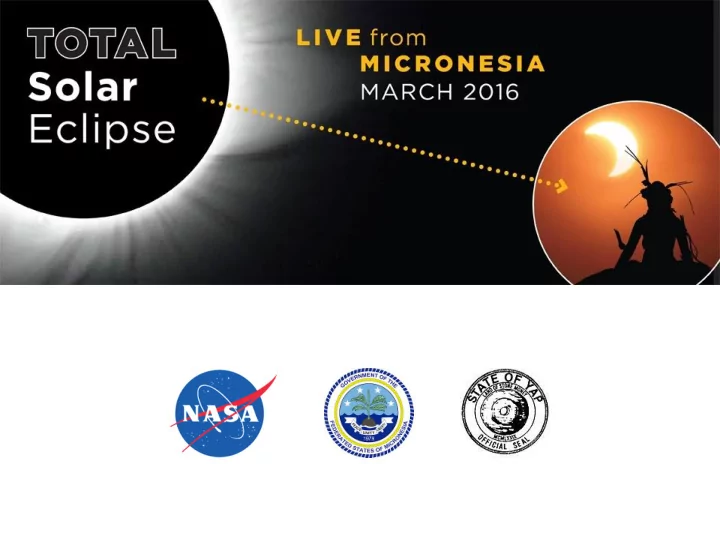
Total Solar Eclipse Project Exploratoriums eclipse history 1998 - - PowerPoint PPT Presentation
Total Solar Eclipse Project Exploratoriums eclipse history 1998 Aruba 1999 Turkey 2001 Zambia 2006 Turkey (again) 2008 China 2016 Micronesia 2017 U.S.A. (August 21) Eclipse Timeline These times are for the eclipse
These times are for the eclipse itself, not the broadcasts 1st Contact Weds, March 9, 2016 00:09:59 UTC Tues, March 8, 2016 7:10 PM EST Washington, DC Tues, March 8, 2016 4:10 PM PST San Francisco Weds, March 9, 2016 10:10 AM CHUT Woleai Atoll, Micronesia 2nd Contact (Totality Begins) (duration: 4 min, 5 seconds) Weds, March 9, 2016 01:38:07 UTC Tues, March 8, 2016 8:38:07 PM EST Washington, DC Tues, March 8, 2016 5:38:07 PM PST San Francisco Weds, March 9, 2016 11:38:07 AM CHUT Woleai Atoll, Micronesia 4th Contact Weds, March 9, 2016 03:14:39 UTC Tues, March 8, 2016 10:14 PM EST Washington, DC Tues, March 8, 2016 7:14 PM PST San Francisco Weds, March 9, 2016 1:14 PM CHUT Woleai Atoll, Micronesia
The path of totality: Woleai Atoll is just before the location of greatest duration
We are producing: Webcasts, blogs, videos, and dispatches from the crew in Micronesia available at: www.exploratorium.edu/eclipse
educational program
with sonification, telescopes with Spanish language commentary
(details follow)
This feed will be a mix from four telescopes There are 2 audio tracks: one is silent, one has a ‘sonification’ Starts Ends Weds, March 9, 2016 00:00:01 UTC 03:15:00 UTC Tues, March 8, 2016 7:00 PM EST 10:15 PM EST Tues, March 8, 2016 4:00 PM PST 7:15 PM PST Weds, March 9, 2016 10:00 AM CHUT 1:15 PM CHUT Available via satellite on Galaxy 17 13K upper (Orb Loc: 91' W; U/L: 14269Mhz Vertical; D/L: 11969Mhz Horizontal) Audio Channel 1: MOS Audio Channel 2: Sonification Available as two separate webcasts (one with each audio channel) at www.exploratorium.edu/eclipse Also Available on Android App (free on Google Play) as Exploratorium Eclipse And on NASA TV, channel 2
A one-hour educational program featuring scientists & educators, hands-on demonstrations, and telescopes imagery Starts Ends Weds, March 9, 2016 01:00:00 UTC 02:00:00 UTC Tues, March 8, 2016 8:00 PM EST 9:00 PM EST Tues, March 8, 2016 5:00 PM PST 6:00 PM PST Weds, March 9, 2016 11:00 AM CHUT 12:00 PM CHUT Available via satellite on Galaxy 17 13K upper (Orb Loc: 91' W; U/L: 14269Mhz Vertical; D/L: 11969Mhz Horizontal) Available as a webcast www.exploratorium.edu/eclipse Also Available on Android App (free on Google Play) as Exploratorium Eclipse And on NASA TV, channel 1
A 30-minute program around totality that will utilize the telescope feed as imagery with added audio commentary in Spanish by Dr. Isabel Hawkins Starts Ends Weds, March 9, 2016 01:15:00 UTC 01:45:00 UTC Tues, March 8, 2016 8:15 PM EST 8:45 PM EST Tues, March 8, 2016 5:15 PM PST 5:45 PM PST Weds, March 9, 2016 11:15 AM CHUT 11:45 PM CHUT Not available on satellite, only online streaming at: www.exploratorium.edu/eclipse
Establishing shots/welcome About the Telescopes (and images) Eclipse 101 (demo/animation of alignment) Moon casting shadow on Earth Why Woleai (path of totality, weather) Local Color (chief, b-roll of culture days) Space Weather (animation, sun bombards us with particles that create aurora at the poles) Magnetosphere (protects us from sun) Prepare for totality (Bailey’s beads, diamond ring, corona) 4 min & 5 seconds of totality Prepare for 2017 eclipse across US How to build a solar viewer Thanks, credits
– 4000 pounds of gear, including a c-band satellite dish – 15 crew (including talent) – 22 hours on plane, 3 days on boat
it is an El Nino year. So we are at 65-75% chance of clear skies. Our contact on Woleai just notified us that they are experiencing drought conditions (and they would not be able to share any drinking water with the crew)
– Jay Anderson http://home.cc.umanitoba.ca/~jander/tot2016/tot2016.htm
– Ancient Chinese believed Celestial Dragon was eating sun (and they would bang on pots and pans to scare it away) – Ancient Mayans, using only naked-eye observing, predicted eclipses for hundreds of years into the future – The Chippewa Indians in N America shot flaming arrows at the sun hoping to rekindle it
– These planets (over 1,000 so far) are found by astronomers noticing a dimming in the light coming from a star. The light dims as the planet passes in front of it
– Assets/maps are available at https://svs.gsfc.nasa.gov/cgi-bin/search.cgi?value=2017+eclipse&expanded=filters
Total solar eclipses are not rare, occurring roughly every year and a half. But each one is visible from only a very limited area on Earth.
“syzygy” (pronounced siz-i-gee).
1,200 miles an hour.
can see a partial eclipse.
eclipse are liable to be eclipsed as well. (This eclipse will be followed by a lunar eclipse two weeks later, on March 23.)
International Space Station, you’d see it as the moon’s shadow cast upon the Earth, moving swiftly across its surface. (You might also see the moon passing in front of the sun.) (possible images: eclipse shadow from space, https://www.youtube.com/watch?v=VenATs6mP8U With the caveat: http://blogs.discovermagazine.com/badastronomy/2012/05/22/a-fake-and-a-real-view-of-the- solar-eclipse-from-space/#.VqaxLlLDfmE )
bigger, it would block out both the sun and its corona; smaller and it would not cover the sun completely. continued on next slide…..
If the moon were at any other distance from Earth, we would not have the total solar eclipses we do. If the moon were closer, it would block out both the sun and its corona; farther away and it would not cover the sun completely.
in the sky, and the moon perfectly covers the sun.
full moon.
No other planet has the right-size moon.
moons block the sun, they block it completely, covering the solar corona as well as the body of the sun.
this: https://www.exploratorium.edu/eclipse/future.html look on mr.eclipse site.)
This is a still image of a great animation made for us by NASA of the path of totality It is available for use, at broadcast resolution here: https://svs.gsfc.nasa.gov/cgi-bin/details.cgi?aid=4427 Also available for 2017 at https://svs.gsfc.nasa.gov/cgi- bin/search.cgi?value=2017+eciipse&expanded=filters
Another still of an animation that shows the shadow moving across earth Available at broadcast resolution here: https://svs.gsfc.nasa.gov/cgi-bin/details.cgi?aid=4424&button=recent Also available for 2017 eclipse at https://svs.gsfc.nasa.gov/cgi-bin/search.cgi?value=2017+eciipse&expanded=filters
The third animation, available for download at https://svs.gsfc.nasa.gov/cgi-bin/details.cgi?aid=4426&button=recent Also available for 2017 eclipse at https://svs.gsfc.nasa.gov/cgi-bin/search.cgi?value=2017+eciipse&expanded=filters
Great stills of totality are available at mreclipse.org He asks for a credit only This site is by Fred Espenak, the most famous of all eclipse chasers and a retired NASA scientist The Exploratorium has produced 10 videos available on our website (and embeddable) on safe viewing, celestial mechanics, Einstein’s Light Bending concept, etc. www.exploratorium.edu/eclipse