
SLIDE 1
The Gospel
- f Luke
The New Testament Class #6
Holly Family , Williston & Saint Anthony Abbott Mission, Inglis
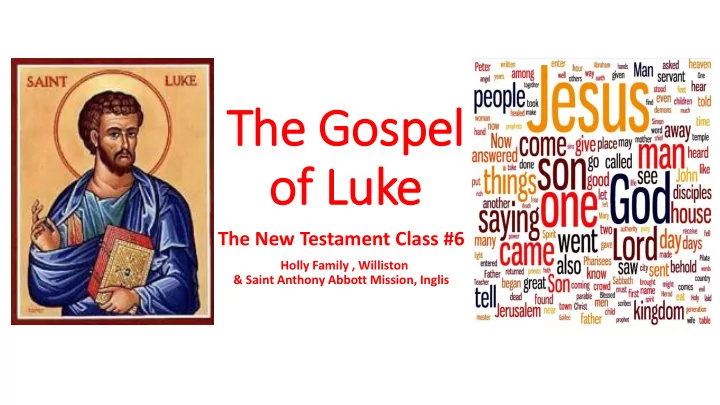
The Gospel of Luke The New Testament Class #6 Holly Family , - - PowerPoint PPT Presentation
The Gospel of Luke The New Testament Class #6 Holly Family , Williston & Saint Anthony Abbott Mission, Inglis PREVIEW: The Gospel According to Luke (Greek: = to kata Loukan euangelion),
The New Testament Class #6
Holly Family , Williston & Saint Anthony Abbott Mission, Inglis
PREVIEW: The Gospel According to Luke (Greek: Τὸ κατὰ Λουκᾶν εὐαγγέλιον= to kata Loukan euangelion), known as the Gospel of Luke, is the third and longest of the four canonical Gospels. It tells of the origins, birth (the only other along with Mark that does this), ministry, death, resurrection and ascension of Jesus Christ. The gospel of Luke and the Acts of the Apostles make up a two-volume work which scholars call Luke–Acts. Together they account for 27.5% of the New Testament, the largest contribution by a single author, providing the framework for both the Church's liturgical calendar and the historical outline. The Gospel of Luke contains 24 chapters. AUTHOR: Early Christian tradition, from the late 2nd century on, identifies the author of this gospel and of the Acts of the Apostles as Luke, a Greek-Syrian physician from Antioch, who is mentioned in the New Testament (Colossians 4:14, Philemon 24 and 2 Timothy 4:11. The prologue of the gospel makes it clear that Luke is not part of the first generation of Christian disciples but is himself dependent upon the traditions he received from those who were eye- witnesses and ministers of the word (Luke 1:2). Luke and the Acts of the Apostles were written by the same author is evidenced by the identical introduction (Luke 1: 14 and Acts 1:1-2). Luke’s consistent substitution of Greek names for the Aramaic or Hebrew names occurring in his sources (e.g., Luke 23:33; Mark 15:22; Luke 18:41; Mark 10:51), his omission from the gospel of specifically Jewish Christian concerns found in his sources (e.g., Mark 7:1–23), his interest in Gentile Christians (Luke 2:30–32; 3:6, 38; 4:16–30; 13:28–30; 14:15–24; 17:11–19; 24:47–48), and his incomplete knowledge of Palestinian geography, customs, and practices are among the characteristics of this gospel that suggest that Luke was a non-Palestinian writing to a non-Palestinian audience made up of Gentile Christians. WHEN AND WHERE WAS IT WRITTEN (AND CONTEXT): Traditionally, the gospel is said to have been circa 80 A.D-85 A.D. The oldest original text is a fragment dating from the late 2nd century, while the oldest complete texts are from the 4th century Codex Sinaiticus and Vaticanus.
Because of its dependence on the Gospel of Mark and because details in Luke’s Gospel (Luke 13:35a; 19:43–44; 21:20; 23:28–31) imply that the author was acquainted with the destruction of the city of Jerusalem by the Romans in A.D. 70, the Gospel of Luke is dated by most scholars after that date; many scholars propose A.D. 80–90 as the time of composition. We cannot identify Exactly were it was written, possibly in Antioch or Cesarea. OVERVIEW: Luke calls upon the Christian disciple to identify with the master Jesus, who is caring and tender toward the poor and lowly, the outcast, the sinner, and the afflicted, toward all those who recognize their dependence on God (Luke 4:18; 6:20–23; 7:36–50; 14:12–14; 15:1–32; 16:19–31; 18:9–14; 19:1–10; 21:1–4), but who is severe toward the proud and self-righteous, and particularly toward those who place their material wealth before the service of God and his people (Luke 6:24–26; 12:13–21; 16:13–15, 19–31; 18:9–14, 15–25; cf. Lk 1:50–53). No gospel writer is more concerned than Luke with the mercy and compassion of Jesus (Luke 7:41–43; 10:29– 37; 13:6–9; 15:11–32). No gospel writer is more concerned with the role of the Spirit in the life of Jesus and the Christian disciple (Luke 1:35, 41; 2:25–27; 4:1, 14, 18; 10:21; 11:13; 24:49), with the importance of prayer (Lk 3:21; 5:16; 6:12; 9:28; 11:1–13; 18:1–8), or with Jesus’ concern for women (Luke 7:11–17, 36–50; 8:2–3; 10:38–42). While Jesus calls on all humanity to repent (Luke 5:32; 10:13; 11:32; 13:1–5; 15:7–10; 16:30; 17:3–4; 24:47), he is particularly demanding of those who would be his disciples. Of them he demands absolute and total detachment from family and material possessions (Luke 9:57–62; 12:32– 34; 14:25–35). To all who respond in faith and repentance to the word Jesus preaches, he brings salvation (Luke 2:30–32; 3:6; 7:50; 8:48, 50; 17:19; 19:9) and peace (Luke 2:14; 7:50; 8:48; 19:38, 42) and life (Luke 10:25–28; 18:26–30).
Luke’s story of Jesus and the church is dominated by a historical perspective. This history is first of all salvation history, moreover, is a part of human history. God’s divine plan for human salvation was accomplished during the period of Jesus, who through the events of his life (Luke 22:22) fulfilled the Old Testament prophecies (Luke 4:21; 18:31; 22:37; 24:26–27, 44), and this salvation is now extended to all humanity in the period of the church (Acts 4:12). Luke includes a considerable number of Jesus' teachings that are not recorded in the
and the Pharisee who went to the Temple to pray, the rich man and Lazarus, the lost coin, the prodigal son, the unjust steward, the rich fool who would tear down his barns and build greater barns in order that he might store his goods, and the story of Zacchaeus, who climbed a tree in order that he might see Jesus. Each of these parables and stories illustrates what Luke regards as an essential characteristic of Jesus' work. Jesus was not trying to raise opposition to the Roman government, nor was he lacking in sympathy or understanding of those whom the Jews regarded as
race or nationality. For example, although many Jews looked with disfavor on the Samaritans, Luke emphasizes that of the ten lepers whom Jesus healed, only the one who was a Samaritan expressed his gratitude for what Jesus had done. And again in the parable of the man who fell among thieves on the road to Jericho, a Samaritan befriended the man and saw to it that he was given proper care. CONTENT OF LUKE: The Infancy Narrative (Luke 1:5–2:52) begins with the announcement of the Birth of John the Baptist (Luke 1: 57- 66), the precursor of the Messiah Jesus (Luke 1: 5-25), followed by Mary’s “yes” (Luke 1: 26-38) and the
announcement and the Birth of Jesus. (Luke 2: 1-14). Of note are the similarities and parallels of both events. The Presentation in the Temple (Luke 2: 22-40) and the interactions between Jesus’ parents and the elders Simeon and Anna points to Jesus’ Divinity. (Luke 2: 25-38). The Boy Jesus in the Temple (Luke 2: 22-40) further illustrates this. The Baptism of Jesus. (Luke 3: 21-22) And Manifests his Divine nature: “And a voice came from heaven, “You are my beloved Son; with you I am well pleased.”” This is followed by his preparation, 40 days in the desert “guided by the Spirit”, the Temptation of Jesus (Luke 4: 1-13), the beginning of the beginning of the Galilean Ministry at Nazareth (Luke 4: 14-15), and his first rejection (Luke 4: 16-30). Central to His ministry even at the beginning was the curing and healing
(Luke 4: 31-41). Jesus heals people in thirteen episodes in the Gospel of Luke: 4:31-37; 4:38-44; 5:12-16; 5:17-26; 7:1-10; 7:11-17; 7:21; 8:26-39; 8:40-56; 9:37-45; 13:10-17; 17:11-19; and 18:35-43. "Nearly one-fifth of the Gospel accounts is devoted to Jesus' healing ministry and the discussion
physical and mental illness and the resurrection of the dead. Except for a discussion of miracles in general, the attention devoted to the healing ministry of Jesus is far greater than that devoted to any one kind of experience." [Gary Wiens, THE HEALING MINISTRY OF JESUS, International House
Jesus begins calling his disciples. Simon Peter, James and John(Luke 5: 1-11), Matthew Levi (Luke 5: 27-32), and the rest of the Twelve (Luke 6: 13-16).
During the Sermon on the Plain and the Beatitudes, He clearly illustrates what is expected of his fallowers (Luke 6: 20-26), and the radical call to love one’s enemies (Luke 6: 27-33), and to: “Be merciful, just as [also] your Father is merciful”. (Luke 6: 36), and of judging others (Luke 6: 37). The Lord’s mission in Galilee (Luke chapters 4-9), begins to change to his mission towards Jerusalem (Luke chapters 10-19 ), which begins with the Lord’s entry, his Passion, crucifixion and death, and His glorious Resurrection (Luke chapters 19-24). The Last Supper and the institution of the Eucharist in Luke (Luke 22: 14-20) is very similar to the other two synoptic
remember him when he entered in “His kingdom” (Luke 23: 39-43). Also only in Luke is the description of the encounter on the road and the supper at Emmaus, and states that a disciple named Cleopas was walking towards Emmaus with another disciple when they met Jesus. They did not recognize him, and discussed their sadness at recent events with him. They persuaded him to come and eat with them, and in the course of the meal they recognized him (Luke 24: 13-31). The prominence given to the period of the church in the story has important consequences for Luke’s interpretation of the teachings of Jesus. By presenting the time of the church as a distinct phase of salvation history, Luke accordingly shifts the early Christian emphasis away from the expectation of an imminent Parousia to the day-to-day concerns of the Christian community in the world. He does this in the gospel by regularly emphasizing the words “each day” (Luke 9:23; cf. Mk 8:34; Luke 11:3; 16:19; 19:47) in the sayings of Jesus. Although Luke still believes the Parousia to be a reality that will come unexpectedly (Luke 12:38, 45–46), he is more concerned with presenting the words and deeds of Jesus as guides for the conduct of Christian disciples in the interim period between the ascension and the Parousia and with presenting Jesus himself as the model of Christian life and piety. The gospel closes with an account of the resurrection and the subsequent meetings of Jesus with the disciples and others. As two men are walking to the village of Emmaus, Jesus joins them, but the men do not recognize Jesus until he sits at a table with them and blesses the food that they are about to eat (Luke 24:13-35).
CONCLUSION: The cornerstone of Luke' theology is the "salvation history", Luke's states that God's purpose is seen in the way Jesus has acted, and will continue to act, in history. This continuity between the historical ministry of Jesus and the ministry of the apostles is Luke’s way of guaranteeing the fidelity of the Church’s teaching to the teaching of
century Christianity into three stages, with the gospel making up the first two of these – the Incarnation among humanity of Jesus the Messiah, from his birth to the beginning of his earthly mission in the meeting with John the Baptist followed by his earthly ministry, Passion, death and
the events post-resurrection and the beginning of Christianity. The principal divisions of the Gospel of Luke:
Ianthe Infancy Narrative (1:5–2:52) Ianthe Preparation for the Public Ministry (3:1–4:13) IV.The Ministry in Galilee (4:14–9:50) V.The Journey to Jerusalem: Luke’s Travel Narrative (9:51–19:27) VI.The Teaching Ministry in Jerusalem (19:28–21:38) VII.The Passion Narrative (22:1–23:56) VIII.The Resurrection Narrative (24:1–53)