SLIDE 1 2 How to craft a Gospel Presentation to a Skeptical World
Gospel Presentations in the Bible
- Matthew and Mark - Son of God
- Luke - Jesus is Liberator of the oppressed setting the captives free in the whole world
- John - Jesus is the Logos, the Way, the Truth
- Paul - Jesus is the second Person of the Trinity. In Him and by Him, we can experience union
with God. We can be “in Christ”, experience sanctification, and glorification
- New Testament - diverse ways to present the Gospel
- Parables by Jesus
- Gospel narratives
- Letters to churches
- Apocalyptic writing
- Hymns
- Prayers
- Creeds
What does this mean for us? Freedom, baby! It frees us up to try different metaphors, and place different emphases on different things while we communicate the same message of the Gospel. Key question to ask ourselves: What best connects with the existential, emotional and cultural landscape of those we are speaking to? Discuss: What are the deep needs and concerns of people in the Tri-Cities today? What are some key things to keep in mind when we are trying to understand and communicate with people in our community? Crafting a Gospel Presentation
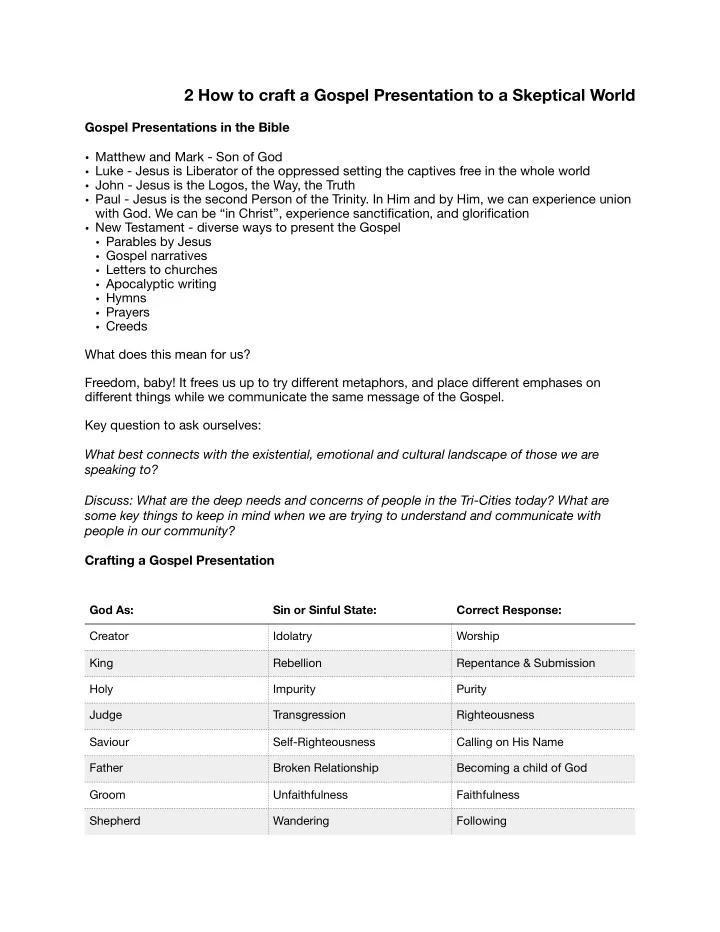
God As: Sin or Sinful State: Correct Response: Creator Idolatry Worship King Rebellion Repentance & Submission Holy Impurity Purity Judge Transgression Righteousness Saviour Self-Righteousness Calling on His Name Father Broken Relationship Becoming a child of God Groom Unfaithfulness Faithfulness Shepherd Wandering Following
SLIDE 2
OR OR
Sin or Sinful State Correct Response Blessings Transgression, guilty, rebellion Faith and Obedience Justification, Forgiveness Falling Short Calling on God’s Name Reconciliation Slavery Serving Jesus Redemption, liberation Blindness Recognizing our blindness I can see! Dead Recognizing our deadness I’m alive! Enemy of God Ceasing our hostilities Peace, reconciliation Not a child Repentance, returning Adoption Unclean, Impure Recognizing our uncleanness Sanctification, Purification Separation Returning Union Idolatry Worshipping God God’s Favour Shame Honouring God Restoration, God’s Face Wander, err, astray Walk in God’s Way Being on the Correct Path Wicked Godly Godly flourishing Jesus As: What Jesus Does: Sinful State: King, Messiah, Christ Rules Rebellion Saviour Saves Sin and Death Priest Reconciles Separation and Impurity Shepherd Shepherds Going Astray Servant Obeys Disobedience Groom Loves Unfaithfulness Word Reveals God Ignorance of God The Way Reveals the Way Lost-ness The Truth Reveals the Truth Error The Life Gives Eternal Life Death
SLIDE 3
Discuss: In your own life, what are two or three ways that resonate? How to Communicate Sin to a world that doesn’t believe in sin Do I need to use the word “sin”? What are other ways that we can communicate “sin” without saying “sin”? Breaking a Law Guilty Need forgiveness Defilement Impure Need cleansing Breaking relationship Shame Need honour restoration Brokenness Life doesn’t wok Restoration/renewal Self-righteousness Miss out on salvation Need Christ’s righteousness Idolatry Owns us & will kill us Turn to the One who delivers Falling Short Not quite there Come to Jesus Big Idea: Bible uses different metaphors, styles, presentations to present the Gospel. We need to learn from this!!
SLIDE 4
Crafting a Gospel Presentation (video)
Which Gospel presentation is the best one? Which is the wrong one? Does it matter? Gospel Presentations are Sharp, Focused Summaries of the Gospel There are no one-size-fits-all, or Silver Bullet Gospel Presentations! As a learning exercise, we will look at:
3 common Gospel Presentations
Two Ways to Live 1. God is the loving ruler of the world He made the world He made us rulers of the world under Him But is that the way it is now? 2. We all reject the ruler (God) by trying to Run life our own way without Him. But we fail to rule ourselves or society or the world. What will God do about such rebellion? 3. God won’t let us rebel forever. God’s punishment for rebellion is death and judgment. God’s judgment sounds harsh, but… 4. Because of His love, God sent His Son into the world: The man Jesus Christ. Jesus always lived under God’s rule. Yet by dying in our place He took our Punishment and brought forgiveness. But that’s not all… 5. God raised Jesus to life again as the ruler of the world. Jesus has conquered death, gives new life, and will return to judge. Well, where does that leave us now?
SLIDE 5 6. We have two ways to live.
- A. Our way, where we reject the ruler, God.
Result: We are condemned by God and face death and judgment.
- B. God’s way, where we submit to Jesus and rely on Jesus’ death and resurrection.
Result: We are forgiven by God and given eternal life. Let’s look at this… Chief Gospel Metaphors
- God is King
- Sin is rebellion against this King
- Judgment for sin is punishment from God
- Salvation blessings are forgiveness and eternal life
- Jesus is the King who died in our place
- The Christian life is submission to God’s rule
Strengths:
- God’s right to be our ruler
- Vertical aspects of our sin
Weaknesses:
- Relational Aspects of the Christian life (God is King, not Father)
- No joy in the Christian life, just submission
- Deemphasizes the world and our work now
- Struggles to explain how to live in this material world - what do I do? Ethics? Art? Study?
Wealth?
- Deistic God
- Weak on Providence, Guidance, Prayer, Healing and Miracles
Good for rebels
SLIDE 6 Four Spiritual Laws Law 1 God loves you and offers a wonderful plan for your life. Law 2 Man is sinful and separated from God. Therefore, he cannot know and experience God’s love and plan for his life. Law 3 Jesus Christ is God’s only provision for man’s sin. Through Him you can know and experience God’s love and plan for your life. Law 4 We must individually receive Jesus Christ as Saviour and Lord; then we can know and experience God’s love and plan for our lives. Let’s look at this… Quite appropriate for its time (1960s) Chief Gospel Metaphors
- God is lover
- Sin is a state of being
- Judgment for sin is separation from God
- Salvation blessings are to “know and experience God’s love and plan for our lives”
- Jesus is the provision for our sin, and the means for knowing and experiencing God
- The Christian life is to “know and experience God’s love and plan for our lives.”
Strengths:
- God is warm, personal, loving, relational
- It explains sin more as a state of being
- Judgment is a privation of good
- The Christian life is one of purpose and fulfilment
- The category of providence is prominent
Weaknesses:
- Opening Premise that there are Laws is not accepted by postmoderns
- Almost makes me the most important person in the universe!
- The Christian life is individualized - it struggles to explain the corporate nature of the
Christian life
- What if we already have fulfilment through other things - sports, work, beer?
- Why do I need God if I’m already happy?
- The category of salvation-history is not so prominent
SLIDE 7 Bridge to Life Let’s look at this… Brilliant…in its time Presumes belief in God What’s more, postmoderns no longer believe in absolute standards of “good” and “bad” Chief Gospel Metaphors
- God is Creator
- Sin is doing the opposite of what God tells us
- The judgment for sin is separation from God
- Salvation blessings are peace, forgiveness, abundant life
- Jesus pays the price for our sins
- The Christian life is peace with God and eternal life
Strengths:
- God is the Creator
- Judgment is separation from God
- The Christian life is a state of being - peace with God - rather than what we do
Weaknesses:
- The Christian life is individualized
- Little to say about physical world and what we do once we are saved
- Struggle to show the worth of ethics, work, aesthetics, work, etc.
Good for religious people.
SLIDE 8 Gospel Summaries are:
- Summaries (and thus leave out some metaphors)
- Contextualized for a specific audience
- Leave out other key biblical ideas
- If we just stick to one, it may lead to theological reductionism (meaning, we leave out
aspects of the Gospel that are also crucial to hear) We need to be familiar with a variety of approaches and summaries.
Manger, Cross, King
Manger - Jesus comes to us in a manger (Incarnation)
- Reversal of values
- God became man
- First became last
- God became a servant
Cross - Jesus dies for us on the Cross (Atonement)
- Penal substitution
- Sinners that can only be saved by grace
King - Jesus is King and will set up His Kingdom on earth (Restoration)
- We can have a renewed LIFE
- This earth will be renewed
- We have a corporate responsibility to help renew and restore the world
Weaknesses:
- Not much on God as Creator
- Assumes a prior knowledge of God as the One who created the heavens and the earth
Strengths:
- It does a good job juggling the tensions between Salvation History and Providence.
Individual Salvation and Corporate responsibility. Spiritual and Physical aspects of our new
- life. Saved as individuals but brought into a corporate responsibility to help cultivate the
Kingdom of God.
- The Structure can be used in a variety of contexts. For example, if I’m telling someone about
what communion is all about, I can just say:
- Jesus came to us as a human. He really did eat a physical meal with his disciples.
- Jesus died on a Cross, and this meal is a symbol of his body that was broken for us, and
his blood that was shed for our sins.
- Jesus is King. Our meal looks forward to the day when Jesus sets up his kingdom on
earth and we will have a banquet with him.
- This summary presents Jesus as a Person in a Story. He comes across as real. He is
someone we are to know, love, and worship. He didn’t just die on a Cross for us, he also had a vital earthly ministry. Conclusion: Wide range of metaphors that we can use. It requires discernment from us on how to use them and when to use them.