Reading Lukewise A. An outline of Lukes Gospel An overview of Lukes - - PowerPoint PPT Presentation

reading lukewise
SMART_READER_LITE
LIVE PREVIEW

Reading Lukewise A. An outline of Lukes Gospel An overview of Lukes - - PowerPoint PPT Presentation

Where were going Reading Lukewise A. An outline of Lukes Gospel An overview of Lukes Gospel B. A look at how Luke writes C. A look at some major Lukan themes using Tom Wrights four speakers Steve Walton D. A walk through


slide-1
SLIDE 1

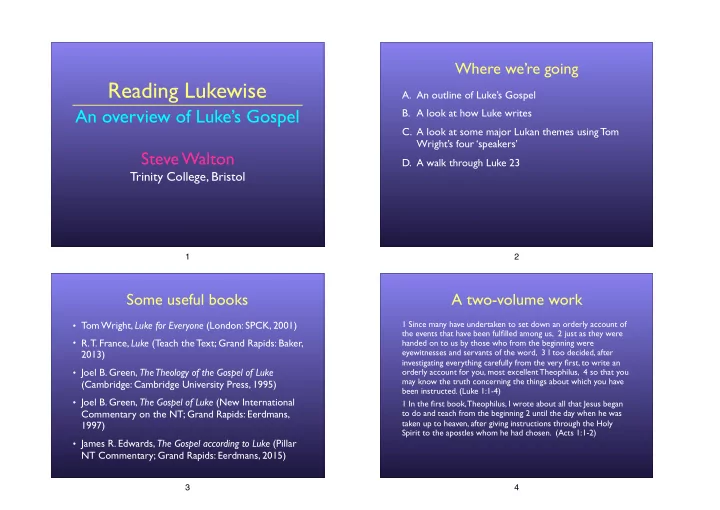
Reading Lukewise

An overview of Luke’s Gospel

Steve Walton


Trinity College, Bristol

1

Where we’re going

  • A. An outline of Luke’s Gospel
  • B. A look at how Luke writes
  • C. A look at some major Lukan themes using Tom

Wright’s four ‘speakers’

  • D. A walk through Luke 23

2

Some useful books

  • Tom Wright, Luke for Everyone (London: SPCK, 2001)
  • R. T. France, Luke (Teach the Text; Grand Rapids: Baker,

2013)

  • Joel B. Green, The

Theology of the Gospel of Luke (Cambridge: Cambridge University Press, 1995)

  • Joel B. Green, The Gospel of Luke (New International

Commentary on the NT; Grand Rapids: Eerdmans, 1997)

  • James R. Edwards, The Gospel according to Luke (Pillar

NT Commentary; Grand Rapids: Eerdmans, 2015)

3

A two-volume work

1 Since many have undertaken to set down an orderly account of the events that have been fulfilled among us, 2 just as they were handed on to us by those who from the beginning were eyewitnesses and servants of the word, 3 I too decided, after investigating everything carefully from the very first, to write an

  • rderly account for you, most excellent Theophilus, 4 so that you

may know the truth concerning the things about which you have been instructed. (Luke 1:1-4) 1 In the first book, Theophilus, I wrote about all that Jesus began to do and teach from the beginning 2 until the day when he was taken up to heaven, after giving instructions through the Holy Spirit to the apostles whom he had chosen. (Acts 1:1-2) 4

slide-2
SLIDE 2

A two-volume work

1 Since many have undertaken to set down an orderly account of the events that have been fulfilled among us, 2 just as they were handed on to us by those who from the beginning were eyewitnesses and servants of the word, 3 I too decided, after investigating everything carefully from the very first, to write an

  • rderly account for you, most excellent Theophilus, 4 so that you

may know the truth concerning the things about which you have been instructed. (Luke 1:1-4) 1 In the first book, Theophilus, I wrote about all that Jesus began to do and teach from the beginning 2 until the day when he was taken up to heaven, after giving instructions through the Holy Spirit to the apostles whom he had chosen. (Acts 1:1-2) 5

A two-volume work

1 Since many have undertaken to set down an orderly account of the events that have been fulfilled among us, 2 just as they were handed on to us by those who from the beginning were eyewitnesses and servants of the word, 3 I too decided, after investigating everything carefully from the very first, to write an

  • rderly account for you, most excellent Theophilus, 4 so that you

may know the truth concerning the things about which you have been instructed. (Luke 1:1-4) 1 In the first book, Theophilus, I wrote about all that Jesus began to do and teach from the beginning 2 until the day when he was taken up to heaven, after giving instructions through the Holy Spirit to the apostles whom he had chosen. (Acts 1:1-2) 6

The Gospels are books about Jesus

7

The shape of Luke’s Gospel

  • chs 1–2 introduce Jesus
  • 3:1–9:50 focused in Galilee
  • 3:1-22 starting with John the baptiser
  • 3:23-28 where Jesus comes from
  • 4:1–9:50 Jesus’ initial ministry
  • 9:51–19:44 the journey to Jerusalem
  • much distinctively Lukan material here
  • focus on reforming the people of God
  • 19:45–24:53 focused in Jerusalem itself

8

slide-3
SLIDE 3

The shape of Luke’s Gospel

  • 2:40 = 12 years

‘The child grew and became strong, filled with wisdom; and the favour of God was upon him.’

  • 2:52 = ?18 years

‘And Jesus increased in wisdom and in years, and in divine and human favour.’

  • 19:28–24:53 = ?a week
  • 22:1–23:56 = ?48 hours

9

What is Luke doing?

  • Three ‘layers’ to his Gospel

1 Since many have undertaken to set down an orderly account of the events that have been fulfilled among us, 2 just as they were handed on to us by those who from the beginning were eyewitnesses and servants of the word, 3 I too decided, after investigating everything carefully from the very first, to write an orderly account for you, most excellent Theophilus, 4 so that you may know the truth concerning the things about which you have been instructed. (Luke 1:1-4)

10

What is Luke doing?

  • Three ‘layers’ to his Gospel

1 Since many have undertaken to set down an orderly account of the events that have been fulfilled among us, 2 just as they were handed on to us by those who from the beginning were eyewitnesses and servants of the word, 3 I too decided, after investigating everything carefully from the very first, to write an orderly account for you, most excellent Theophilus, 4 so that you may know the truth concerning the things about which you have been instructed. (Luke 1:1-4)

11 12

slide-4
SLIDE 4

What is Luke doing?

  • Three ‘layers’ to his Gospel

1 Since many have undertaken to set down an orderly account of the events that have been fulfilled among us, 2 just as they were handed on to us by those who from the beginning were eyewitnesses and servants of the word, 3 I too decided, after investigating everything carefully from the very first, to write an orderly account for you, most excellent Theophilus, 4 so that you may know the truth concerning the things about which you have been instructed. (Luke 1:1-4)

13

What is Luke doing?

  • Three ‘layers’ to his Gospel

1 Since many have undertaken to set down an orderly account of the events that have been fulfilled among us, 2 just as they were handed on to us by those who from the beginning were eyewitnesses and servants of the word, 3 I too decided, after investigating everything carefully from the very first, to write an orderly account for you, most excellent Theophilus, 4 so that you may know the truth concerning the things about which you have been instructed. (Luke 1:1-4)

14

Who was Theophilus?

  • an actual person or a fictional character?
  • a believer, an enquirer or an unbeliever?
  • a Gentile, a godfearer or a Jew?

15

Wright’s four ‘loudspeakers’

  • The Gospels as the climax of the

story of Israel

  • The story of Jesus as the story
  • f Israel’s God coming back to

his people

  • The Gospels as foundation

documents for a new movement

  • The story of the kingdom of

God clashing with the kingdom

  • f Caesar

16

slide-5
SLIDE 5

Luke as the climax of the story of Israel

  • fulfilment of Scripture
  • the infancy narratives, Luke 1–2
  • biblical language, e.g. ‘before God’ 1:6
  • biblical echoes, e.g. 1:7
  • biblical ideas, e.g. 1:5
  • reappearance of biblical characters, e.g. angels

1:11-20, 26-38; 2:8-14

  • return of prophecy, e.g. 1:67; 2:36-38
  • fulfilling the law, e.g. 2:22-24, 41

17

Luke as the climax of the story of Israel

  • fulfilment of Scripture
  • the infancy narratives, Luke 1–2
  • the mission of Jesus as new exodus 3:4-6

18

Luke 3:3-6, quoting Isaiah 40:3-5

3 [John] went into all the region around the Jordan, proclaiming a baptism of repentance for the forgiveness of sins, 4 as it is written in the book of the words of the prophet Isaiah, “The voice of one crying out in the wilderness: ‘Prepare the way of the Lord, make his paths straight. 5 Every valley shall be filled, and every mountain and hill shall be made low, and the crooked shall be made straight, and the rough ways made smooth; 6 and all flesh shall see the salvation of God.’”

19

Luke as the climax of the story of Israel

  • fulfilment of Scripture
  • the infancy narratives, Luke 1–2
  • the mission of Jesus as new exodus 3:4-6
  • the death of Jesus

18:31-33 ‘See, we are going up to Jerusalem, and everything that is written about the Son of Man by the prophets will be accomplished.’

20

slide-6
SLIDE 6

Luke as the climax of the story of Israel

  • fulfilment of Scripture
  • the infancy narratives, Luke 1–2
  • the mission of Jesus as new exodus 3:4-5
  • the death of Jesus
  • 18:31-33
  • 20:17, quoting Psalm 118:22

‘What then does this text mean: “The stone that the builders rejected has become the cornerstone”?’

21

Luke as the climax of the story of Israel

  • fulfilment of Scripture
  • the infancy narratives, Luke 1–2
  • the mission of Jesus as new exodus 3:4-5
  • the death of Jesus
  • 18:31-33
  • 20:17, quoting Psalm 118:22
  • 22:37, quoting Isaiah 53:12

‘For I tell you, this scripture must be fulfilled in me, “And he was counted among the lawless”; and indeed what is written about me is being fulfilled.’

22

Luke as the climax of the story of Israel

  • fulfilment of Scripture
  • the infancy narratives, Luke 1–2
  • the mission of Jesus as new exodus 3:4-5
  • the death of Jesus
  • 18:31-33
  • 20:17, quoting Psalm 118:22
  • 22:37, quoting Isaiah 53:12
  • 24:26-27, 44, 46-47

23

Luke 24:26-27, 44, 46-47

“Was it not necessary that the Messiah should suffer these things and then enter into his glory?” Then beginning with Moses and all the prophets, [Jesus] interpreted to them the things about himself in all the scriptures. (vv 26-27) Then [Jesus] said to them, “These are my words that I spoke to you while I was still with you—that everything written about me in the law of Moses, the prophets, and the psalms must be fulfilled.” (v 44) [Jesus] said to them, “Thus it is written, that the Messiah is to suffer and to rise from the dead on the third day, and that repentance and forgiveness of sins is to be proclaimed in his name to all nations, beginning from Jerusalem.” (vv 46-47)

24

slide-7
SLIDE 7

The story of Israel’s God coming back to his people

  • 3:4-6, quoting Isaiah 40:3-5

25

Luke 3:3-6, quoting Isaiah 40:3-5

3 [John] went into all the region around the Jordan, proclaiming a baptism of repentance for the forgiveness of sins, 4 as it is written in the book of the words of the prophet Isaiah, “The voice of one crying out in the wilderness: ‘Prepare the way of the Lord, make his paths straight. 5 Every valley shall be filled, and every mountain and hill shall be made low, and the crooked shall be made straight, and the rough ways made smooth; 6 and all flesh shall see the salvation of God.’”

26

Who is John the baptiser?

  • Jesus’ testimony about John


7:27, quoting Malachi 3:1: “Behold, I send my messenger, and he will prepare the way before me. And the Lord, whom you seek, will suddenly come to his temple, even the messenger of the covenant, in whom you delight. Behold, he is coming,” says the Lord of hosts.

27

Who is John the baptiser?

  • Jesus’ testimony about John


7:27, quoting Malachi 3:1: “Behold, I send my messenger, and he will prepare the way before me. And the Lord, whom you seek, will suddenly come to his temple, even the messenger of the covenant, in whom you delight. Behold, he is coming,” says the Lord of hosts.

28

slide-8
SLIDE 8

The story of Israel’s God coming back to his people

  • 3:4-6, quoting Isaiah 40:3-5
  • John’s identity as the messenger who prepares

for God to come 7:27, quoting Malachi 3:1

  • Jesus visits the temple to inspect it 19:45-46

29

Luke 19:45-46

Then [Jesus] entered the temple and began to drive

  • ut those who were selling things there; and he said,

“It is written,‘My house shall be a house of prayer’; but you have made it a den of robbers.” Isaiah 56:7 ‘my house shall be called a house of prayer for all the nations’ Jeremiah 7:11 ‘Has this house, which bears my Name, become a den of robbers to you? But I have been watching! declares the Lord.’

30

The story of Israel’s God coming back to his people

  • 3:4-6, quoting Isaiah 40:3-5
  • John’s identity as the messenger who prepares

for God to come 7:27, quoting Malachi 3:1

  • Jesus visits the temple to inspect it 19:45-46,

quoting Isaiah 56:7 and Jeremiah 7:11

  • the leaders of God’s people reject Jesus
  • Luke 21 echoes fall of Jerusalem in OT prophets

(especially Jeremiah, Isaiah, Ezekiel) and 2 Kings 25—C. H. Dodd

31

Luke as foundation document for a new movement

  • telling the story of the launch of God’s renewed

people

  • portrait of discipleship in the journey narrative,

9:51–19:10—will focus on 12:1–13:9

32

slide-9
SLIDE 9

Discipleship in Luke 12:1–13:9

  • 12:4-7 the threat of death for following Jesus
  • 12:8-12 the need to own up to following Jesus
  • 12:13-21 the danger of covetousness
  • 12:22-32 God will care for Jesus’ followers…
  • 12:33-34 …so they can give to those in need
  • 12:36-48 parables on readiness
  • 12:54-57 call to read ‘the signs of the times’
  • 12:49-53 warning about the division Jesus brings
  • 13:1-9 warning of the consequences of not repenting and

bearing fruit by following Jesus 33

More on discipleship in Luke’s travel narrative in chapter 11 of this book

34

Luke as foundation document for a new movement

  • telling the story of the launch of God’s renewed

people

  • portrait of discipleship in the journey narrative,

9:51–19:10—will focus on 12:1–13:9

  • the nature of the new movement—it includes

marginalised people

35

Marginalised people: women

  • infancy narratives
  • Mary, Elisabeth, Anna
  • contrast Matthew 1:20-21

36

slide-10
SLIDE 10

Marginalised people: women

  • helpers of Jesus

8:1-3 ‘Soon afterwards he went on through cities and villages, proclaiming and bringing the good news of the kingdom of God. The twelve were with him, as well as some women who had been cured of evil spirits and infirmities: Mary, called Magdalene, from whom seven demons had gone

  • ut, and Joanna, the wife of Herod’s steward

Chuza, and Susanna, and many others, who provided for them out of their resources.’

37

Marginalised people: women

  • helpers of Jesus

8:1-3 ‘Soon afterwards he went on through cities and villages, proclaiming and bringing the good news of the kingdom of God. The twelve were with him, as well as some women who had been cured of evil spirits and infirmities: Mary, called Magdalene, from whom seven demons had gone

  • ut, and Joanna, the wife of Herod’s steward

Chuza, and Susanna, and many others, who provided for them out of their resources.’

38

Marginalised people: women

  • helpers of Jesus

10:38-42 ‘Now as they went on their way, he entered a certain village, where a woman named Martha welcomed him into her home. 39 She had a sister named Mary, who sat at the Lord’s feet and listened to what he was saying. 40 But Martha was distracted by her many tasks; so she came to him and asked, “Lord, do you not care that my sister has left me to do all the work by myself? Tell her then to help me.” 41 But the Lord answered her, “Martha, Martha, you are worried and distracted by many things; 42 there is need of only one thing. Mary has chosen the better part, which will not be taken away from her.”’

39

Marginalised people: women

  • helpers of Jesus

10:38-42 ‘Now as they went on their way, he entered a certain village, where a woman named Martha welcomed him into her home. 39 She had a sister named Mary, who sat at the Lord’s feet and listened to what he was saying. 40 But Martha was distracted by her many tasks; so she came to him and asked, “Lord, do you not care that my sister has left me to do all the work by myself? Tell her then to help me.” 41 But the Lord answered her, “Martha, Martha, you are worried and distracted by many things; 42 there is need of only one thing. Mary has chosen the better part, which will not be taken away from her.”’

40

slide-11
SLIDE 11

Marginalised people: women

  • helped by Jesus
  • the widow at Nain 7:11-15
  • the woman who anointed Jesus 7:36-50
  • the woman bent double 13:11-17

‘And ought not this woman, a daughter of Abraham whom Satan bound for eighteen long years, be set free from this bondage on the sabbath day?’ (v 16)

41

Marginalised people: women

  • women as subject of parables
  • the lost coin 15:8-10
  • the persistent widow 18:1-8

42

Marginalised people: people in poverty

  • 2:24 Jesus from a poor family

Leviticus 12:6-8 ‘When the days of her purification are completed, whether for a son or for a daughter, she shall bring to the priest at the entrance of the tent of meeting a lamb in its first year for a burnt offering, and a pigeon or a turtledove for a sin offering. He shall offer it before the Lord, and make atonement on her behalf; then she shall be clean from her flow of blood. This is the law for her who bears a child, male or female. If she cannot afford a sheep, she shall take two turtledoves or two pigeons, one for a burnt offering and the other for a sin offering; and the priest shall make atonement on her behalf, and she shall be clean.’

43

Marginalised people: people in poverty

  • 2:24 Jesus from a poor family
  • Jesus’ mission
  • 1:52-53 lifts up the lowly, fill the hungry
  • 4:18 (Isaiah 61:1-2) good news to poor people
  • 7:22 poor people have good news preached to

them

44

slide-12
SLIDE 12

Marginalised people: people in poverty

  • 2:24 Jesus from a poor family
  • Jesus’ mission
  • care for people in poverty
  • 6:20 ‘blessed are the poor’
  • 6:30 ‘Give to everyone who begs from you’
  • 14:12-14 Invite poor people to banquets

45

Marginalised people: people in poverty

  • 2:24 Jesus from a poor family
  • Jesus’ mission
  • care for people in poverty
  • parables about wealth and poverty—all distinctively

Lukan

  • the two debtors 7:41-50
  • the rich fool 12:13-21
  • the rich man and Lazarus 16:19-31
  • the pounds 19:11-17

46

Marginalised people:
 people who are disreputable

  • Samaritans
  • Jesus visits a Samaritan village 9:52
  • The parable of the good Samaritan

10:33 ‘a Samaritan while travelling came near him; and when he saw him, he was moved with pity.’

47

Marginalised people:
 people who are disreputable

  • Samaritans
  • Jesus visits a Samaritan village 9:52
  • The parable of the good Samaritan 10:33
  • The person healed of leprosy who returns 17:16
  • All distinctively Lukan
  • and note Acts 8:5-25

48

slide-13
SLIDE 13

Marginalised people:
 people who are disreputable

  • Samaritans
  • ‘tax collectors and sinners’ 5:30; 7:34; 15:2; 19:7
  • Jesus anointed by a ‘sinner’ 7:37, 39
  • people with leprosy
  • Naaman 4:27
  • ten people with leprosy 17:11-19
  • healings of people with leprosy 5:12-13; 7:22

49

Marginalised people:
 people who are disreputable

  • Samaritans
  • ‘tax collectors and sinners’
  • people with leprosy
  • the penitent thief 23:39-43

‘And we indeed have been condemned justly, for we are getting what we deserve for our deeds, but this man has done nothing wrong.’ (v 41)

50

Marginalised people: children

  • infancy stories of John and Jesus chs 1–2
  • boyhood of Jesus 2:39-52
  • only son/daughter
  • widow’s son 7:12
  • Jairus’ daughter 8:42
  • epileptic boy 9:38

51

Luke’s story of the kingdom of God clashing with the kingdom of Caesar

  • Luke alone places Jesus’ birth in the context of

world history 2:1-2; 3:1-2

52

slide-14
SLIDE 14

The context of world history

2:1-2 ‘In those days a decree went out from Emperor Augustus that all the world should be registered. This was the first registration and was taken while Quirinius was governor of Syria.’ 3:1-2 ‘In the fifteenth year of the reign of Emperor Tiberius, when Pontius Pilate was governor of Judea, and Herod was ruler of Galilee, and his brother Philip ruler of the region of Ituraea and Trachonitis, and Lysanias ruler of Abilene, during the high priesthood of Annas and Caiaphas, the word of God came to John son of Zechariah in the wilderness.’

53

The context of world history

2:1-2 ‘In those days a decree went out from Emperor Augustus that all the world should be registered. This registration was taken before Quirinius was governor of Syria.’ 3:1-2 ‘In the fifteenth year of the reign of Emperor Tiberius, when Pontius Pilate was governor of Judea, and Herod was ruler of Galilee, and his brother Philip ruler of the region of Ituraea and Trachonitis, and Lysanias ruler of Abilene, during the high priesthood of Annas and Caiaphas, the word of God came to John son of Zechariah in the wilderness.’

54

Luke’s story of the kingdom of God clashing with the kingdom of Caesar

  • Luke alone places Jesus’ birth in the context of

world history 2:1-2; 3:1-2

  • Luke’s Jesus is the saviour of the world 2:32

‘a light for revelation to the Gentiles and glory to your people Israel’

55

Luke’s story of the kingdom of God clashing with the kingdom of Caesar

  • Luke alone places Jesus’ birth in the context of

world history 2:1-2; 3:1-2

  • Luke’s Jesus is the saviour of the world 2:32
  • Luke sees that the gospel message has

implications for social and political powers

  • Acts 17:7 Paul announces ‘another king, Jesus’

56

slide-15
SLIDE 15

Luke’s story of the kingdom of God clashing with the kingdom of Caesar

  • Luke alone places Jesus’ birth in the context of

world history 2:1-2; 3:1-2

  • the question about taxes 20:20-26

57

Luke 20:20-26

20 So they watched [Jesus] and sent spies who pretended to be honest, in order to trap him by what he said, so as to hand him

  • ver to the jurisdiction and authority of the governor. 21 So

they asked him, “Teacher, we know that you are right in what you say and teach, and you show deference to no one, but teach the way of God in accordance with truth. 22 Is it lawful for us to pay taxes to the emperor, or not?” 23 But he perceived their craftiness and said to them, 24 “Show me a denarius. Whose head and whose title does it bear?” They said, “The emperor’s.” 25 He said to them, “Then give to the emperor the things that are the emperor’s, and to God the things that are God’s.” 26 And they were not able in the presence of the people to trap him by what he said; and being amazed by his answer, they became silent. 58

Luke 20:20-26

20 So they watched [Jesus] and sent spies who pretended to be honest, in order to trap him by what he said, so as to hand him

  • ver to the jurisdiction and authority of the governor. 21 So

they asked him, “Teacher, we know that you are right in what you say and teach, and you show deference to no one, but teach the way of God in accordance with truth. 22 Is it lawful for us to pay taxes to the emperor, or not?” 23 But he perceived their craftiness and said to them, 24 “Show me a denarius. Whose head and whose title does it bear?” They said, “The emperor’s.” 25 He said to them, “Then give to the emperor the things that are the emperor’s, and to God the things that are God’s.” 26 And they were not able in the presence of the people to trap him by what he said; and being amazed by his answer, they became silent. 59

The inscription on the denarius

  • Tiberius Caesar, son of the divine Augustus,

Augustus

  • high priest

60

slide-16
SLIDE 16

Luke 20:20-26

20 So they watched [Jesus] and sent spies who pretended to be honest, in order to trap him by what he said, so as to hand him

  • ver to the jurisdiction and authority of the governor. 21 So

they asked him, “Teacher, we know that you are right in what you say and teach, and you show deference to no one, but teach the way of God in accordance with truth. 22 Is it lawful for us to pay taxes to the emperor, or not?” 23 But he perceived their craftiness and said to them, 24 “Show me a denarius. Whose head and whose title does it bear?” They said, “The emperor’s.” 25 He said to them, “Then give to the emperor the things that are the emperor’s, and to God the things that are God’s.” 26 And they were not able in the presence of the people to trap him by what he said; and being amazed by his answer, they became silent. 61

Luke’s story of the kingdom of God clashing with the kingdom of Caesar

  • Luke alone places Jesus’ birth in the context of

world history 2:1-2; 3:1-2

  • the question about taxes 20:20-26
  • the portrait of the ‘powers’ is mixed
  • Pilate and Herod in Luke 23
  • positive periods
  • Acts 18:1-18a
  • Acts 28:1-10

62

Wright’s four ‘loudspeakers’

  • Luke as the climax of the story
  • f Israel
  • The story of Jesus as the story
  • f Israel’s God coming back to

his people

  • Luke (and Acts) as foundation

documents for a new movement

  • Luke (and Acts) as the story of

the kingdom of God clashing with the kingdom of Caesar

63

You can get these slides from

Acts and More http://stevewalton.info

64