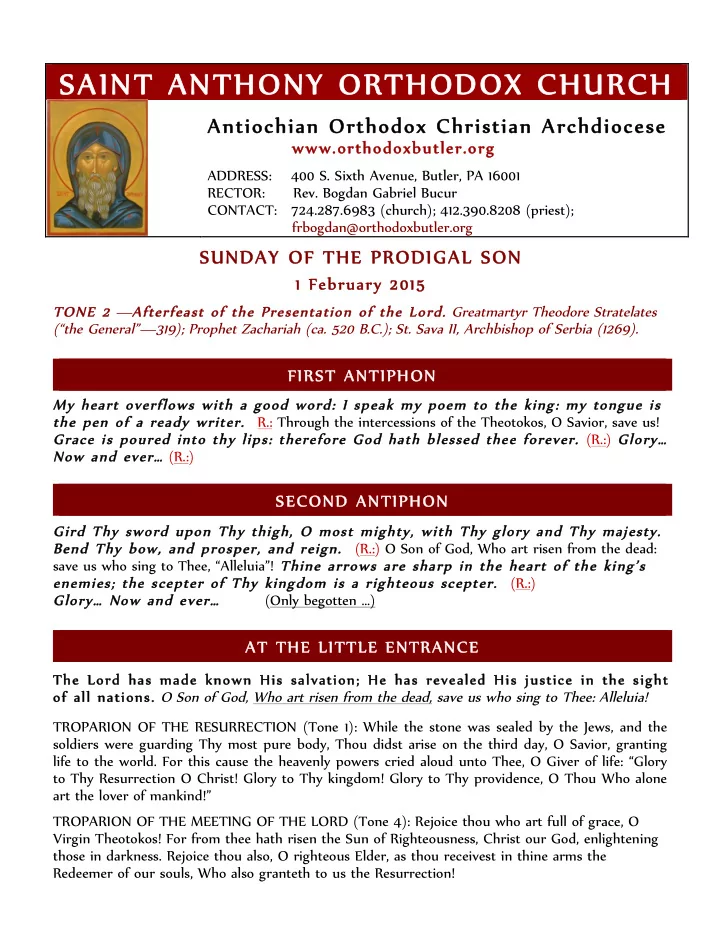
SA SAINT ANTHONY ORT RTHODOX X CH CHURCH RCH Antioc Ant - - PDF document

sa saint anthony ort rthodox x ch church rch
SMART_READER_LITE
LIVE PREVIEW

SA SAINT ANTHONY ORT RTHODOX X CH CHURCH RCH Antioc Ant - - PDF document

SA SAINT ANTHONY ORT RTHODOX X CH CHURCH RCH Antioc Ant ochian n Orthod odox ox Ch Christian n Ar Archdioc ocese www. www.orthodoxbutler.org ADDRESS: 400 S. Sixth Avenue, Butler, PA 16001 RECTOR: Rev. Bogdan Gabriel Bucur


slide-1
SLIDE 1

SA SAINT ANTHONY ORT RTHODOX X CH CHURCH RCH

Ant Antioc

  • chian

n Orthod

  • dox
  • x Ch

Christian n Ar Archdioc

  • cese

www. www.orthodoxbutler.org

ADDRESS: 400 S. Sixth Avenue, Butler, PA 16001 RECTOR:

  • Rev. Bogdan Gabriel Bucur

CONTACT: 724.287.6983 (church); 412.390.8208 (priest); frbogdan@orthodoxbutler.org

SUN SUNDAY OF TH DAY OF THE E PRODIGAL SON PRODIGAL SON

1 Feb Februa uary 201 2015

TO TONE NE 2 —Af Afterfeast of

  • f the Pr

Present ntation

  • n of
  • f the Lor
  • Lord. Greatmartyr Theodore Stratelates

(“the General”—319); Prophet Zachariah (ca. 520 B.C.); St. Sava II, Archbishop of Serbia (1269).

FI FIRST ST ANTI ANTIPHO HON

My My heart overflows ws wi with a good wo word: I speak my my poem m to the king: my my tongue is th the p pen o

  • f a

f a re ready w wri rite ter.

  • r. R.: Through the intercessions of the Theotokos, O Savior, save us!

Gr Grace is pou poured int nto

  • thy lips

ps: therefor

  • re God

God hath bl blessed thee for

  • rever. (R.:) Gl

Glor

  • ry…

Now Now and nd ever… (R.:)

SEC SECOND ANTI ANTIPHO HON

Gi Gird Th Thy swor word upon pon Th Thy thigh, O mos

  • st mighty, wi

with Th Thy glor

  • ry and Th

Thy majesty. Bend Bend Thy hy bo bow, and and prosper er, and and rei eign.

  • gn. (R.:) O Son of God, Who art risen from the dead:

save us who sing to Thee, “Alleluia”! Th Thine ne arrows

  • ws are sharp

p in n the heart of

  • f the king

ng’s en enem emies es; the he scep cepter er of Thy hy ki kingdo ngdom is a a right ghteo eous us scep cepter

  • er. (R.:)

Gl Glor

  • ry… Now

Now and ever… (Only begotten …)

AT AT THE THE LITTL TTLE ENTR NTRANCE ANCE

The he Lo Lord d has has made ade kn known His sal alvat vation; He e has has re reve veale led His s justi stice ce in th the si sigh ght t

  • f
  • f al

all na nations

  • ns. O Son of God, Who art risen from the dead, save us who sing to Thee: Alleluia!

TROPARION OF THE RESURRECTION (Tone 1): While the stone was sealed by the Jews, and the soldiers were guarding Thy most pure body, Thou didst arise on the third day, O Savior, granting life to the world. For this cause the heavenly powers cried aloud unto Thee, O Giver of life: “Glory to Thy Resurrection O Christ! Glory to Thy kingdom! Glory to Thy providence, O Thou Who alone art the lover of mankind!” TROPARION OF THE MEETING OF THE LORD (Tone 4): Rejoice thou who art full of grace, O Virgin Theotokos! For from thee hath risen the Sun of Righteousness, Christ our God, enlightening those in darkness. Rejoice thou also, O righteous Elder, as thou receivest in thine arms the Redeemer of our souls, Who also granteth to us the Resurrection!

slide-2
SLIDE 2

KONTAKION FOR THE SUNDAY OF THE PRODIGAL SON (Tone 3): Foolishly I sprang away from Thy great fatherly glory and dispersed in wicked deeds the riches that Thou didst give me. With the prodigal I therefore cry unto Thee now: “I have sinned against Thee, O compassionate Father. But receive me in repentance; make me as one of Thy hired servants, O Lord!” KONTAKION FOR THE PRESENTATION OF THE LORD (Tone 1): Thou, O Christ God, Who by Thy birth didst sanctify the Virgin’s womb and, as is meet, didst bless Simeon’s arms, and didst also come to save us: preserve Thy fold in wars, and confirm them whom Thou didst love, for Thou alone art the Lover of mankind!

TO TODAY’ AY’S EPISTL TLE RE READ ADING NG

Let your mercy, O Lord, be upon us. Rejoice in the Lord, O you righteous! Fr From

  • m the

he Fi First Ep Epistle e of

  • f Sai

Saint nt Paul Paul to

  • the

he Cor Corint nthi hians ans (I Cor 6:12-20) Br Bret ethr hren: en: "al all thi hings ngs ar are e la lawfu ful fo l for m r me," b ," but n t not a t all th ll things a s are re hel helpful

  • ul. "All thi

hings ngs ar are e law awful ul for me, e," but but I will no not be be ens enslaved aved by by anyt anythi hing. ng. "F "Food i is m s mean eant fo t for th r the sto e stomach ach an and th the sto e stomach ach fo for fo r food"—an and d God d will des destroy y bot both h one

  • ne and

nd the he ot

  • the
  • her. The

The body body is not not meant nt for

  • r immor
  • rality

ty, b , but fo t for th the L Lord rd, , an and d the he Lord d for the he body

  • body. And

nd God

  • d raised

d the he Lor Lord d and nd will also

  • raise us

us up up by by hi his power

  • er. Do yo

you u no not kno know that hat yo your ur bo bodi dies es ar are e mem ember bers of Chr hrist? Shal Shall I th there refo fore re ta take th the m members o rs of C f Chri rist a st and m make th them m members o rs of a f a p pro rosti stitu tute te? ? Ne Never er! Do yo you u no not kno know that hat he he who ho joins ns hi himsel elf to a a prostitut ute e beco ecomes es one ne body body with h he her? For For, as it is written, n, "The The two

  • sha

hall be becom

  • me one
  • ne flesh.

h." But But he he who ho is is unit ited to the Lord becomes one spir irit it wit ith him im. . Shun im immoralit ity. . Every other si sin w which ch a a m man co commi mits is outside the body; but the immo mmoral ma man sins against hi his own n bo body.

  • dy. Do yo

you u no not kno know that hat yo your ur bo body dy is the he tem emple e of the he Holy y Sp Spirit wi within you, wh which you have from m Go God? Yo You are not your own wn; you we were bought wi with a pr

  • price. So glorify Go

God in your body and d in n your your spirit whi hich h bel belong

  • ng to
  • God.
  • d.

Saint Paul is here writing to the community in Corinth, to correct some serious errors in their understanding of Christianity. All believers in Christ, so they claimed, are saved and have already transitioned to the life of the risen Jesus. For them, this resurrection was first and foremost a reality

  • f the soul; the body was left out. And since the body was not included in their life in Christ, the

Corinthians didn’t mind various types of immorality related to the body. Their slogan was "All things are lawful for me!" The Apostle steps in with very important corrections. First, a human being is not, essentially, a soul that happens to be attached to a body! It is rather a complex soul- body unity. This is why it is impossible to have a strict division between the things of the body and things of the soul. To be a Christian means to subject the entire person, body and soul, to Christ, and to function increasingly according to the direction of the Holy Spirit. The body is not only some sort of instrument for food and sex that we haul around during

  • ur earthly journey and then discard at death. The body is, rather, part of what we are and who we

are; and if we are Christians, the body, too, is something we entrust to the Lord (as we say in the Liturgy, we commend all of our life—soul and body—to Christ our God). As Christians, then, our body is the temple of the Holy Spirit. In short, the body is not only a machine that explores and

slide-3
SLIDE 3

experiences material realities, but also a place where God is present. Moreover, we will continue to be a soul-and-body unity even in the world to come, because the body will be part of our future resurrected self. How do we know this? We know because Jesus Christ has also risen with his body! The same power that did this in Him “will also raise us up”— soul and body! Overall, we are called to “glorify God” (that is, to become dwelling-place for God’s glory) both in our bodies and in our souls. In short: our life in Christ either includes our body, or it includes nothing at all.

TO TODAY’ AY’S GO GOSPEL RE READ ADING NG

Fro rom th the G Gosp spel a l acco ccord rding to g to S Saint L t Luke (Luke 15:11-32) Th The Lor Lord tol

  • ld this pa

parabl ble: Th There wa was a man n wh who

  • had two

wo son

  • ns; and

nd th the y younger o r of th f them sa said to to h his fa s fath ther, “F r, “Fath ther, g r, give m me th the sh share re o

  • f

f pr prope

  • perty

th that fa t falls to lls to m me!” A ” And h he d divided h his li s living b betw tween th

  • them. N

. Not m t many d days la s late ter, r, th the y younger so r son g gath there red a all h ll he h had a and to took h his j s journ rney i into to a a fa far c r country try, a , and th there re h he sq squandere red h his p s pro roperty rty i in lo loose se li

  • living. A

. And w when h he h had sp spent t ever everyt ythi hing, g, a a great great fam famine aro e arose i se in t that hat co country, ry, an and he b he began egan t to b be i e in w wan

  • ant. S

So he he went ent and and joined ned hi himsel elf to one ne of the he ci citizens zens of that hat co count untry, y, who ho sent ent hi him in into his is fie ields to feed swin ine. . And he would gladly have fed on the pods that the sw swine a ate te; a and n no o

  • ne ga

gave ve h him im anythin ing. . But when he came to him imself he said id, , 'H 'How many of my father's 's hired servants have bread enough and to spare, but I pe perish here wi with hunger! I wi will rise and nd go

  • to
  • my father, and I wi

will say to

  • him,

"F "Fath ather, er, I h I have si ave sinned ed agai against h st heaven eaven an and b befo efore e yo you; u; I am am no longer ger worthy hy to be be called d your

  • ur son;
  • n; treat me as one
  • ne of
  • f your
  • ur hi

hired d servant nts."' And nd he he aros

  • se and

nd cam came t e to hi his fat s father.

  • her. Bu

But w whi hile he w e he was st as still at at a d a dist stan ance, ce, hi his fat s father saw her saw hi him an and had had co compas assion, n, and and ran an and and em embr braced aced hi him and and ki kissed ed hi

  • him. And

nd the he so son sa said to to hi him, “Fat Father her, I have have sinned nned agai agains nst heaven heaven and and bef before e yo you; u; I am am no no longer nger worthy hy to to b be c calle lled y your so r son.” B .” But th t the fa fath ther sa r said to to th the se serv rvants, “B ts, “Bri ring q quickly ly th the b best st ro robe, a and p put i t it o t on h him a and p put a t a ri ring o g on h his fi s finge ger, r, a and sh shoes o s on h his fe s feet; t; an and d br bring ng the he fatted d calf and nd kill it, and nd let us us eat and nd make merry; for

  • r thi

his my son

  • n

wa was dead, and is alive again; he wa was lost, and is found.” An And they began to ma make me

  • merry. Now

w his elder son wa was in the field; and as he came me and drew w near the ho hous use, e, he he hea heard rd m musi sic a c and d danci cing.

  • g. A

And h he ca calle lled o

  • ne o
  • f th

f the se serva rvants a ts and a ask sked wh what this me

  • meant. An

And he said to him, m, “Yo Your brother has come me, and your father has has ki killed ed the he fat atted ed cal calf, becaus because e he he has has recei eceived ved hi him saf afe e and and sound. und.” But But he he wa was angry and refused to go in. His is father came out and entreated him im, , but he an answer ered ed hi his fat ather her, “Look, k, thes hese e man any y year years I have have been een ser ervi ving g yo you, an and d I never ever di disobeyed

  • beyed your

your com

  • mmand;

and; yet yet you you never never gave ave me e a a ki kid, d, that hat I might ht make ake mer erry y wi with my my friends. But wh when this son of yours came me, wh who

  • has de

devour

  • ured

d your

  • ur living

ng wi with harlots, you killed for him m the fatted calf!” An And he said to him, m, “Son, you ar are e al always ays with h me, e, an and d al all that hat is mine e is yo

  • yours. It was

as fitting g to make ake mer erry y an and d be e gl glad, ad, for thi his yo your brother her was as dead, dead, an and d is al alive; ve; he he was as lost, st, a and i is s fo found." The hearers of this parable would have perceived the son’s request, “Give me the share of property that falls to me!” as unbelievably rude, even cruel! This child was impatient for his father’s death; he

slide-4
SLIDE 4

wanted to behave as though his parent had died. Any father in such a situation would have been

  • utraged and reacted with anger, probably handing out some severe retribution.

But God is not like that: He bows to the free choice of His creatures, just like the father in this parable gives the son what he had asked for. Jesus’ audience would have expected the father to respond in kind to his son: something along the lines of “since you wanted to behave as though I was dead, from now on you shall be as dead to me! Do what you want, I no longer care!” But God is not like that. We see that when the prodigal son returns, the father ran and embraced him and kissed him— he does not hold a grudge, he does not bring up the hurtful things from the past. All he cares about is that his child “was dead, and is now alive; was lost, and is found!” As Ezekiel 18:23 says (quoted in the prayer read at Confession), “Do I desire the death of the wicked? No, but rather that he should return from his wicked way and live!” The son plans his steps carefully: he will get back to his village, he will try to speak to his father, appease him and make a proposal. He has even prepared the little speech he intends to give to his father. But God does not wait for us to ascend to Him. Just as the father in this parable ran into the street while his son was still at a distance, God came down to meet us here, and walk us back home. The greatest hope the prodigal son can entertain is that his father will accept him back as a slave. But God is not like that! He does not weigh virtues and vices like a petty bureaucrat; He is rather like the father in the parable, who takes the repentant in, clothes him with “the robe of

  • ld”—the robe of light that once belonged to Adam in paradise!—and, by placing a ring on his

finger, gives him full rights of sonship. As the Gospel of John puts it: “To all who did receive him ... he gave the right to become children of God!” (John 1:12). Unfortunately, the older son does things differently: although he is a son, he views his relationship with his father mainly as a burden (“all these years I have been serving you ... I never disobeyed your command”), and he actually resents it profoundly (“you never gave me a kid”). Indeed, “obedience to God” such as we see in the older brother is a terrible delusion, an idolatry that will make us sick in mind and soul and body. There is something peculiar about his relation with the younger brother, as well. If he had longed to see him, and listened for any sign of him, he would have known, like the father, that the prodigal was on his way back. He should have been there, in the street, coming out to meet him with tears of joy. Instead, however, the older brother refuses to forgive his brother, even though the prodigal has returned and repented; moreover, he reminds his father of everything that happened and puts the worst possible spin on his brother’s lost wealth (“he has devoured your living with harlots”). He even refuses to call him his brother: “this son of yours!” he says. He is angry and refuses to join the banquet. It seems that the two sons are not very different from each other: one chooses to leave far away, while the other stays home but is just as far away in his heart. One repents and returns; the

  • ther one refuses the invitation of his father. The banquet to welcome the prodigal son who returns

is also an opportunity for the older brother: the opportunity to also “return to his father.” Of course, we learn first of all from the prodigal son. This Gospel is urging us to come to

  • ur senses—that is, to notice that we have wandered off and away from God, and to return to
  • Him. But we are also learning from the older brother, just as we learned from the Pharisee, last

Sunday—that is, we learn not to repeat their errors. We are invited to call the heavenly God “Father” by calling our neighbor “brother”; we are called to living and rejoicing in God by rejoicing in meeting our brother.

slide-5
SLIDE 5

ANNO ANNOUNCE UNCEMENTS NTS

Tod Today: memorial Trisagion for Ileana Șerbănescu's grandmother, Petruta.

  • silent auction for packages of dark chocolate (supplied freely by the Harrisons). The proceeds

will be sent as a gift to Ignatius and Amy, who are expecting their second child.

  • Sunda

Sunday, Febr Februa uary 15 (Sunday of the Last Judgment— "Meatfare"): Pan-Orthodox services and Pre-Lenten Luncheon at Sts. Peter and Paul Ukrainian Church. Matins 9:15, Liturgy 10 am.

  • We

Wednesday, February 18, 6: 6:15-8 8 pm pm: Fe Fellow

  • wship

p and nd St Stud udy Gr Group

  • up in

n Cr Cranbe nberry. We will be reading and discussing a few pages from Elder Porphyrios, a contemporary saint. The pages will be posted on the parish website early next week.

  • Hous

House bl blessing

  • ngs. Fr. Bogdan will be available on Saturdays and Sundays afternoons and
  • evenings. Please email or call to schedule a visit!
  • La

Ladi dies’ Re Retreat (int nto

  • the wilde

derne ness): : this year's retreat is being planned for the weekend of August 21st or 28th at Kooser State Park in the Laurel Highlands. If interested, please talk to Ileana to reserve your spot

  • "A

"A D Day w ay with th S Sula. la." Sula has graciously invited us to her home to share with us her faith

  • journey. If interested, please talk to Cristina or Georgia.

SC SCHED EDULE LE OF F LEN LENTEN EN SERV SERVICES ES DURI RING THE E WEEK EEK

FIRST WEEK OF LENT (St. Andrew’s Orthodox Church)

  • Mo

Monday-Th Thursday, 2/ 2/23 23-26, 26, 6PM 6PM: Compline and Great Canon of Saint Andrew

  • Fr

Friday, day, 3/ 3/27 27, , 6 PM: : Liturgy of Pre-Sanctified Gifts LITURGY OF THE PRESANCTIFIED GIFTS: The Orthodox practice is to fast before these evening Liturgies from about noon (have a light lunch, then abstain from food and drink). Following the services, we will break the fast with a Lenten potluck meal.

  • We

Wednesday, 3/4, , 6 PM: : Liturgy of Presanctified Gifts (Sts Peter & Paul)

  • We

Wednesday, 3/1 /11, , 6 PM: : Liturgy of Presanctified Gifts (St. Anthony’s)

  • We

Wednesday, 3/18, 6 PM: Liturgy of Presanctified Gifts (St. Andrew’s)

  • We

Wednesday, 3/2 /25, , 6 PM: : Feast of the Annunciation (Sts Peter & Paul)

  • We

Wednesday, 4/ 4/1, , 6 PM: : Liturgy of Presanctified Gifts (St. Anthony’s)

Remember Remember in n your your pr prayer ayers LIVING: Seba, Lisa, and Sam (Michaels), Bill and Ann, George (Georgiades), Christine (Abraham), Jim, Tony, Samantha, Luke (relatives of Dollie's), Norma, Victoria (Frank’s mother), Richard (Johns), Bill, Ed, Peter, Georgia and Scot, Sam, Karen (Joanna’s mother), Diane, Sula, Dollie, Dolores (Bingham), Karyn, Ignatius and Amy, John, Jonathan and Joanna, Andrei and Nyoka, Benjamin, John, Janet, Craig, Christy (relatives of Jean); Yvonne (Ben’s mother). Ron, catechumen; Shea & Katie, Timothy & Caroline – seeking for the true faith. DEPARTED: Rick, Phyllis (Seba’s husband and sister), Angeliki, Metropolitan Philip, Joe and David Sipos; Bill (Georgia's father-in-law), Glenn (Jean's grandson); Stella, Edmund (Ed’s uncle), Richard, Dolores Patricia (Thompson), Leatrice (Totin), Ed (Joanna’s grandfather), Joseph (Rose’s father), Fred (Dollie’s uncle), Bob (Diane’s father), Michael, Gabriel, Hilda (Chris Abraham’s mother).

slide-6
SLIDE 6

Fr From

  • m Alex

exander ander Sc Schm hmem emann, ann, Gr Great Le Lent nt

SU SUNDAY OF F THE E PU PUBLI BLICAN AND THE E PH PHARI RISEE SEE: : Humil ilit ity The culture in which we live constantly instills in us the sense of pride, of self- glorification, and of self-righteousness. It is built on the assumption that man can achieve anything by himself and it even pictures God as the one who all the time "gives credit" for man's achievements and good deeds. Humility—be it individual or corporate, ethnic or national—is viewed as a sign of weakness, as something unbecoming a real

  • man. Even our churches: are they not imbued with that same spirit as the Pharisee? Do

we not want our every contribution, every "good deed," all that we do "for the Church" to be acknowledged, praised, publicized? The Lenten season begins then by a quest, a prayer for humility, which is the beginning of true repentance. For repentance, above everything else, is a return to the genuine order of things, the restoration of the right vision. It is, therefore, rooted in humility, and humility-- the divine and beautiful humility-- is its fruit and end. "Let us avoid the high-flown speech of the Pharisee," says the Kontakion of this day, "and learn the majesty of the Publican's humble words..." We are at the gates of repentance and at the most solemn moment of the Sunday vigil; After the Resurrection and the appearance of Christ have been announced—"having beheld the Resurrection ...." —we sing for the first time the troparia which will accompany us throughout the entire Lent:

Open to me the gates of repentance, O Giver of Life, for my spirit rises early to pray towards thy holy temple, bearing the temple of my body all defiled. But in Thy compassion, purify me by the loving kindness of Thy mercy! Lead me on the paths of salvation, O Mother of God, for I have profaned my soul with shameful sins, and have wasted my life in laziness. But by your intercessions, deliver me from all impurity. When I think of the many evil things I have done, wretch that I am, I tremble at the fearful day of judgment. But trusting in Thy living kindness, like David I cry to Thee: Have mercy on me, O God, according to Thy great mercy.

THE THE SUND NDAY AY OF THE THE PRO RODIGAL GAL SON: : Return from Exil ile A man who has never felt that he is exiled from God and from real life, will never understand what Christianity is about. And the one who is perfectly "at home" in this world and its life, who has never been wounded by the nostalgic desire for another Reality, will not understand what is repentance. Repentance is often simply identified as a cool and "objective" enumeration of sins and transgressions, as the act of "pleading guilty" to a legal indictment. Confession and absolution are seen as being of a juridical nature. But something very essential is

slide-7
SLIDE 7
  • verlooked, without which neither confession nor absolution have any real meaning or
  • power. This "something" is precisely the feeling of alienation from God, from the joy of

communion with Him, from the real life as created and given by God. It is easy indeed to confess that I have not fasted on prescribed days, or missed my prayers, or become

  • angry. It is quite a different thing, however, to realize suddenly that I have defiled and

lost my spiritual beauty, that I am far away from my real home, my real life, and that something precious and pure and beautiful has been hopelessly broken in the very texture of my existence. Yet this, and only this, is repentance, and therefore it is also a deep desire to return, to go back, to recover that lost home.... One liturgical peculiarity of this "Sunday of the Prodigal Son" must be especially mentioned here. At Sunday Matins, following the solemn and joyful Psalms of the Polyeleon, we sing the sad and nostalgic Psalm 137: By the rivers of Babylon, there we sat down, and we wept when we remembered Zion... How shall we sing the Lord's song in a strange land? If I forget thee, O Jerusalem, let my right hand forgotten. If I do not remember thee, let my tongue cleave to the roof of my mouth; if I prefer not Jerusalem above my chief joy... It is the Psalm of exile. It was sung by the Jews in their Babylonian captivity as they thought of their holy city of Jerusalem. It has become forever the song of man as he realizes his exile from God, and realizing it, becomes man again: the one who can never be fully satisfied by anything in this fallen world, for by nature and vocation he is a pilgrim of the Absolute. This Psalm reveals Lent itself as pilgrimage and repentance—as return. SU SUNDAY OF F THE E LA LAST ST JUDGMEN ENT: : Preparatio ion for Lent The Gospel lesson for the day is Christ's parable of the Last Judgment (Matt. 25:31- 46). When Christ comes to judge us, what will be the criterion of His judgment? The parable answers: love-- not a mere humanitarian concern for abstract justice and the anonymous "poor," but concrete and personal love for the human person, any human person, that God makes me encounter in my life [...] Christian love is the "possible impossibility" to see Christ in another man, whoever he is, and whom God, in His eternal and mysterious plan, has decided to introduce into my life, be it only for a few moments, not as an occasion for a "good deed" or an exercise in philanthropy, but as the beginning of an eternal companionship in God Himself. For, indeed, what is love if not that mysterious power which transcends the accidental and the external in the "other"-- his physical appearance, social rank, ethnic origin, intellectual capacity-- and reaches the soul, the unique and uniquely personal "root" of a human being, truly the part of God in him? If God loves every man it is because He alone knows the priceless and absolutely unique treasure, the "soul" or

slide-8
SLIDE 8

"person" He gave every man. Christian love then is the participation in that divine knowledge and the gift of that divine love. There is no "impersonal" love because love is the wonderful discovery of the "person" in "man," of the personal and unique in the common and general. It is the discovery in each man of that which is "lovable" in him,

  • f that which is from God. [....]

The parable of the Last Judgment is about Christian love. Not all of us are called to work for "humanity," yet each one of us has received the gift and the grace of Christ's love. We know that all men ultimately need this personal love-- the recognition in them of their unique soul in which the beauty of the whole creation is reflected in a unique way. We also know that men are in prison and are sick and thirsty and hungry because that personal love has been denied them. And, finally, we know that however narrow and limited the framework of our personal existence, each one of us has been made responsible for a tiny part of the Kingdom of God, made responsible by that very gift of Christ's love. Thus, on whether or not we have accepted this responsibility, on whether we have loved or refused to love, shall we be judged. For "inasmuch as you have done it unto one of the least of these My brethren, you have done it unto Me!"