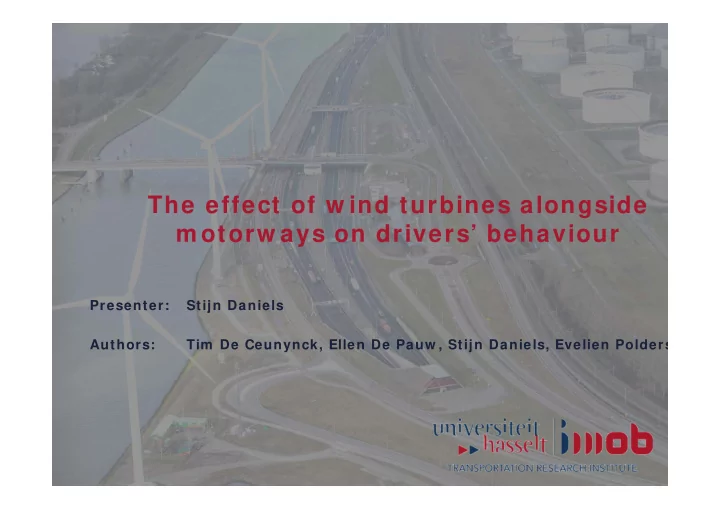
The effect of w ind turbines alongside m otorw ays on drivers - - PowerPoint PPT Presentation

the effect of w ind turbines alongside m otorw ays on
SMART_READER_LITE
LIVE PREVIEW

The effect of w ind turbines alongside m otorw ays on drivers - - PowerPoint PPT Presentation

The effect of w ind turbines alongside m otorw ays on drivers behaviour Presenter: Stijn Daniels Authors: Tim De Ceunynck, Ellen De Pauw , Stijn Daniels, Evelien Polders Wind turbines? Increasing use as renewable energy source


slide-1
SLIDE 1

The effect of w ind turbines alongside m otorw ays on drivers’ behaviour

Presenter: Stijn Daniels Authors: Tim De Ceunynck, Ellen De Pauw , Stijn Daniels, Evelien Polders

slide-2
SLIDE 2

Wind turbines?

  • Increasing use as renewable energy source
  • Possible visual and acoustic impact
  • Location close to motorways?
  • Favourable wind conditions
  • Less environmental impact
  • But what about effects on
  • Distraction?
  • Behaviour?
  • Road Safety?
slide-3
SLIDE 3

Research question

“Is driving behaviour on motorways observably affected due to the presence of wind turbines in close proximity? “

slide-4
SLIDE 4

Methodology

  • One study site
  • Before-and-after study design
  • 3 types of analysis:
  • Analysis of driving speed (loop detector data)
  • Observed lateral lane position (video)
  • Traffic conflict observation (video)
slide-5
SLIDE 5

Methodology – study site

  • Motorway section of N15 near Rotterdam,

The Netherlands

slide-6
SLIDE 6

Methodology – analysis of speed

  • Inductive loop data
  • 2 months before, 2 months after (2 conditions)
  • Treatment sites: 5 consecutive loop detectors

near the first wind turbines

  • 2 comparison sites
  • Only daytime data are used (6h00 – 21h59)
  • Effect on mean speed and SDDS analysed
  • Model form:

ɛ

slide-7
SLIDE 7

Methodology – analysis of lateral position

  • Temporary cameras on 3 consecutive lamp posts
  • Each covering about 200 m
  • Close to the first wind turbine
  • 3 conditions:
  • No wind turbines (=before)
  • Wind turbines parallel to roadway
  • Wind turbines perpendicular to roadway
slide-8
SLIDE 8

Methodology – analysis of lateral position

  • B&A: 2x24h analysed (matched hours)
  • Absolute lane position & SDLP analysed
  • Lateral position of every 10th vehicle
  • 3,649 vehicles in total
  • 3 measurement points (at entry of each camera

view)

  • Also registered:
  • Driving lane
  • Vehicle type
  • Day/night
  • 2 regression models built
slide-9
SLIDE 9

Methodology – analysis of traffic conflicts

  • Situations considered as serious conflicts if:
  • Serious according to STCT
  • TTCmin ≤ 1.5s
slide-10
SLIDE 10

Methodology – video analyses

  • Lateral positions & conflict severity measured

using T-Analyst

slide-11
SLIDE 11

Results – driving speed (mean)

Overall effect ‐2.24 km/h [‐2.25; ‐2.24]1 Location Mean speed before (km/h) Mean speed after (km/h) Evolution before‐after (km/h) [95%CI] Study site 1 99.75 99.31 ‐0.44 [‐0.44; ‐0.44] Study site 2 99.70 98.65 ‐1.05 [‐1.06; ‐1.05] Study site 3 99.58 98.78 ‐0.79 [‐0.80; ‐0.79] Study site 4 100.11 98.36 ‐1.75 [‐1.75; ‐1.74] Study site 5 98.99 97.39 ‐1.60 [‐1.61; ‐1.60] Comparison site 1 (upstream) 95.36 96.59 +1.23 [+1.23; +1.24] Comparison site 2 (downstream) 107.85 110.51 +2.29 [+2.28; +2.29]

slide-12
SLIDE 12

Results – driving speed (SDDS)

Location SDDS before (km/h) SDDS after (km/h) Evolution of SDDS (km/h) Study site 1 9.24 10.57 +1.33 Study site 2 9.70 10.67 +0.97 Study site 3 9.45 10.33 +0.88 Study site 4 9.67 10.29 +0.62 Study site 5 9.86 10.07 +0.21 Comparison site 1 (upstream) 7.67 7.69 +0.02 Comparison site 2 (downstream) 11.09 9.90 ‐1.19

slide-13
SLIDE 13

Results – lateral position (absolute)

Variable p‐value of variable Category Estimate (in meter) S.E. p‐value

  • f

category Constant < 0.001 0.847 0.008 < 0.001 Vehicle type < 0.001 HGV ‐0.165 0.008 < 0.001 Minivan ‐0.045 0.015 0.003 Passenger car 0 (ref.) Lane < 0.001 Left ‐0.156 0.009 < 0.001 Right 0 (ref.) Time < 0.001 Night ‐0.066 0.015 < 0.001 Day 0 (ref.) Condition < 0.001 Blades parallel (after) ‐0.136 0.009 < 0.001 Blades perpendicular (after) ‐0.078 0.009 < 0.001 No turbines (before) 0 (ref.)

slide-14
SLIDE 14

Results – lateral position (SDLP)

Variable p‐value of variable Category Estimate S.E. p‐value

  • f

category Constant < 0.001 0.141 0.003 <0.001 Vehicle type < 0.001 HGV ‐0.027 0.003 <0.001 Minivan ‐0.003 0.006 0.609 Passenger car 0 (ref.) Lane < 0.001 Left ‐0.020 0.004 <0.001 Right 0 (ref.) Time 0.011 Night ‐0.015 0.006 0.011 Day 0 (ref.) Condition 0.156 Blades parallel (after) 0.001 0.004 0.736 Blades perpendicular (after) 0.007 0.004 0.057 No turbines (before) 0 (ref.)

slide-15
SLIDE 15

Results – traffic conflicts

  • Few situations preselected for further

analysis

  • Mainly lane changing in front of approaching

vehicle

  • None were serious conflicts
slide-16
SLIDE 16

Discussion

  • Shift in lateral position:
  • No effect on safety in itself
  • Possible indication for distraction
  • SDLP:
  • Increase in SDLP is generally unfavourable for

road safety

  • Limited effect (ns)
slide-17
SLIDE 17

Discussion

  • SDDS
  • Increase in SDDS tends to have a negative

effect on road safety

  • Small increases are not expected to have an

effect

Salusjärvi (1990)

slide-18
SLIDE 18

Discussion

  • Driving simulator study (Alferdinck et al., 2012)
  • Increase of SDDS and SDLP when turbines are located close

to the motorway

  • Longer gaze
  • Slightly lower average speed
  • Present results are well in line with DS study
slide-19
SLIDE 19

Conclusions

  • Wind turbines lead to some observable

behavioural adaptations:

  • Reduction of mean speeds
  • Shift in lateral position towards the left
  • Small increases in SDLP and SDDS
  • Resulting effect on safety not yet clear,

although not likely to be substantial

slide-20
SLIDE 20

Acknowledgement

  • Study funded by the Ministry of

Infrastructure and the Environment, The Netherlands.

  • Content is the sole responsibility of the

authors

slide-21
SLIDE 21

Thank you for your attention! Questions?