The culture of corruption in public administration A comparison - - PowerPoint PPT Presentation

the culture of corruption in public administration
SMART_READER_LITE
LIVE PREVIEW

The culture of corruption in public administration A comparison - - PowerPoint PPT Presentation

The culture of corruption in public administration A comparison between Sweden and Italy Dr. Peter Stiernstedt (Presenting) and Prof. Alberto Testa Presented on December 6 at the Conference in Perugia, Italy Introduction What to expect from


slide-1
SLIDE 1

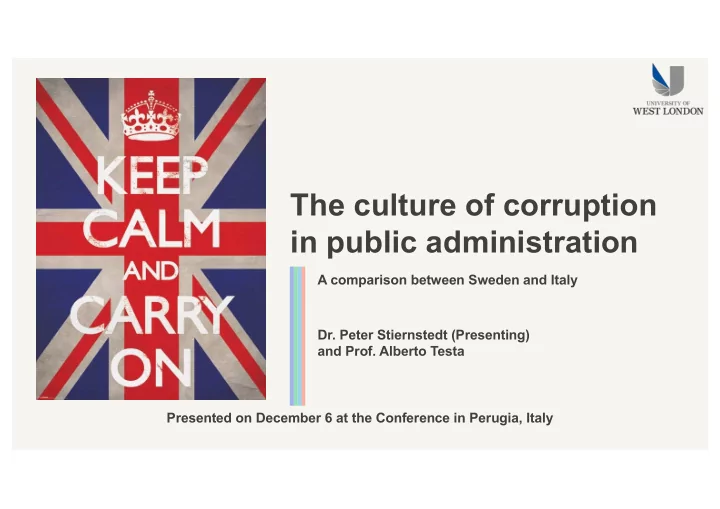
The culture of corruption in public administration

A comparison between Sweden and Italy Presented on December 6 at the Conference in Perugia, Italy

  • Dr. Peter Stiernstedt (Presenting)

and Prof. Alberto Testa

slide-2
SLIDE 2

Introduction

What to expect from this presentation

The project The observation The report The framework The countries The lenses The cases The impact

slide-3
SLIDE 3

The project

A study on corruption in Sweden by comparing it to Italy by some guys in the UK

Sir Isac Newton

slide-4
SLIDE 4

The observation

Truth Transparency Trust

slide-5
SLIDE 5

Corruption in Swedish public administration

Korruption i Myndighetssverige (Brå, 2014)

  • In 2014 the Swedish National Council for Crime Prevention published the report

"Corruption in government agencies”.

  • The report presents a study that focuses on corruption that seeks to influence the

core domain of the work of public sector agencies – the exercise of public authority.

  • The results and conclusions of the report can be summarised as follows:

Research on corruption remains limited.

  • The Swedish Anti-Corruption Institute, emphasised the importance of the four cultures

that increase the risk for corruption.

slide-6
SLIDE 6

The methodological framework

The four cultures conducive to corruption

Blindness

[Blindhet]

“Corruption cannot

  • ccur here.”

Silence

[Tystnad]

“Mind your

  • wn

business.”

Informal rules

[Informella regler]

“Rationalisations favourable to deviance.”

Efficiency

[Effektivitet]

“Choosing and creating shortcuts.”

slide-7
SLIDE 7

Countries of analysis

Do not use the CPI as a time-series!

Points: 85/100 Rank: 3/180 Points: 52/100 Rank: 53/180

For the third year running, the top seven countries in the Corruption Perceptions Index 2018 consist

  • f the four Nordic nations –

Denmark, Finland, Sweden and Norway. All score between 84 and 88 points

  • ut of 100 on the index.
slide-8
SLIDE 8

Theoretical lens

Bourdieu’s (1989) micro-macro theory

Humans naively learn about the world and its axioms in a pre-reflective unconscious way.

Habitus - Blindness

01

A network or configuration

  • f objective relations

between positions

  • ccupied by social actors.

Fields - Silence

02

Each field has dominant (and dominated) actors ranked in the order of power they possess.

Capitals – Efficiency

03

A product of a tacit agreement representing what seems obvious and normal in a field.

Doxa (logic) – Informal rules

04

slide-9
SLIDE 9

Criminological lens

General Strain Theory (Agnew, 1992)

slide-10
SLIDE 10

Case studies welcome

An Italian stem with Swedish branches

Tangentopoli

  • Multilevel
  • Progressive
  • Context
  • Impact

Levels Life-cycle Outcomes Coverage Discoveries Other…?!

slide-11
SLIDE 11

Impact on perceptions

Educated guesses

01 02 03 04 05 06

Level Occurrence Reach Management Attrition Solutions

(Sub-)Culture seem more relevant on regional/local than on national level.

Level

A culture of truth, trust and transparency? A culture of integrity?

Solutions

Progressive acceptance

  • f current state of affairs.

(Reduced strain*)

Blindness

Frequency of discovering irregularities has increased. (Reduced strain)

Silence

Compartmentalisation insulate wider recognition. (Unchanged strain)

Informal rules

NPM reforms drives results based performance indicators. (Increased strain)

Efficiency
slide-12
SLIDE 12

Thank you for listening!

Presented on December 6 at the Conference in Perugia, Italy The culture of corruption in public administration peter.Stiernstedt@uwl.ac.uk @omniumrerum

Dr Peter Stiernstedt

alberto.testa@uwl.ac.uk @DrATesta

  • Prof. Alberto Testa