Theories of Practice and Infiltration into Public Health Nutrition - - PowerPoint PPT Presentation

theories of practice and
SMART_READER_LITE
LIVE PREVIEW

Theories of Practice and Infiltration into Public Health Nutrition - - PowerPoint PPT Presentation

Bourdieu, Social Theories of Practice and Infiltration into Public Health Nutrition Territories Wendy Wills Director, Centre for Research in Public Health and Community Care (CRIPACC) School of Health and Social Work University of


slide-1
SLIDE 1

Bourdieu, Social Theories of Practice and Infiltration into Public Health Nutrition Territories

Wendy Wills Director, Centre for Research in Public Health and Community Care (CRIPACC) School of Health and Social Work University of Hertfordshire w.j.wills@Herts.ac.uk KCL Symposium April 2019

slide-2
SLIDE 2

Bourdieu and Social Distinctions

  • Eating is not driven by conscious

decision-making or ‘freedom of choice’ - It is a result of habitus

  • We all develop an automatic,

unconscious capacity to act in a way that is meaningful in our social context

  • Food, eating and ‘tastes’ – relate to

cultural, social and economic capital

  • Therefore unspoken moral boundary

work might shape what groups consider ‘tasty’ or ‘disgusting’

  • How does this underscore /reflect the

reality of poverty, disadvantage or affluence?

slide-3
SLIDE 3

A practices approach to understanding [eating] behaviours

  • “A practice . . . is a routinised type of behaviour which consists of

several elements, interconnected to one another: forms of bodily activities, forms of mental activities, things and their use, a background knowledge in the form of understanding, knowhow, states of emotion and motivational knowledge” (Reckwitz, 2002: 249–50)

  • Practices encompass three domains (Warde 2005):

– The people who shape/ perform practices – The available resources – The meaning given to the practice

  • Individuals can be viewed as ‘carriers of practices’ (Warde

2005) – one part of the jigsaw puzzle
slide-4
SLIDE 4

A practices approach to understanding [eating] behaviours

  • Practice frameworks account for the

entangled nature of relational events, things people and places – it provides context for the ‘doings and sayings’ (Schatzki 1996) of everyday life

  • Practices are performed repetitively with

little reflection (we have a ‘feel for the game’ (Bourdieu 1984)

slide-5
SLIDE 5

The ‘beyond the school gate’ project

Food Standards Scotland [grant number FS411002]

  • The aim of this study was to

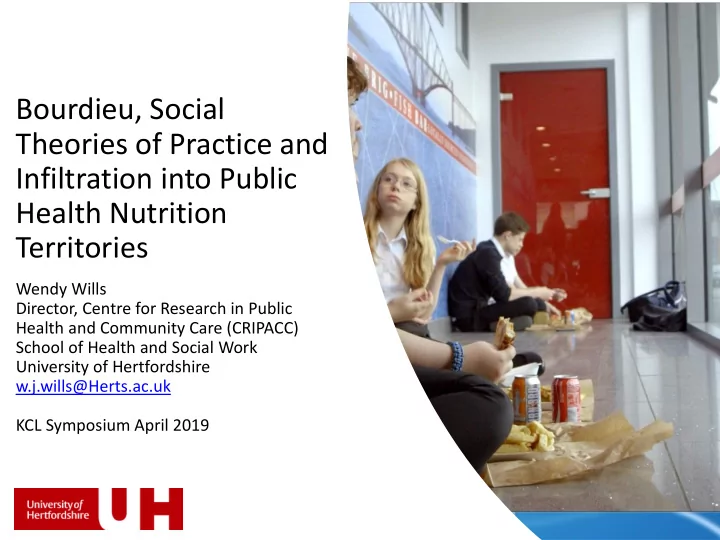
explore the influence of the food environment (the type and density of outlets; marketing and promotion initiatives), socio-economic deprivation and other factors (such as peer and family influence) on the food and drink purchased at lunchtime by secondary school pupils beyond the school gate in Scotland.

‘They kick us out early’; ‘ the [school] café should be just for us’ [young person] “…every customer’s important to me …so if you treat them [pupils] with respect generally they’re okay” (Newsagent) ‘if [parents] work it’s not fair, it doesn’t mean they can afford it’ [young person]

slide-6
SLIDE 6

Socially defined places and spaces

slide-7
SLIDE 7

Food acquisition in later life

ESRC: ES/M00306X/1

slide-8
SLIDE 8

Considerations for Influencing Public Health Practice

  • METHODOLOGICAL APPROACHES

to take account of the complexity of public health challenges and “real life” contexts

  • EVALUATE using realist evaluation

frameworks (Pawson and Tilley 1997) – Generative principles

  • ‘what works in which

circumstances and for whom?’

  • SOCIAL NETWORKS, encounters,

relationships and social capital matter [ensure ‘systems’ approaches are ‘social…]

slide-9
SLIDE 9

From sociological research to innovative outputs/impact…