The Courage to Persevere: Contemporary re-interrogations of faith and - - PDF document

the courage to persevere contemporary re interrogations
SMART_READER_LITE
LIVE PREVIEW

The Courage to Persevere: Contemporary re-interrogations of faith and - - PDF document

The Courage to Persevere: Contemporary re-interrogations of faith and their public implications Jorella Andrews PRESENTATION: Goldsmiths, University of London 13.11.2018 It is time, in the west, to defend not so much human rights as human


slide-1
SLIDE 1

1 J Andrews PRESENTATION The Courage to Persevere Faiths and Civil Society Unit 13 November 2018

The Courage to Persevere: Contemporary re-interrogations of faith and their public implications Jorella Andrews PRESENTATION: Goldsmiths, University of London 13.11.2018 It is time, in the west, to defend not so much human rights as human obligations … a decline in courage may be the most striking feature which an outside observer notices in the west in our days. The western world has lost its civil

  • courage. (Aleksandr Solzhenitsyn, Harvard

Commencement Address, 8 June 1978) Introduction: Public life, public space, ‘civic virtue’ This talk is in response to an invitation to reflect on ideas that emerged from a lecture series on the topic of faith - entitled 'A Fearless Look at the Unspeakable’ and convened by my colleague Jean-Paul Martinon and I in January and February of this year as part of the Visual Cultures department public programme - and to consider their potential contributions to the topic

  • f this series about 'the future of civil

society'. I will come back to the series

  • f faith in a moment but, by way of

creating a context with respect to the

slide-2
SLIDE 2

2 J Andrews PRESENTATION The Courage to Persevere Faiths and Civil Society Unit 13 November 2018

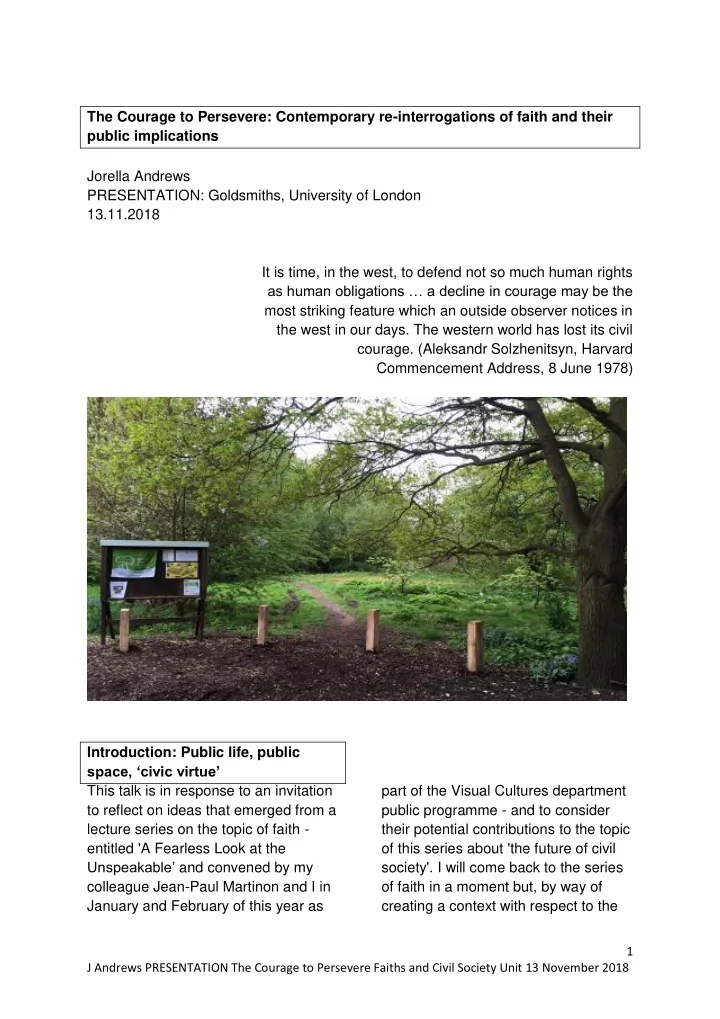
‘future of civil society’ challenge, I wanted to start by bringing into play two different contemporary expressions of public space with which I’m involved. Fittingly, both are spaces that were established with the explicit aim of promoting both human and non- human flourishing. 1. The first example (to which I will return at the end of this presentation) is drawn from the locality of Forest Hill in SE London where I’ve been living since 2010 and where, as well as being socially involved as an active member of a local church, I’ve also been involved (since 2016) as a friend

  • f Albion Millennium Green, a small

area of urban woodland that was developed at the start of this century

  • n the site of a disused tennis club. It

was created under the Countryside Agency’s Millennium Greens’ scheme and also got funding from the London Borough of Lewisham. It’s owned by a local charitable trust which is charged with protecting and enhancing the space for the benefit of the local community. I first got to know it as a secluded and glorious albeit also somewhat wild and in places unkempt retreat located about a minute’s walk from my flat, traversed by winding paths, and including areas of meadow, a couple

  • f small ponds and the beginnings of a

community orchard. It is kept always

  • pen and has recently also started

being used by local schools and as the site for a Forest School for toddlers. As a friend I’m part of a group of volunteers that helps facilitate events

  • n the Green (arts, theatre

performances, etc.) and I get involved in monthly plant management workdays. All very idyllic – or so I thought! Upon becoming involved as a caretaker of the space a different or at least a more complex reality emerged. On workdays, rather than focus on plant management, my main activity involved extensive and at times quite acrobatic litter picking of items including drug paraphernalia, used condoms and beer cans and bottles thrown out-of-reach into bushes. From this detritus, and from information gained from Friends’ Meetings and AGMs and the flow of email exchanges between Friends - often also involving exchanges with the local police forces inadequately staffed Safer Neighbourhood team, it is clear that, especially at night, the Green is a gathering place for drug dealers and addicts as well as a base for local burglars attempting to break into surrounding homes. Indeed, over the years, and despite invitations for local involvement and an inclusive ethos, what I have witnessed has not been a process of greater local participation and the creation of an increasingly safe, shared space but instead an increase in various forms of aggression that have been enacted upon the space, including vandalism and several attempts to set fires – to the Green’s noticeboards, for instance! More recently, local heroin addicts set up a rapidly expanding squatters’

slide-3
SLIDE 3

3 J Andrews PRESENTATION The Courage to Persevere Faiths and Civil Society Unit 13 November 2018

camp, taking over a space to which, in fact, they have as much right to use as anyone else, but in such a way as to make it unsafe and unwelcome for

  • ther users.

Having become actively involved in the care of this place, then, I discovered that for all its promise, it was a remarkably contested space constantly throwing up problems for which there were often none-too-obvious solutions. This interested me a good deal; it seemed to me as though it was functioning within the locality, among

  • ther things, as an intensified

symptom (a microcosm) of broader contemporary social dis-ease and thus as a space that needed to be paid attention to. A space that required

  • discernment. But how?

2. The second public space is well-known to most if not all of us in this room:

  • Goldsmiths. A place intended to

support intellectual flourishing for the benefit of society at large but which (as we know only too well) is operating again as a conflictual entity. On the

  • ne hand (and this issue is by now

well-rehearsed) there are the academic ideals of nurturing free, radical and exploratory thought and on the other hand there are the administrative realities of an infrastructure governed by market values which undermine those very

  • ideals. But as noted this is nothing
  • new. Reading Alfred North

Whitehead’s 1932 book The Aims of Education one gets a shock of recognition - his diagnoses of the problems characterising then-current education in the UK apply just as well

  • today. Nonetheless, today this

situation is often experienced by educators and students as increasingly unworkable with several of us wondering whether this is an environment in which it is now possible to work (or study) with integrity. But there is something else at issue that I think is just as great an obstacle to the nurturing of free, open and – crucially – sufficiently self-critical thought in a place such as Goldsmiths. It has to do with the degree to which

  • ur reputed intellectual openness is
  • nly conditionally so, that is,

conditional upon certain intellectual fashions being followed and upon

  • ther, unfashionable topics being

suppressed: like the question of faith and the possibility of exploring questions of faith outside of the auspices of theological or religious studies contexts. Hence the series Jean Paul and I put together and named ‘A fearless look at the unspeakable.’ Our aim, here, was to challenge the dominant modern and contemporary (western) view that treats faith either as obsolete and therefore unworthy of

slide-4
SLIDE 4

4 J Andrews PRESENTATION The Courage to Persevere Faiths and Civil Society Unit 13 November 2018

critical debate or, more radically, as anathema and therefore vigorously to be opposed – and certainly to be kept private. Nonetheless, we wanted to take as non-alienating a route into the topic of faith as possible (to establish common ground and shared thought) so we decided to define faith not primarily in relation to a set of beliefs, religious or

  • therwise, but as a kind of orientation

– specifically as an effort to persevere in the face of what cannot readily be verbalised or indeed endured, however we might experience or define that. As we put it in our promotional material, we wanted to hazard a look at how we interact with what stubbornly presents itself as already beyond words and is therefore consistently dismissed as unreal, fictitious, hypothetical, irrational, dangerous, or false, the argument for this series being that contemporary forms of incredulity with respect to faith are historically, culturally, and ideologically embedded within modern logocentric and reductively rationalistic paradigms. We also made the claim that faith, thus experienced or defined, was something really rather familiar to most

  • f us in our everyday working lives –
  • ur audience consisting mainly of

researchers and artists working in fields of endeavour where, time and again, we find ourselves on the threshold of new or uncertain territory in which precisely the sorts of

  • rientation that Jean-Paul and I were

associating with faith are required if progress is to be made. And so we invited five speakers to reflect on faith taking whatever approach they saw fit in the hope that they would develop these ideas, hopefully in unanticipated directions. For the purposes of this presentation, what I’d like to do in the first place is extract, from the wealth of ideas that interesting ideas that were presented, just two re-interrogations of faith that seemed to me to be particularly fruitful in terms of challenging dominant negative presuppositions and habits of thought regarding this topic. I will then go on to look at two explorations of faith more pointedly understood as an expression of and intertwined with the capacity to persevere. I will end by bringing in some material of my own, linked to my research interests in the writing of the French phenomenologist Maurice Merleau-Ponty, notably the perspectives offered in a very short essay from 1954 called ‘On News Items’. (In phenomenology, and very much so in Merleau-Pontean phenomenology, the operations of faith, notably perceptual faith, are central.) Faith

slide-5
SLIDE 5

5 J Andrews PRESENTATION The Courage to Persevere Faiths and Civil Society Unit 13 November 2018

faith in God understood and experienced as a loving parent - is

  • central. The founding narrative of

Judaism begins when a man called Abram (later Abraham) is called by a God he doesn’t know to leave behind everything familiar and journey to an unknown land with the promise that, with his wife and although though already aged, he would found a nation, indeed become a father of multitudes. The central narrative and model of Christianity is about Christ’s (that is, God-made-man’s) journey of faith to

  • btain salvation for humankind. As

such, he is described in the book of Hebrews (12:2) as 'the pioneer and perfecter of faith' (and thus the one Christians should emulate) who 'for the joy set before him he endured the cross, scorning its shame, and sat down at the right hand of the throne of God.' At the moment of his death he cried out “Father into your hands I commend my spirit” and through his preaching had given his followers the radical injunction that the route to a flourishing life, to achieving the highest good for themselves and others, is the route of renunciation. “If you cling to your life, you will lose it; but if you give up your life for me, you will find it.” (Matthew 10:39, The Living Bible translation). In our series, and in a talk entitled ‘Reason, Faith & Virtue: Deconstructing Rationality’, Lydia Schumacher – who lectures in philosophical theology and medieval studies at Kings College, London – set

  • ut to challenge a longstanding

intellectual obstacle to faith, namely the idea that faith is irrational or at least non-rational (an argument she has explored at greater length in two books, Rationality as Virtue (2015), and Divine Illumination (2011). Presenting what she called an ‘offensive’ rather than ‘defensive’ account of the rationality of faith she argued not only that “that faith is intrinsically rational” but also, and indeed “that rationality anticipates its fulfilment in faith.” In other words, her re-interrogations of faith were at the same time re-interrogations of rationality beyond the limited, rationalist models in which they have become confined. As she put it: In the attempt to re-think the nature of rationality in a way that underlines rather than undermines the rationality of faith, I

slide-6
SLIDE 6

6 J Andrews PRESENTATION The Courage to Persevere Faiths and Civil Society Unit 13 November 2018

will bolster the contention that rationality is not a merely epistemological matter to do with the soundness of our thinking. She continued: [Rationality] is also, and ultimately, an ethical matter, to do with the question of whether we use our knowledge to lead lives that are consistent with the

  • verarching purpose of

‘rational animals’, which is to flourish through the exercise of individual abilities and thereby contribute to the flourishing of others. Regarding faith as intrinsically rational and ethical - that is, not only as a religious matter but as fundamental, or generic, to all of our quests honestly and rigorously to grow in understanding - Schumacher spoke of a process of thought-development involving inquiry, judgment, and directing reason, which she described in terms of ‘expectant, fulfilled, and informed faith’. In her words: The main reason why I appeal to the concept of faith, defined in a generic not religious sense, in explaining how we achieve and grow in understanding is that it highlights that we do not start out knowing whatever we want to know but necessarily work to obtain knowledge

  • ver time on the belief

that we will eventually attain it. Thus, the first phase of expectant faith is characterized by a lack

  • f knowledge and a

desire to know that motivates us to undertake inquiries that are orientated towards hastening the arrival of knowledge. The second phase of fulfilled faith is the one in which we actually discover the truth we believed we could know. In the third phase of informed faith, we place faith in the knowledge we have obtained in order to make sense of further

  • experiences. Whenever

we do so, the whole process of moving from expectant, to fulfilled, to informed faith begins again, such that the search for truth is interminable, and knowledge therefore never ceases to be a matter of faith. A second, tremendously inspiring re- interrogation of faith in the context of

  • ur lecture series was that presented

by our first speaker, Catherine Chalier. Chalier is Emeritus Professor of

slide-7
SLIDE 7

7 J Andrews PRESENTATION The Courage to Persevere Faiths and Civil Society Unit 13 November 2018

Philosophy at the University of Paris and the author of over thirty books written at the intersection of Hebrew Studies and philosophy. Her latest books in English are What Ought I to Do? (2011) and Reading the Torah (2017). In her exploration of faith, she defined it as intrinsically directed by hope which, in turn, she presented as a subjective attitude orientated towards the present before being an attitude directed towards the future. In making her case, she brought together readings of the Bible, the work of Emmanuel Levinas and that of the Marxist thinker Ernest Bloch. For the purposes of this presentation today, a crucial point is that hope, as she defined it, relies on our capacity to access what she called ‘a blessing’ (or ‘a good word’) in the present, and which is personal to each one of us such that (and this is a second crucial point) it will allow us to persevere, especially in situations where we might

  • therwise feel that there is no more

reason to hope. She insisted that such a good word is available to everyone if we can but listen – although it often comes to us in unexpected or unanticipated ways - and may be received within even the most devastating of contexts. In this regard, she related a powerful testimony of a Jewish child who received such a word, against all odds, in a Nazi concentration camp. A recording of her talk is available on YouTube. Fortitude Fortitude is an old-fashioned term for faith-as-perseverance in the face of that which cannot easily be articulated (or indeed endured), and one that is not much used today. One of the four cardinal virtues of Prudence, Justice, Fortitude and Temperance, as far as we know it was first extensively examined by Plato in Book 4 of The Republic (written around 380 BCE) – the character of the ‘good city’, he wrote, was that it be wise, brave, temperate and just. Here, if you like, we are presented with the moral architecture of communal life. These virtues later also taken up by Christian thinkers and associated, in different ways, with the Theological Virtues of faith, hope and love. Saint Augustine (who, in his book The City

  • f God Against the Pagans (426 CE)

associated faith particularly with Justice and not, I am doing here, with fortitude), had set out what he called 'the Christian definition of the four [Cardinal] Virtues’ in chapter 15 of his earlier book Of the Morals of the Catholic Church (388 CE) as follows: As to virtue leading us to a happy life, I hold virtue to be

slide-8
SLIDE 8

8 J Andrews PRESENTATION The Courage to Persevere Faiths and Civil Society Unit 13 November 2018

nothing else than perfect love of

  • God. For the fourfold division of

virtue I regard as taken from four forms of love. ... temperance is love giving itself entirely to that which is loved; fortitude is love readily bearing all things for the sake of the loved object; justice is love serving only the loved object, and therefore ruling rightly; prudence is love distinguishing with sagacity between what hinders it and what helps it. The

  • bject of this love is not

anything, but only God, the chief good, the highest wisdom, the perfect harmony. So we may express the definition thus: that temperance is love keeping itself entire and incorrupt for God; fortitude is love bearing everything readily for the sake of God; justice is love serving God only, and therefore ruling well all else, as subject to man; prudence is love making a right distinction between what helps it towards God and what might hinder it. Fortitude in any case, and to return more pointedly to it, has plentiful synonyms: courage, strength of mind

  • r character, moral strength,

toughness of spirit, firmness of purpose, strong-mindedness, resilience, fearlessness, valour, intrepidity, endurance; stoicism, steadfastness, patience, long- suffering, forbearance, tenacity, pertinacity, perseverance, resolve, resolution, resoluteness,

  • determination. Fortitude, of course,

implies trouble (pain or adversity). In Schumacher’s talk, the role of fortitude (as steadfastness of will), and indeed of the four cardinal virtues (particularly as later developed by Thomas Aquinas), was a key to her re- interrogation of the faith/rationality relationship with respect to the achievement of human flourishing. It

  • ccurred broadly in her discussions of

the role of the will in collaboration with the intellect and with reference to the passions in either assisting us or preventing us from seeking after truth. Referring to prudence, justice, fortitude and temperance as ‘the virtues of the passions’ as well as “intellectual passions” due to their vital role within the pursuit and correct application of truth, she wrote that: “fortitude and temperance make it possible for us to follow through on the purposes of prudence and justice by teaching us to have the courage and discipline we

slide-9
SLIDE 9

9 J Andrews PRESENTATION The Courage to Persevere Faiths and Civil Society Unit 13 November 2018

need to do exactly this.” And again: ‘Thus, the four intellectual virtues together predispose us truthfully to testify to our experiences. Although new experiences may require that we revise beliefs we originally took to be true, they do not undermine our

  • bjectivity insofar as we are able to

explain our ability to adapt our views about what is true.’ She continued, reiterating an earlier point, that: “the larger context for the pursuit of knowledge is a moral one, in which human beings become what they are and enable others to do the same in their own distinct ways.” Indeed, she qualified the notion of existence in this regard. Existence, she stated, is not a predicate. Rather (I am paraphrasing her here), I exist only to the degree to which I am living in accordance with that essential being that I – and no-one else – was created and called to be. +++ Fortitude (the courage to persevere) - to focus on it now still more closely – has an iconography associated with it. Often, it is allegorized as a female figure in classical dress, head covered with a veil. In other instances, she is pictured in armour, as a warrior. She might be accompanied by one or more

  • f several possible attributes (such as

a club, a palm, a tower, a yoke or a column which is sometimes depicted as broken). In a statuette which is part

  • f the V&A’s collection, she is shown

with a column which she embraces with both arms also wrapping her veil around it. The column signifies spiritual strength and steadfastness, and her actions affirm the resolution not to be

  • vercome. When a broken column is

depicted reference is being made to the account of Samson’s final feat as recorded in the Book of Judges 16: 21- 31, where having finally been robbed

  • f his superhuman strength, blinded,

and enslaved by the Philistines, he is put on triumphant show to an audience

  • f about 3,000 men and women in the

temple of the god Dagon. Samson is recorded as praying to God that his strength might return one last time and, tricking his captors with a show of weakness, pushes against the temple’s great pillars and brings the building crashing down upon himself and those celebrating around him, killing them all. It is a brutal story. What is underlined, however, by the iconographic referencing of pillars in relation to fortitude is an association between fortitude and martyrdom. (As am aside, since this relates to my wider research interests, and bearing in mind the etymology of the term ‘cardinal’ from cardo meaning hinge – the cardinal virtues, when practiced, are taken to function like hinges in terms of opening up for us the possibility of entering into our own highest good (to flourish) and to enable and assist others to do so also – what I particularly like about this sculptural representation are precisely the varied evocations of turning that are expressed within it.) Returning to the issue of martyrdom and death, figures of the cardinal virtues, including the figure of Fortitude

  • ften played a significant role in the
slide-10
SLIDE 10

10 J Andrews PRESENTATION The Courage to Persevere Faiths and Civil Society Unit 13 November 2018

  • rnamentation of tombs – this statuette

(created circa 1517-22) is believed to have been related to a design scheme for the tomb of one Gaston de Foix (d. 1512), who was a nephew of Louis X11 of France. Indeed, turning to a further work of art, fortitude – as an

  • rientation – is beautifully rendered in

an almost contemporaneous work, Raphael’s Saint Catherine of Alexandria, circa 1507 (National Gallery, London) which depicts the martyr leaning, in an apparently relaxed and unconcerned manner on her attribute, the wheel upon which she was intended to be executed. What this painting seems to convey (although created within a context when the man-centeredness of humanism as opposed to the God- centredness of religious faith was already taking a cultural hold) is a tremendous sense of grace – of fortitude (in the Christian sense) not merely as the outcome of long- cultivated good habit but also as a spiritual gift or capacity, a grace, received from God It is at this stage, though, with this referencing of martyrdom, that I want to turn to a second discussion of faith- as-fortitude drawn this time from the contribution of the Visual Culture Public Programme lecture series’ second speaker Vincent van Gerven Oei, who is a philologist and co- director of punctum books as well as (among other credentials) the co-editor

  • f Dotawo, the imprint of the Union for

Nubian Studies. Van Gerven Oei’s paper was called "Thinking With & Without the Mother". In this paper, the site of faith-as-perseverance (or fortitude) was related to questions about the conditions required for the very possibility of thinking (again understood as that which opens up routes towards human flourishing). Here, two key points were made. First – and here van Gerven Oei was drawing on the writing of Heidegger, notably Heidegger’s Contributions to Philosophy, which was written between 1936 and 1938 and What is Called Thinking, first delivered as a lecture in 1952/53 – the possibility of thinking requires a condition of

  • distress. No distress, no possibility for

the emergence of thought. In the Contributions to Philosophy (which Heidegger refused to publish during his lifetime; it only appeared in Germany in 1989, more than ten years after his death), Heidegger wrote: "All necessity is rooted in distress. As the first and utmost mindfulness of the truth of be-ing and of the be-ing of truth, the necessity of philosophy lies in the first and utmost distress." In ‘What is called thinking’, Heidegger wrote that:

slide-11
SLIDE 11

11 J Andrews PRESENTATION The Courage to Persevere Faiths and Civil Society Unit 13 November 2018

"Thinking is thinking when it answers to what is most thought-provoking. In our thought-provoking time, what is most thought-provoking shows itself in the fact that we are still not thinking." What we call though-provoking in the condition of someone gravely ill, for example, is that it gives us cause for worry. We call thought-provoking what is dark, threatening, and gloomy, and generally what is adverse. When we say "though- provoking," we usually have in mind immediately something injurious, that is, negative. Returning now to the second of van Gerven Oei’s key points, the actuality

  • f thinking requires that this formative

experience of distress is successfully negotiated, and this is where van Gervan Oei’s turned to the image and metaphor of the mother with infant as well as to the work of the British psychoanalyst Wilfred Bion, notably his "A Theory of Thinking," first published in 1962. At issue here is a particular scene of distress: the moment of weaning for which the mother must accomplish two things. First, she must successfully have fed her child at the breast, this feeding not

  • nly being a matter of physical but also

emotional nourishment and the intensification of intimacy. Secondly she must successfully wean her child from that wondrous substance (her milk) upon which, until then, the child has wholly depended. This means that in the process of withholding the breast and directing the child towards alternate sources of sustenance that the child now needs (but doesn’t want) if it is going to grow up, she must be able to tolerate and hold calmly (that is with fortitude) the aggression and frustration that the deprived infant is directing towards her. Why is this scene also that of the emergence of thought? To cite Van Gerven Oei drawing on the work of Bion: “Thoughts are the result of tolerating frustration and at the same time improve our tolerance, because they shape and form the thing whose absence is felt. This then becomes the process of thinking. If the infant is unable to tolerate the frustration and modify it by creating thoughts, it will create strategies to evade the

  • frustration. As Bion puts it:

Inability to tolerate frustration can obstruct the development of thoughts and a capacity to think, though a capacity to think would diminish the sense of frustration intrinsic to appreciation of the gap between wish and its fulfilment. Thoughts, then, are produced under the sign of withdrawal and negation. Here again we see demonstrated the Judeo-Christian model of gain through loss or sacrifice. Van Gerven Oei also made a third point in relation to the dynamics of this

  • scene. What this scenario also

demonstrates is that thinking is always

  • social. As he put it:
slide-12
SLIDE 12

12 J Andrews PRESENTATION The Courage to Persevere Faiths and Civil Society Unit 13 November 2018

… thinking is not the result of a single person, but the result of at least a couple – mother and

  • infant. As Noreen Giffney puts

it, "thinking comes into being in relationship with another, the mother." This means that thinking is in essence a social activity. By contrast: the [Cartesian] idea of the thinking, individual subject without social bonds has remained very attractive and current, thanks to the economic model in which it found its main expression, capitalism, and the political model that was developed in parallel, liberalism.” There is so much more that van Gervan Oei opened up in his lecture, in particular questions about the possibility of the emergence of thought as he has defined it within contemporary contexts in which it is not thought (thus defined) but rather intelligence, artificial intelligence and the hope of artificial general intelligence that matters. The latter he defines as thought without the mother. “Intelligence” he claimed, “is a trait of the individual, not the group … according to the social standards of human society, artificial intelligence is trauma, an absent mother, on full display.” Where is called thinking? Merleau- Ponty’s ‘On News Items’ With our various discussions of faith and fortitude as they relate to thought understood not merely as intellectual but as ethical and social it is time to come back more directly to the questions posed by this lecture series – The Future of Civil Society – and back to Albion Millennium Green. But first I would like to dwell a bit longer on the issue of distress and its adequate negotiation as opposed to its elimination as necessary for the production of thought. (Weaning can’t be evaded, it must be endured.). And, since, following van Gervan Oei, thought is always fundamentally social, and as such necessary for the creation

  • f civility understood as a commitment

for the flourishing of created beings, human and non-human, I’d like to do so from the context of a different body

  • f work – Merleau-Ponty’s ‘On news

items’ referenced earlier. I think that considering this material might be useful in terms of further demonstrating how faith-as- perseverance (or fortitude) might usefully be situated within discussions about the desired configurations and energies of public life, public space, civil society – even though Merleau- Ponty did not himself use any of these terms. ‘On News Items’ (which may be found in the anthology Signs) opens with the line: ‘There is perhaps no news item which cannot give rise to deep thoughts’.1 By ‘deep thoughts’, it soon becomes apparent, Merleau-Ponty meant transformative self-reflexive thought; thought provoked by some

slide-13
SLIDE 13

13 J Andrews PRESENTATION The Courage to Persevere Faiths and Civil Society Unit 13 November 2018

  • ccurrence within public space which

we then also allow to loop back onto, and challenge, our own lives. There is, he wrote a bit further on, ‘a good and a bad use of news items, perhaps even two kinds of news items, according to the type of revelation they bring’. 2 In the essay Merleau-Ponty provided two negative instances. The first was an event he presented as having witnessed himself in ‘Fascist Italy’:3 an institutionally-driven act of concealment within public space — the ‘railway police’ in Genoa pushing back crowds in the wake of a messy suicide: ‘This blood disturbed order; it had to be quickly wiped away, and the world restored to its reassuring aspect’.4 Merleau-Ponty went on to describe this act of concealment as defending the witnesses of this event, above all, from self-reflexively learning ‘to judge’ their

  • wn lives in relation to what had just

happened, terrible though it was. The second negative instance he presented were fictionalized, filmic scenarios (which I can only briefly reference here): scenes from Luis Buñuel’s Le chien andalou which he described as instances, within public space, in which what we are taught is ‘only our bias of looking without understanding.’5 Merleau-Ponty contrasted publically situated modes of not-seeing and not- thinking such as the one in Genoa, with the kinds of revelatory situation to which he was particularly sensitive as a phenomenologist, and which he regarded as crucial. Again he turned to an example drawn from the arts: the writing of the great French novelist Stendhal who, as he put it, ‘passionately loved to look but who surveyed himself’ and who ‘understood very well that even indignation is at times suspect’.6 In particular, Merleau- Ponty referred Stendhal’s use of his ‘true little incidents’, small, sometimes

  • bjectively insignificant encounters or

happenings that he presented as having witnessed, that had enraptured him, and which he then ruminated upon.7 In Merleau-Ponty’s words: Stendhal’s true little incidents must be set aside from or above

  • these. His reveal not just the

underside, the dust, dirt, and residues of a life, but rather what is incontestable in a man — what he is in limiting cases, when he is simplified by circumstances, when he is not thinking of creating himself, in good fortune or bad.8 And here, by way of further exemplification, the words of intercultural communication theorist Mark Orbe as found in his 1998 book Constructing Co-Cultural Theory: An Explication of Culture, Power and Communication are worth turning to, specifically a section titled ‘Conflicting Standpoints on the World’ (which references further sites of trouble, of distress, that characterise public life). In it he drew both on Merleau-Ponty’s ‘On News Items’ and on the more recent writing of the sociologist Mary E Swigonski, whose work includes arguments for the necessity of perceiving the patterns of assumed privilege and superiority that are

  • perative within society and the need

‘to step outside of those patterns’.9

slide-14
SLIDE 14

14 J Andrews PRESENTATION The Courage to Persevere Faiths and Civil Society Unit 13 November 2018

Particularly at issue for Orbe (and here again modes of thought; attempts at attaining to the truth are at issue) was how phenomenological priorities might successfully impact the development of social research strategies that would be especially

  • rientated towards garnering rich,

situated, even self-contradictory or conflictual experiential data, namely ‘Standpoint Theory’10 and ‘Muted Group Theory’, and, derived from them, the ‘Co-cultural Communication Theory’ that Orbe himself played a foundational role in developing during the 1990’s.11 This was in contrast to the generally still-preferred, superficially precise but existentially inaccurate standardized category-driven procedures of quantitative data gathering. Insisting that the life perspectives

  • f both non-dominant and

dominant group members develop from ‘their daily — often indiscernible, but nonetheless meaningful — activities’, he specifically referenced ‘On News Items’. In his words: ‘Merleau- Ponty confirms the relevance of scrutinizing the daily, seemingly insignificant, experiences of others since “true little incidents” are not life’s debris but signs, emblems, and appeals.’12 Orbe continued: The appropriate perspective for research activities is exploration of the

  • ccurrences of everyday life.

A focus on the everyday life experiences helps to reveal the ways in which the public world structures the private, everyday/everynight lives of persons in ways that are not immediately visible as those lives are lived. Giving consciousness to these daily practices allows scholars to question the larger ‘taken- for-granted’ assumptions that guide our communicative behaviors. Besides a crucial point of understanding the conflicting life perspectives between dominant and nondominant groups, this focus of inquiry also allows a discernment among the various standpoints within a specific co-cultural positioning.13 This notion of the ways in which “the public world structures the private, everyday/everynight lives

  • f persons in ways that are not

immediately visible as those lives are lived” is fascinating – it warrants further attention. Melreau-Ponty himself wrote, early on, in Phenomenology of Perception of 1945: The world … is the natural setting of, and field for, all my thoughts and all my explicit perceptions. Truth does not ‘inhabit’ only ‘the inner man’, or, more accurately, there is no inner man, man is in the world, and only in the world does

slide-15
SLIDE 15

15 J Andrews PRESENTATION The Courage to Persevere Faiths and Civil Society Unit 13 November 2018

he know himself. When I return to myself from an excursion into the realm of dogmatic common sense or

  • f science, I find, not a

source of intrinsic truth, but a subject destined to the world.14 So, let us return, finally, to the Green, and to the tents, and to the question of how faith and fortitude as explored thus far might play a role. As it turns out, just as I was ruminating over the dilemma with the squatters on the Green (they’d been there about two weeks) the police came and moved them due to the illegality of the drug taking, disturbance of peace and other factors that they had been carrying

  • ut while inhabiting the Green.

These were matters that the Friends had really been agonizing

  • ver it; The Green was, after all,

public space. It was never locked. The intention was not to exclude anyone. One Saturday in the context of one of the workdays on the Green, I had documented the mess created by the squatters just in case it would be

  • needed. Later, when one of the tent-

dwellers returned, a fellow Friend and I took the opportunity to approach and speak with her; she was emaciated, high, and hyper-stimulated so it was difficult to converse. What to do – again – about this distress – her distressing condition (to our eyes) and the distressed condition of the Green, too, which was now covered in detritus and human waste? There was something about being in this role of Friend - of being publicly committed to the care of the space rather than just a casual user or passer-through - that made this attempt at approach easier

  • though. We ended up letting her be.

Earlier though when I was photographing the empty tents I noticed that one of them was tidily put

  • together. Nearby, a plucked flower had

been put in an empty bottle: an attempt at creating a sense of home. At first I contrasted this with the apparent lack of care surrounding the

  • ther tent (the one belonging to the

emaciated woman). But much later – a few days ago, in fact, when I was preparing the visuals to accompany this talk - I looked at my photographs more carefully. She too had attempted to create a sense of home with her pink banner (most likely a cot screen) and when I enlarged my photos I began to decipher what was written and drawn there (I hadn’t registered any of this when I’d been in the Green itself – in part because I didn’t want to get too close). There were references to love, expressions of love, images of crosses… cuddly toy. Had a child died, perhaps? I wonder what kind of conversation we could have had if I’d

slide-16
SLIDE 16

16 J Andrews PRESENTATION The Courage to Persevere Faiths and Civil Society Unit 13 November 2018

noticed some of this at the time – the banner was, after all, hung up, in public, with the invitation that we could come and read if we wanted to and perhaps understand. Yes, there was distress, yes the space had become inhospitable, even dangerous, to several of its users (especially the children who would have come for Nature Study and Forest School). But there were also expressions in the squatter camp of the desire to make a space that could feel … better. And, had I but noticed it at the time, there was an apparent

  • ffering of common communicative

ground - hanging on that tree – and the possibility of having have a different, even a deep conversation. Or to try. Where might this have led? The trouble or distress demonstrated within the Green at that moment, when considered in relation to the ideas about faith and fortitude presented today, have given me cause for reflection. First – and this was a point made earlier – distress and its negotiation are necessary for the development of thought, of growth, of flourishing. But there are also those forms of distress that are deadly. We are called to be caretakers, that is, to protect and safeguard and nurture, which means eliminating that which works against flourishing. But how, when and where? How to do this in ways that are not oppressive to

  • thers? Or are there times when we

need to be? As a Christian I might have clear ideas about what constitutes flourishing and what doesn’t – what might constitute the highest good. I certainly know when I’m missing the mark in my own

  • life. But we live in a world where it

rarely feel right to impose our own values onto others… In van Gervan Oei’s lecture, in the context of his discussions of Heidegger’s writing (notably ‘What is called thinking’) he cited the appearance of a mother-reference in the text: a mother teaching her child to

  • bey (a scene of weaning –of a

different kind?). "You'll just wait – I'll teach you what we call obedience!" a mother might say to her boy who won't come home. Does she promise him a definition of

  • bedience? No. Or is she going

to give him a lecture? No again, if she is a proper mother. Rather, she will convey him what obedience is. Or better, the other way around: she will bring him to obey. Her success will be more lasting the less she scolds him; it will be easier, the more directly she can get him to listen – not just condescend to listen, but listen in such a way that he can no longer stop wanting to do it. What do we make of this? Is this coercion? Or is it training? A form of imposed practice, such that the disobedient one can no longer stop wanting to obey? Is this the training

slide-17
SLIDE 17

17 J Andrews PRESENTATION The Courage to Persevere Faiths and Civil Society Unit 13 November 2018

that parents are meant to gift to their children? Does it represent not repression but a commitment to the flourishing of others, a commitment, following Solzhenitsyn (whose words I cited at the beginning of this talk), that is associated with moral courage which, however, he’d already identified forty years ago as being in decline within the west?

1 ‘On News Items’,1954. In Signs, 311

– 13, 311.

2 Ibid., 312. Emphases mine. 3 Ibid., 311. 4 Ibid. 5 Ibid., 312. Emphases mine. 6 Ibid., 311. 7 Ibid., 312 - 13. 8 Merleau-Ponty, Signs, 312. 9 He made particular reference here to

Swigonski’s essay ‘The logic of feminist standpoint theory for social work research’ Social Work, Volume 39, Issue 4, 1 July 1994, 387 – 393. The reference to ‘stepping outside of patterns of assumed privilege and superiority’ was taken from ‘For the White Social Worker Who Wants to Know how to Work with Lesbians of Color' in Hilda Hidalgo (ed), Lesbians

  • f Color: Social and Human Services,

The Harrington Park Press, an imprint

  • f The Haworth Press Inc 1995, 7-21.

10 Standpoint theory was developed in

contradistinction to traditional research where the general outcome is ‘a propensity toward encouraging generalizations on the basis of ‘scientific’ findings with representative samples of subjects’ (Mark P Orbe, Constructing Co-Cultural Theory: An Explication of Culture, Power and Communication, Thousand Oaks, London, New Delhi: Sage, 1998, 25) an approach that tends to be insensitive to the diversity within co- cultural groups.

11 Also of note is Phenomenological

Interpretative Analysis which was developed by Jonathan A. Smith and

  • colleagues. See Jonathan A. Smith,

Paul Flowers and Michael Larkin, Interpretative Phenomenological Analysis: Theory, Method, Research, Los Angeles, London, New Delhi, Singapore, Washington DC: Sage, 2009.

12 Orbe, op cit, 28. 13 Ibid. The emphasis is mine. 14 Merleau-Ponty, Phenomenology of

Perception, xi.