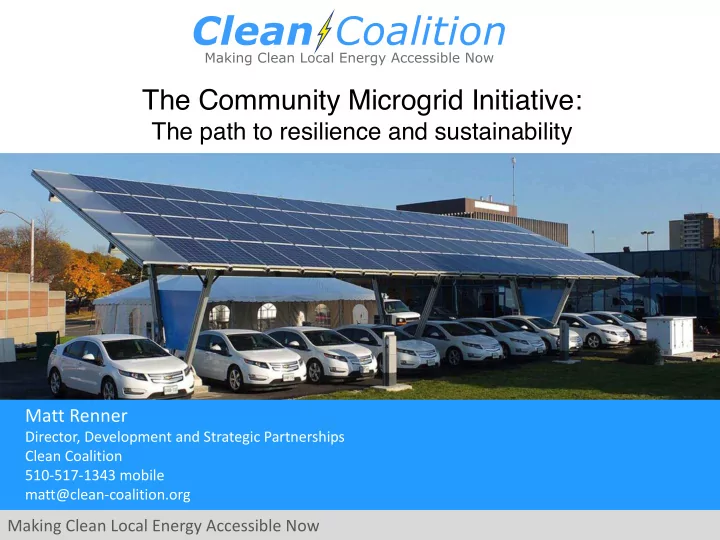
The Community Microgrid Initiative: The path to resilience and - - PowerPoint PPT Presentation
The Community Microgrid Initiative: The path to resilience and sustainability Matt Renner Director, Development and Strategic Partnerships Clean Coalition 510-517-1343 mobile matt@clean-coalition.org Making Clean Local Energy Accessible Now
Making Clean Local Energy Accessible Now
2
Clean Coalition (nonprofit) mission
To accelerate the transition to renewable energy and a modern grid through technical, policy, and project development expertise
Making Clean Local Energy Accessible Now
3
Expertise areas
Analysis & Planning Program and Policy Design Community Microgrid Projects Grid Modeling & Optimization
Powerflow modeling; DER optimization
- PG&E
- PSEG
- SCE
Grid planning, procurement, and interconnection
- LADWP, Fort Collins,
PSEG
- City of Palo Alto (FIT
and solar canopy RFP)
- RAM, ReMAT
- Rule 21 & FERC
Design and implementation
- San Francisco, CA
- Long Island, NY
- Montecito, CA
- U.S. Virgin Islands
Full cost and value accounting for DER; siting analysis
- PG&E
- PSEG
- SCE
Making Clean Local Energy Accessible Now
4
Source: Oncor Electric Delivery Company
Traditional microgrids focus on single customers
Making Clean Local Energy Accessible Now
5
Community Microgrids serve up to thousands of customers
Source: Oncor Electric Delivery Company
Making Clean Local Energy Accessible Now
6
Community Microgrid defined
A modern approach for designing and operating the electric grid, stacked with local renewables and staged for resilience.
- “Islanding” from the grid: A coordinated local grid area that can separate
from the main grid and operate independently.
- Components: Solar PV, energy storage, demand response, and monitoring,
communications, & control
- Clean local energy: Community Microgrids facilitate optimal deployment of
distributed energy resources (DER).
- Resilient: Ongoing, renewables-driven backup power for critical and
prioritized loads.
- Replicable: A solution that can be readily extended
and replicated throughout any utility service territory.
Making Clean Local Energy Accessible Now
7
Community Microgrid enabling policies lead to rapid proliferation of distributed energy resources
Policies and programs to support development:
- Feed-in Tariff 2.0
- Provides some certainty for developers and financiers, lowering costs
- Features market-responsive pricing
- Includes dispatchability and preferred location adders
- Can support resilience and environmental justice/equity goals
- Streamlined interconnection of in-front-of-the-meter distributed energy
resources
- Transmission Access Charges
- Charges for transmission should no longer apply to distribution-
connected generation, leading to lower transmission costs for load serving entities that choose clean local energy
- Currently a massive market distortion in California and elsewhere
- Distribution System Operator (DSO)
- Local balancing, local markets
- Provides grid services with aggregated DER portfolio
- Manages “ducklings” at local level instead of one giant “duck curve”
Making Clean Local Energy Accessible Now
8
Opportunity: Untapped commercial and industrial (C&I) parking and rooftops
ü Largest rooftops and parking lots — most generation potential ü Largest daytime loads — matching peak solar production hours ü Largest utility bills, including demand charges — motivated customers ü Best solution for grid — system peak reduction, strong feeders already in place ü Most carbon emissions within cities
Solar on 25% of commercial and industrial rooftops = 25%+ annual energy use
Making Clean Local Energy Accessible Now
9
North Bay Community Resilience Initiative
Objective: make energy abundant, affordable, resilient, and sustainable
1. Rebuild fire-destroyed areas with high levels of sustainability in homes, buildings, and the electric grid, enabling a modern, distributed, and low-carbon system that delivers substantial economic, environmental, and resilience benefits. 2. Establish a blueprint for rebuilding disaster-destroyed areas in a timely and cost-effective manner that also maximizes the economic and resilience value of energy as a critical resource to ratepayers, property owners, and municipalities. 3. Provide a model for operating a modern distribution grid that incorporates optimal distributed energy resources, full interaction with the transmission system, and local energy markets — with resulting benefits across both grid operations and economics. 4. Ensure that building codes are advanced to achieve more resilient, safer, and cleaner building stock and communities. 5. Lower ratepayer costs: DER will be utilized to defer or avoid substantial costs including peak energy procurement and transmission & distribution (T&D) infrastructure investments.
Making Clean Local Energy Accessible Now
10
North Bay Community Resilience Initiative
Team
- Clean Coalition
- Sonoma Clean Power
- PG&E
- Rebuild North Bay
- Center for Climate Protection
- County of Sonoma, Energy & Sustainability Division
- Regional Climate Protection Authority
- Bay Area Air Quality Management District
- Design AVEnues, LLC — EE/ZNE expert Ann
Edminster
- Stone Edge Farm Microgrid
Stone Edge Farm Microgrid
Making Clean Local Energy Accessible Now
11
- Larkfield and the Old Redwood Highway Corridor – ideal for Community Microgrid
- Served by single substation, Fulton.
Fire-damaged area
North Bay Community Resilience Initiative: **Example location only**
Making Clean Local Energy Accessible Now
12
North Bay Community Resilience Initiative
Example key sites: critical, priority, large roofs & parking, etc.
Larkfield and the Old Redwood Highway Corridor
- Sutter Santa Rosa Regional Hospital
- Luther Burbank Center for the Arts
- Cardinal Newman High School
- Mark West School and area
- Larkfield Shopping Center
- Molsberry Markets
- John B Riebli School
- St. Rose School
Making Clean Local Energy Accessible Now
13
Example: Larkfield and Old Redwood Highway Area Community Resilience block diagram
Transmission Fulton Substation Diagram Elements
Autonomously Controllable Microgrid Relay/Switch (open, closed)
North of Mark West Springs Rd
Larkfield Shopping Center Cardinal Newman High School Sutter Santa Rosa Hospital Medical Offices Luther Burbank Ctr for Arts Tier 2 & 3 Loads Tier 2 & 3 Loads Tier 2 & 3 Loads
South of Mark West Springs Rd
Tier 2 & 3 Loads FULTON 1107
Making Clean Local Energy Accessible Now
14
North Bay Community Resilience Initiative: Homes and buildings as grid partners
- Well-designed and well-situated ZNE
homes become a valuable part of the resource mix when combined with larger PV arrays on commercial and industrial structures.
Making Clean Local Energy Accessible Now
15
Advanced Energy Rebuild for Homes
Support for Rebuild
- Sonoma Clean Power (SCP), Pacific Gas and
Electric Company (PG&E), and Bay Area Air Quality Management District have joined efforts to help homeowners affected by the firestorms to rebuild energy-efficient, sustainable homes.
- The program is an enhancement to PG&E’s
long-standing California Advanced Homes Program, and offers two incentive packages tailored to Sonoma and Mendocino Counties.
- Each package has a flexible performance
pathway or a simple prescriptive menu.
Making Clean Local Energy Accessible Now
16
Advanced Energy Rebuild for Homes
Making Clean Local Energy Accessible Now
17
Resilience
$50M: Avoided transmission costs $20M: Avoided power interruptions
Economic
$120M: New regional impact $60M: Added local wages 1,000 job-years: New near- term and ongoing employment $6M: Site leasing income
Environmental
46M pounds: Annual reductions in GHG emissions 10M gallons: Annual water savings 225: Acres of land preserved Example: Large rooftop
- System size = 714 kW
Example: Large parking lot
- System size = 567 kW
Example: 50 avg. rooftops
- Avg. system size = 5 kW
Commercial: 18 MW Parking lots: 2 MW Residential: 10 MW
North Bay Community Resilience Initiative: Resilience, economic, and environmental benefits
Example target: 30 MW Solar PV Benefits over 20 years
Making Clean Local Energy Accessible Now
18
Value of Resilience How much does resilience cost and what is its value?
Making Clean Local Energy Accessible Now
19
What does lack of resilience cost?
- $119 billion: Annual cost of power outages to the U.S.
- $20 - $55 billion: Annual cost to Americans of extreme weather and related
power outages
- $243 billion - $1 trillion: Potential cost of a cyber attack that shuts down
New York and D.C. areas
Making Clean Local Energy Accessible Now
20
- Powers critical loads until utility services are restored
- Eliminates need to relocate vulnerable populations (infirm, elderly, and disadvantaged)
- Ensures continued critical services
- Water supply, medical and elder-care facilities, grocery stores, gas stations, shelters,
communications centers
- Avoids the cost of emergency aid logistics
- Provides power for essential recovery operations
- Lighting for buildings, communications, water pumps for firefighting and flood control,
emergency shelters, food refrigeration
- Reduces dependence on diesel generators
- Diesel can be expensive and difficult to
deliver in emergencies
- Ongoing diesel maintenance requires
regular operation with onsite air pollution
- Keeps businesses open
- Serves the community and maintains
revenue streams
Resilience provided by Community Microgrids has tremendous value during a disaster
Making Clean Local Energy Accessible Now
21
But how do we determine the monetary value
- f resilience?
Consequence of disaster Resilience assessment metric Unavailable electrical service
- Cumulative customer-hours of outages
- Cumulative customer energy demand not
served
- Average percentage of customers
experiencing an outage in a specified time period Grid restoration
- Time to recovery
- Cost of recovery
Monetary impact
- Loss of utility revenue
- Cost of grid repair and replacement
- Cost of recovery
- Avoided outage cost
- Lost business revenue
Community impact
- Critical services without power
- Cost of outages: Varies by
location, population density, facility type. Can include lost
- utput and wages, spoiled
inventory, delayed production, damage to the electric grid
- Cost of storage: Varies by size
- f electric load and size of
critical load
- Cost of islanding: 3% - 21% of
non-islandable solar+storage cost (figures from NREL)
Factors to consider
Making Clean Local Energy Accessible Now
22
Value of Resilience: $2,808/kW of critical load per year
Annually, resilience is worth $2,808 per kilowatt of critical load in the US
- Based on real-world scenarios run through the Clean Coalition VOR model
- Tier 1 = Critical load, usually 10% of total load — life-sustaining or crucial to keep
facility operational during a grid outage
- Tier 2 = Priority load (15%) — important but not necessary to keep operational during an
- utage
- Tier 3 = Discretionary load (75%) — the remainder of the total load
- Based on keeping critical load
- nline for one day on the worst-
case solar day
- If outage spans days with greater
solar resource, may be able to keep Tier 2 or even Tier 3 loads
- nline
Making Clean Local Energy Accessible Now
23
Valuing resilience: The Clean Coalition Value of Resilience (VOR) Model
The size of your load: How much electricity do you use per year? The size of your critical load: What percentage of your electrical load is essential to keep running during an extended outage? For many facilities, this is 10%. The length of outage you want to prepare for: Do you want to prepare for short outages of a few minutes, or prepare for outages lasting several days or more? The cost of an outage: How much revenue or productivity do you lose per hour during an
- utage? If you don’t have this figure, you can use the national average of $117 per kilowatt-
hour, based on data from the Department of Energy’s National Renewable Energy Lab (NREL). Your energy storage system: The minimum and maximum state of charge you’d like to allow for your battery; the initial state of charge at the time of an outage; and your battery cost (including cost/benefit analysis for demand charge reduction), capacity, and round-trip efficiency. The amount of sunshine in your area: Average amount of sunshine in your area, as well as the amount of sunshine on the worst 5 solar days of the year.
Making Clean Local Energy Accessible Now
24
Clean Coalition Value of Resilience Model outputs
The tool calculates:
- The minimum battery capacity you need for resilience
- The total cost for a system at your site to monetize demand charge reduction
- Your total system cost, based on the required battery capacity
- Resilience cost: The total system cost for the resilience portion of your system
- Resilience value: The annual value of resilience provided by your system
Making Clean Local Energy Accessible Now
25
Value of resilience for a Community Microgrid: One building at a corporate campus
Item Inputs Units Inputs Calculation
Inverters 250 [kW] $1,062 [$/kW] $265,500 Battery for resilience 308 [kWh] $ 256 [$/kWh] $78,887 System islanding 2 controllers $30,000 $60,000 Total system cost $404,387 System cost offset by demand charge reduction
- $803,100
Total cost for resilience
- $398,713
Cost of resilience
Item Calculation Units Notes
Cost of outage $117 [$/kWh] $117 is nationwide average for surveyed customers Size of critical load 12 [kW] Value of lost load per hour $1,404 Cost of outage per kilowatt-hour x size of critical load Days of outage to prepare for 1 Annual value of resilience $33,696
Value of resilience
- Cost of resilience = -$33,226 per kW of critical load
- Annual value of resilience = $2,808 per kW of critical load
- Break-even point = immediate
Making Clean Local Energy Accessible Now
26
Value of resilience for a Community Microgrid: Medium-sized installation at large corporate campus
Item Inputs Units Inputs Calculation
Inverters 1,000 [kW] $1,062 [$/kW] $1,062,000 Battery for resilience 12,203 [kWh] $ 256 [$/kWh] $3,124,038 System islanding 9 controllers $30,000 $270,000 Total system cost $4,456,038 System cost offset by demand charge reduction
- $2,674,800
Total cost for resilience $1,781,238
Cost of resilience
Item Calculation Units Notes
Cost of outage $117 [$/kWh] $117 is nationwide average for surveyed customers Size of critical load 253 [kW] Value of lost load per hour $29,601 Cost of outage per kilowatt-hour x size of critical load Days of outage to prepare for 1 Annual value of resilience $710,424
Value of resilience
- Cost of resilience = $7,040 per kW of critical load
- Annual value of resilience = $2,808 per kW of critical load
- Break-even point = 2.5 years
Making Clean Local Energy Accessible Now
27
Value of resilience for a Community Microgrid: Campus-wide installation at large corporate campus
Item Inputs Units Inputs Calculation
Inverters 1,750 [kW] $1,062 [$/kW] $1,858,500 Battery for resilience 17,760 [kWh] $ 256 [$/kWh] $4,546,459 System islanding 18 controllers $30,000 $540,000 Total system cost $6,944,959 System cost offset by demand charge reduction
- $4,008,900
Total cost for resilience $2,936,059
Cost of resilience
Item Calculation Units Notes
Cost of outage $117 [$/kWh] $117 is nationwide average for surveyed customers Size of critical load 375 [kW] Value of lost load per hour $43,875 Cost of outage per kilowatt-hour x size of critical load Days of outage to prepare for 1 Annual value of resilience $1,053,000
Value of resilience
- Cost of resilience = $7,829 per kW of critical load
- Annual value of resilience = $2,808 per kW of critical load
- Break-even point = 2.8 years
Making Clean Local Energy Accessible Now
28
Backup slides
Making Clean Local Energy Accessible Now
29
California’s distributed solar and efficiency saves $2.6 billion on power lines
- In March 2018, California’s grid operator signed
- ff on the state’s 2017-2018 Transmission
Plan, which approved 17 new transmission projects combined at a cost of nearly $271 million.
- 20 transmission projects were canceled and
21 were revised due to energy efficiency and residential solar power altering local area load forecasts.
- The projected savings from these changes is
estimated to be $2.6 billion.
The future of energy is distributed…
Making Clean Local Energy Accessible Now
30
Sacramento Utility Pushes All-Electric Homes: “California Is Wasting Money to Build Homes With Gas”
- On June 1, the Sacramento Municipal Utility District
(SMUD) launched an incentive program to provide rebates promoting electrification in both retrofitted and new homes.
- SMUD’s electrification rebate packages are worth up
to $5,000 for new homes and up to $13,750 for gas- to-electric conversions in existing homes.
- 10% of California’s GHG emissions come
from burning fossil fuels for space and water heating in buildings. SMUD’s electrification initiative helps achieve its 2050 GHG reduction target.
The future of energy is distributed…
Making Clean Local Energy Accessible Now
31
Canada plan promises to transform cities and communities
- “Build Smart ─ Canada’s Buildings Strategy” plan commits
Ottawa to develop — and the provinces and territories to adopt — a series of model building codes requiring increasingly higher levels of energy efficiency.
- Under the plan, by 2030, every new building being built in
the country will be required to meet a net-zero-energy- ready level of performance.
- In other words, in just over a dozen years or so, new
buildings will be so well-designed and carefully built that they should be able to meet all of their energy needs with renewable energy either generated on-site or nearby.
The future of energy is distributed…
Making Clean Local Energy Accessible Now
32
Vermont utility Green Mountain Power now pays customers over $30 per month to use their battery systems as a load-offsetting resource.
- Helps address the steep transmission access charge
assessed by ISO New England. That charge more than doubled from $3 per kilowatt per month in 2016 to over $7 in 2017, and is expected to increase to over $9 in 2018.
- As more solar is installed on the distribution grid,
access to locally generated and stored solar energy at times when electricity from transmission is the most expensive is a grid benefit that can save money for utilities and customers.
The future of energy is distributed…
Making Clean Local Energy Accessible Now
33
Illinois is now "transforming the regulatory compact" to embrace performance-based policy goals
- Illinois team at RMI eLab Accelerator, featuring utility ComEd,
are devising four broad policy goals for future legislation and compensation: – Power sector decarbonization – 100% renewables – Community development and equity – Beneficial electrification of other sectors, e.g EVs
- Illinois now supports shared utility + customer microgrids.
Joe Svachula, VP Engineering & Smart Grid Technology at ComEd: “It’s an important step forward in our effort to develop a more secure, resilient, and reliable distribution system in the future.”
The future of energy is distributed…
Making Clean Local Energy Accessible Now
34
Sources: Newport Consulting Group, ICF Consulting
The advantages of distribute energy resources
Making Clean Local Energy Accessible Now
35
Restoration times for gas vs. electric service after a major urban earthquake
2.5 5 10 30 65 100 5 25 60 95 97 98.5 100 100 100 100 1 DAY 2 DAYS 3 DAYS 1 WEEK 2 WEEKS 3 WEEKS 1 MONTH 2 MONTHS 3 MONTHS 6 MONTHS
Potential Service Restoration Timeframes (M7.9 Earthquake)
Gas Electricity
60% restoration in 3 days.
Restoration for gas takes 10 times longer than electricity
(Data source: San Francisco Lifeline Council Interdependency Study, 2014)
Making Clean Local Energy Accessible Now
36
$1B+ weather events in U.S. Jan – Sept 2017
Source: National Oceanic and Atmospheric Administration